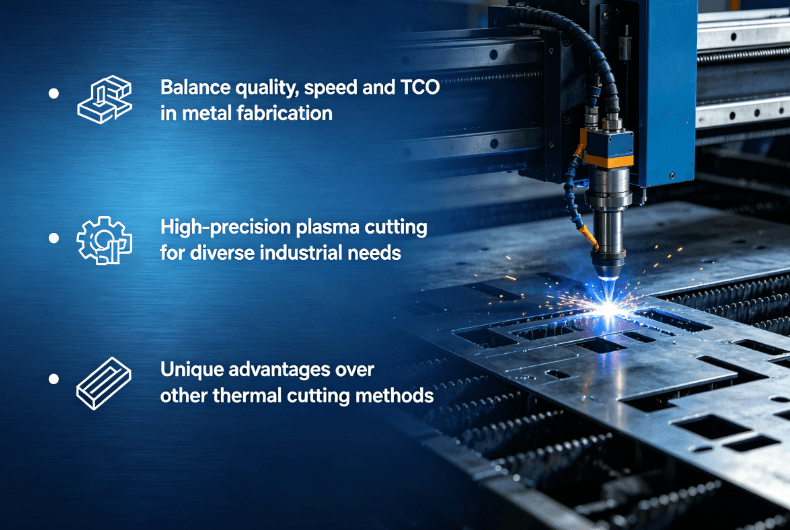
In the fast-paced world of industrial procurement, the decision-making process for metal fabrication often hinges on balancing quality, speed, and total cost of ownership (TCO). As we look toward the manufacturing landscape of 2026, plasma cutting remains a vital technology for global supply chains. For sourcing professionals and brand owners, understanding the specific advantages of plasma cutting is no longer just a technical requirement—it is a strategic necessity for optimizing production workflows and maintaining competitive margins.
Plasma cutting has evolved from a "rough cut" tool into a high-precision solution capable of handling diverse industrial needs. Whether you are sourcing components for heavy machinery, structural steel for infrastructure, or specialized parts for the energy sector, plasma technology offers a unique set of benefits that other thermal cutting methods, such as laser or oxy-fuel, often cannot match in specific thickness ranges.
What Are the Core Advantages of Plasma Cutting for Buyers?
When evaluating a new supplier or auditing an existing fabrication partner, procurement teams must look at how plasma cutting affects the bottom line. The technology utilizes a high-velocity jet of ionized gas (plasma) to conduct electricity from the torch to the workpiece, melting the metal and blowing away the molten material. This process yields several distinct advantages for the modern buyer.
Versatility Across All Conductive Metals
A significant advantage for procurement is the ability to use a single sourcing partner for multiple material types. Unlike oxy-fuel cutting, which is restricted to ferrous metals like carbon steel, plasma cutting can handle any electrically conductive material.
- Carbon Steel: Efficiently processed across a wide range of thicknesses.
- Stainless Steel: High-speed cutting without the risk of warping common in thinner gauges.
- Aluminum: Reliable results for automotive and marine-grade components.
- Copper and Brass: Specialized applications that require high heat but precise control.
This material flexibility allows brand owners to consolidate their supplier list. Instead of managing three different vendors for steel, aluminum, and copper parts, a single shop with advanced CNC plasma tables can often fulfill the entire RFQ (Request for Quote).
Superior Production Speed and Throughput
Time-to-market is a critical KPI for ecommerce sellers and bulk buyers alike. Plasma cutting is significantly faster than oxy-fuel on thicknesses up to 2 inches (50mm). On medium-thickness plates (12mm to 25mm), high-definition plasma systems can reach speeds that make them more cost-effective than laser cutting, which requires significantly more power to penetrate thicker materials.
For a procurement manager, faster cutting speeds translate directly into:
- Reduced machine-hour costs.
- Shorter lead times for bulk orders.
- Higher supplier capacity, allowing for sudden spikes in demand without production bottlenecks.
Cost-Effectiveness and Lower TCO
From a commercial transparency perspective, plasma cutting is often the most budget-friendly option for industrial-scale parts. The capital expenditure for a plasma table is generally lower than that of a high-wattage fiber laser, and the consumables (nozzles and electrodes) are inexpensive and easy to replace.
When these savings are passed down the supply chain, the buyer sees a lower "price per part." This makes plasma cutting the ideal choice for projects where extreme aerospace-level tolerances are not required, but industrial durability and cost-efficiency are paramount.
Strategic Comparison: Why Choose Plasma Over Other Methods?
Deciding between plasma, laser, and waterjet cutting is a common challenge in the sourcing workflow. Each has its niche, but plasma often occupies the "sweet spot" for industrial procurement.
| Feature | Plasma Cutting | Fiber Laser | Oxy-Fuel |
|---|---|---|---|
| Material Range | All conductive metals | Mostly thin-medium sheets | Ferrous metals only |
| Cutting Speed | High (especially on thick) | Very high (on thin) | Low |
| Edge Precision | Good (HD Plasma) | Excellent | Fair |
| Operating Cost | Moderate | High (initial setup) | Low |
| Best For | 6mm - 50mm plates | < 12mm high precision | > 50mm heavy plates |
As shown in the table above, the procurement logic favors plasma for that middle-ground thickness where most industrial components reside.
How High-Definition Plasma Enhances Edge Quality?
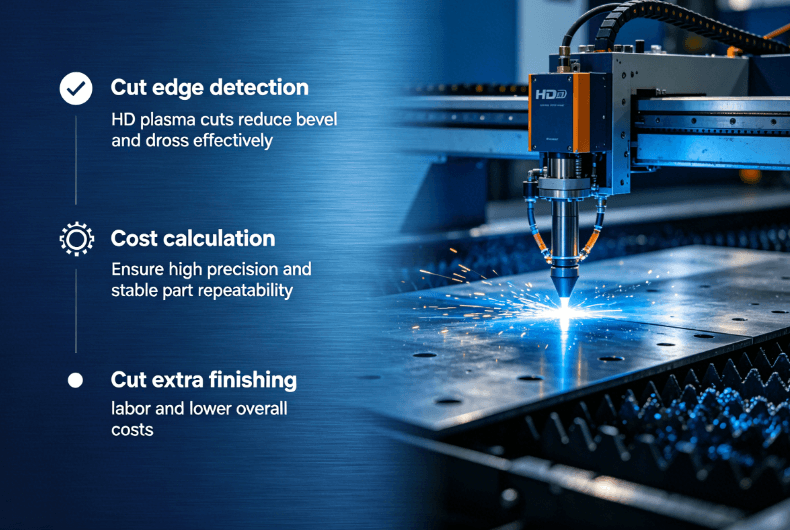
A frequent concern for sourcing agents is the quality of the cut edge. Older plasma technology often left a "bevel" (an angled edge) or dross (re-solidified metal) that required secondary grinding. However, 2026-standard High-Definition (HD) plasma systems have largely solved these issues.
Precision and Tolerance Management
Modern CNC plasma tables utilize sophisticated software and torch height control to maintain a tight, focused arc. This results in:
- Minimal beveling, usually within 1-3 degrees.
- High repeatability across thousands of parts.
- Clean entry and exit points (lead-ins and lead-outs), which are vital for mechanical assembly.
Minimizing Secondary Processing Costs
For a bulk buyer, the "hidden" cost of fabrication is often in the finishing. If a part comes off the table with heavy dross, a worker must manually grind it. HD plasma systems produce "dross-free" cuts on many materials. By eliminating the need for secondary cleaning, the supplier reduces labor hours, which should be reflected in a more competitive unit price during the RFQ process.
Strategic Sourcing: Large-Format Flexibility
For industries such as shipbuilding, agriculture, and construction, the ability to cut large components is a non-negotiable requirement. Plasma tables are uniquely suited for large-format sourcing because the tables can be scaled to massive sizes—often exceeding 50 feet in length.
From a procurement standpoint, this offers:
- Reduced Welding: Cutting a single large part instead of three small ones reduces the need for costly welding and inspection (NDT).
- Material Optimization: Large tables allow for "nesting" hundreds of parts onto a single plate, reducing scrap metal waste. In a market where raw material prices fluctuate, high nesting efficiency is a major cost-saver.
Supplier Selection Criteria for Plasma Fabrication
To ensure you are getting the full advantages of plasma cutting, your supplier evaluation process should include a technical audit of their equipment and workflow.
Assessing CNC Technology and Software
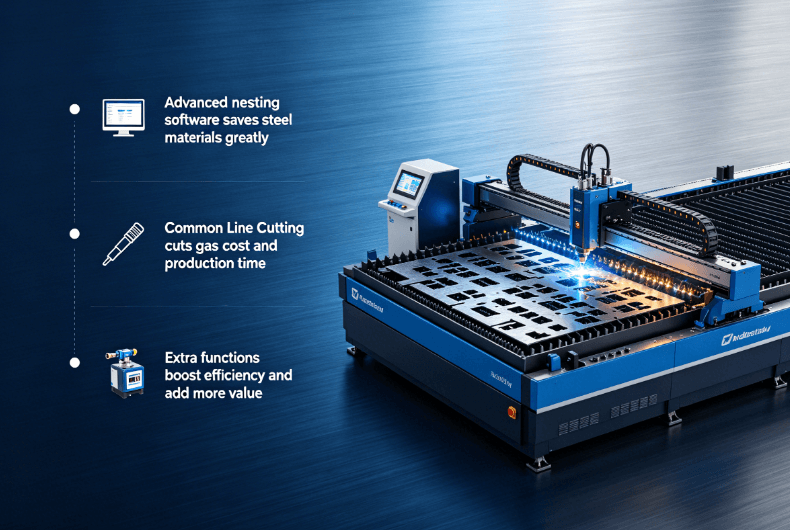
Is the supplier using the latest nesting software? Advanced algorithms can squeeze 5-10% more parts out of a single sheet of steel than manual nesting. For a bulk buyer, this 10% material saving can represent thousands of dollars over a production run. Furthermore, ask about their "Common Line Cutting" capabilities, which allow the torch to cut the edge of two parts simultaneously, further reducing gas consumption and time.
Integrated Services and Value-Add
The best fabrication partners offer integrated operations directly on the plasma table. Look for suppliers who provide:
- Plasma Marking: Using the torch to etch part numbers, fold lines, or QR codes onto the metal.
- Bevel Heads: Torches that can tilt to cut 45-degree angles, preparing the metal for immediate welding.
- Multi-Torch Setups: Tables with multiple torches that cut identical parts simultaneously, doubling production output without doubling the time.
Summary
In conclusion, the advantages of plasma cutting in 2026 center on its role as a versatile, high-speed, and cost-effective workhorse for the metal fabrication industry. For procurement professionals, it offers a reliable way to source high-quality components across various conductive metals while keeping lead times short and costs manageable. By focusing on suppliers who utilize high-definition systems and advanced nesting software, buyers can maximize their ROI and build a more resilient, efficient supply chain.
Reference Sources
The Fabricator: Thermal Cutting Technology Trends 2026