In the global manufacturing ecosystem, metal fabrication is a foundational pillar. For procurement officers, brand owners, and sourcing specialists, choosing the right cutting technology is not just a technical decision—it is a strategic one that impacts lead times, production costs, and final product quality. Plasma cutting remains one of the most versatile and cost-effective methods for cutting conductive metals.
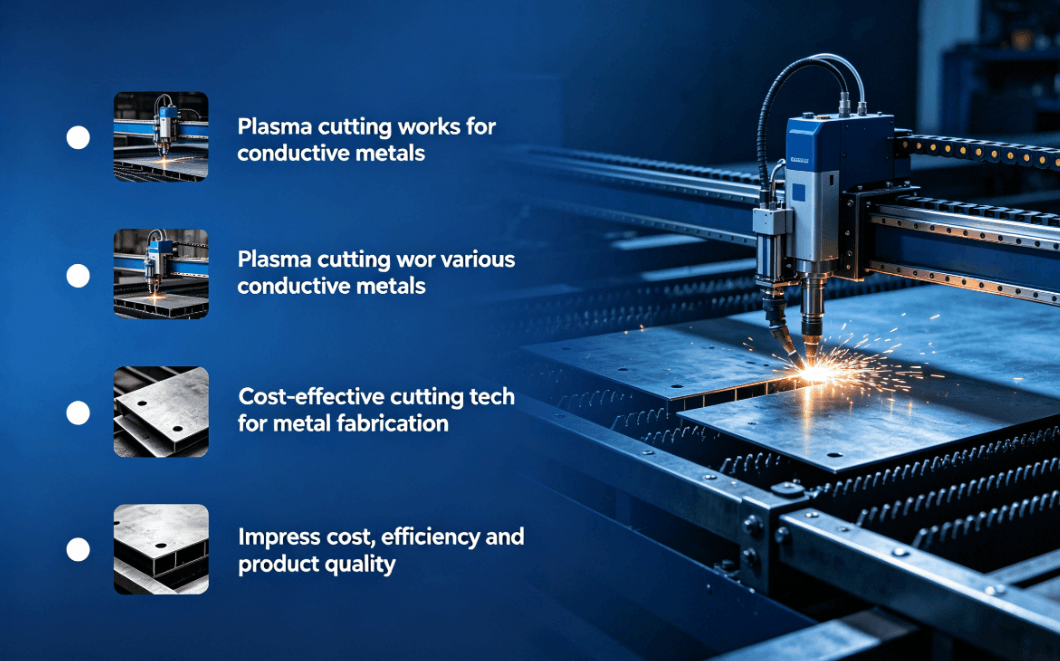
Plasma Cutting Basics: How the Process Works
At its core, plasma cutting is a thermal cutting process that uses a constricted jet of ionized gas—plasma—to melt and eject material from a workpiece.
The Science of Ionized Gas
Plasma is often referred to as the "fourth state of matter." In a cutting torch, an electrical arc is passed through a gas (such as nitrogen, argon, or oxygen) passing through a constricted nozzle. This increases the gas's temperature to the point where it becomes ionized and electrically conductive. This high-velocity plasma stream reaches temperatures up to 30,000°F, instantly melting the metal while the force of the gas blows the molten material away to create a "kerf."
Why Procurement Teams Prioritize Plasma
From a sourcing perspective, plasma cutting sits in the "sweet spot" of the fabrication triangle:
- Speed: Faster than oxy-fuel on medium thicknesses.
- Versatility: Cuts any conductive metal (mild steel, stainless steel, aluminum, copper, brass).
- Cost: Lower capital expenditure (CapEx) compared to high-wattage fiber lasers.
Commercial Classification: Air vs. High-Definition
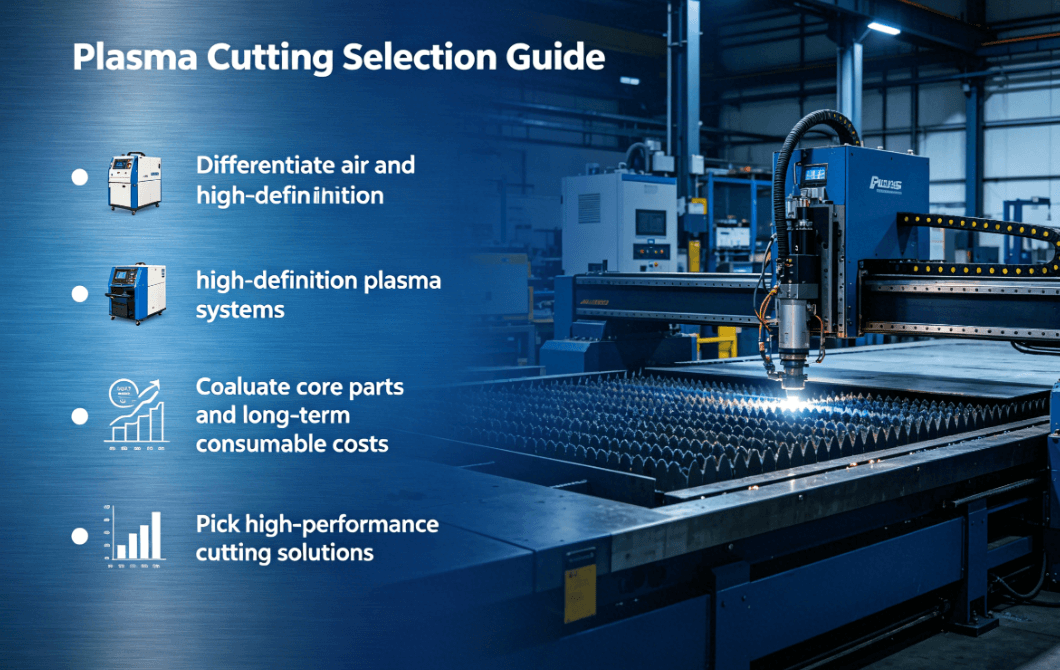
Not all plasma systems are created equal. When evaluating a supplier's production capacity or purchasing a plasma cutting table, you must distinguish between these two primary categories.
Air Plasma for Small-Scale Sourcing
Air plasma systems use shop air as the primary gas. These are typically portable units used for maintenance, repair, and light manufacturing.
- Best for: Small buyers, startup workshops, and onsite construction.
- Sourcing Reality: Low cost-per-unit, but higher dross (slag) levels and less precision.
High-Definition Plasma for Precision OEM
High-definition systems use sophisticated nozzle designs to further constrict the plasma arc, resulting in a narrower kerf and cleaner edges that often rival laser quality.
- Best for: Bulk buyers, OEM manufacturers, and precision engineering firms.
- Sourcing Reality: Higher initial investment, but significantly lower "secondary operation" costs (less grinding or deburring required).
| Feature | Air Plasma | High-Definition Plasma |
|---|---|---|
| Edge Quality | Average (2° - 3° bevel) | Excellent (<1° bevel) |
| Tolerance | Lower Precision | High Precision |
| Operating Cost | Low (Air is free) | Moderate (Requires specialized gases) |
| Ideal For | Sourcing simple brackets | Sourcing complex mechanical parts |
Critical Components of a CNC Plasma Cutting Table
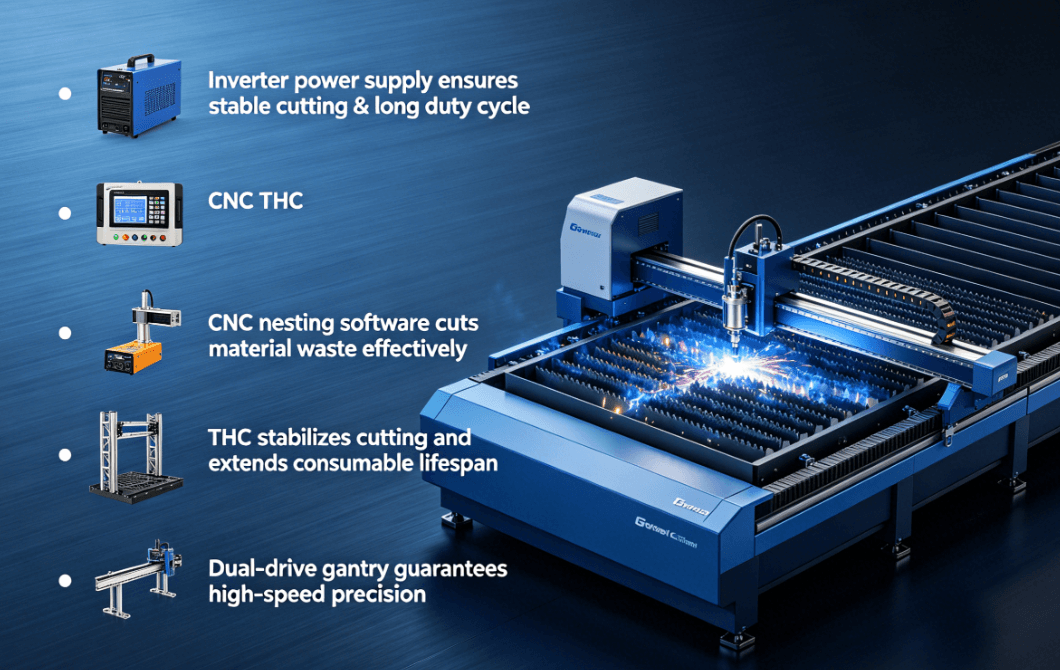
When reviewing a Request for Quotation (RFQ) for a plasma cutting system, procurement professionals must look beyond the brand name and evaluate the component ecosystem. A high-quality plasma cutting table is a synergy of four critical subsystems.
Power Supply and Duty Cycle
The power source determines the "duty cycle" and the maximum piercing thickness. In 2026, inverter-based power supplies are the industry standard due to their energy efficiency and stable arc characteristics. Always ask for the "production pierce capacity" rather than the "maximum severance capacity."
CNC Controller and Nesting Software
The "brain" of the operation. Modern CNC systems integrate CAD/CAM software that optimizes "nesting"—the arrangement of parts on a metal sheet to minimize waste. Efficient nesting software can reduce material costs by 5-15% annually.
Torch Height Control (THC)
The distance between the torch tip and the metal plate is critical. THC automatically adjusts the torch position during the cut to account for warped plates. Without reliable THC, consumable life is shortened, and part consistency drops.
Gantry and Drive System
The mechanical frame that moves the torch. For high-volume importers, a "dual-drive" gantry (motors on both sides) is essential for maintaining accuracy at high speeds.
Plasma vs. Other Cutting Technologies
A common challenge in the sourcing workflow is determining if plasma is truly the right fit for the project compared to other technologies.
- Plasma vs. Laser: Fiber lasers are the king of thin materials (<6mm) and extreme detail. However, once you move into the 12mm to 40mm thickness range, plasma is significantly faster and cheaper to operate.
- Plasma vs. Waterjet: Waterjet offers the highest precision and no Heat Affected Zone (HAZ), but it is extremely slow and expensive due to abrasive costs. If the parts require subsequent welding, the slight HAZ from plasma is usually acceptable.
Sourcing Checklist for Equipment Suppliers
When vetting an OEM/ODM manufacturer for plasma cutting equipment, use this framework to ensure supplier transparency and technical alignment.
- Verify the Gas Management System: Does the machine support multi-gas consoles? Automatic gas consoles allow the machine to switch between gases without manual intervention.
- Consumable Availability: Ensure the torch system is compatible with globally available brands to avoid supply chain bottlenecks.
- Duty Cycle Requirements: For industrial-scale production, a 100% duty cycle at the required amperage is non-negotiable.
- Technical Support: Ensure the contract includes remote diagnostics and on-site operator training.
Operating Costs and Consumable Management
For sourcing consultants, the Total Cost of Ownership (TCO) is more important than the purchase price. Plasma cutting involves "consumables"—the nozzle, electrode, swirl ring, and shield. In a standard 8-hour shift, an operator might change consumables once or twice. Always include a high-quality refrigerated air dryer in your procurement package to protect your investment and lower long-term OpEx.
Summary
Understanding plasma cutting basics is essential for modern procurement. By focusing on the distinction between air and high-definition systems, evaluating the CNC table's core components, and accounting for long-term consumable costs, buyers can secure a high-performance fabrication solution that aligns with 2026 manufacturing standards.
FAQ
1. What is the maximum thickness a CNC plasma table can cut?
For most industrial B2B applications, plasma is used for piercing up to 50mm and edge-starting up to 80mm. For thicknesses beyond this, oxy-fuel systems are usually preferred to maintain edge quality and cost efficiency.
2. Can plasma cutting be used for non-conductive materials?
No. Because the process relies on an electrical circuit between the torch and the workpiece, it can only cut conductive metals. For non-conductive materials like wood or plastic, buyers should look into CNC Routing or Waterjet sourcing.
3. How does the Heat Affected Zone (HAZ) affect post-processing?
Plasma cutting uses intense heat, which creates a thin layer of hardened metal along the cut edge. For brand owners with high-spec structural requirements, this may require a secondary edge-milling step if the part is to be subjected to specific coating standards.
4. Is it better to buy a turnkey system or separate components?
For most ecommerce sellers or small buyers, a turnkey system is safer. Bulk buyers and specialized factories may prefer to source a high-end gantry from one supplier and a premium power source from another to create a custom-optimized cell.
Reference Sources
American Welding Society Official Plasma Arc Resources