In the evolving landscape of global manufacturing, procuring a CNC (Computer Numerical Control) lathe is no longer a simple equipment purchase; it is a long-term capital investment that determines your facility's competitive edge. As we move into 2026, the market has shifted toward high-precision, multi-axis capabilities and integrated automation. For procurement professionals, understanding the "procurement realism" of this machinery—balancing technical performance with total cost of ownership—is essential.
Whether you are a bulk buyer upgrading an automotive assembly line or a sourcing agent finding a reliable OEM for a brand owner, the decision-making process must be data-driven. This market guide provides the technical and commercial framework required to navigate the supplier ecosystem and secure machinery that offers maximum ROI.
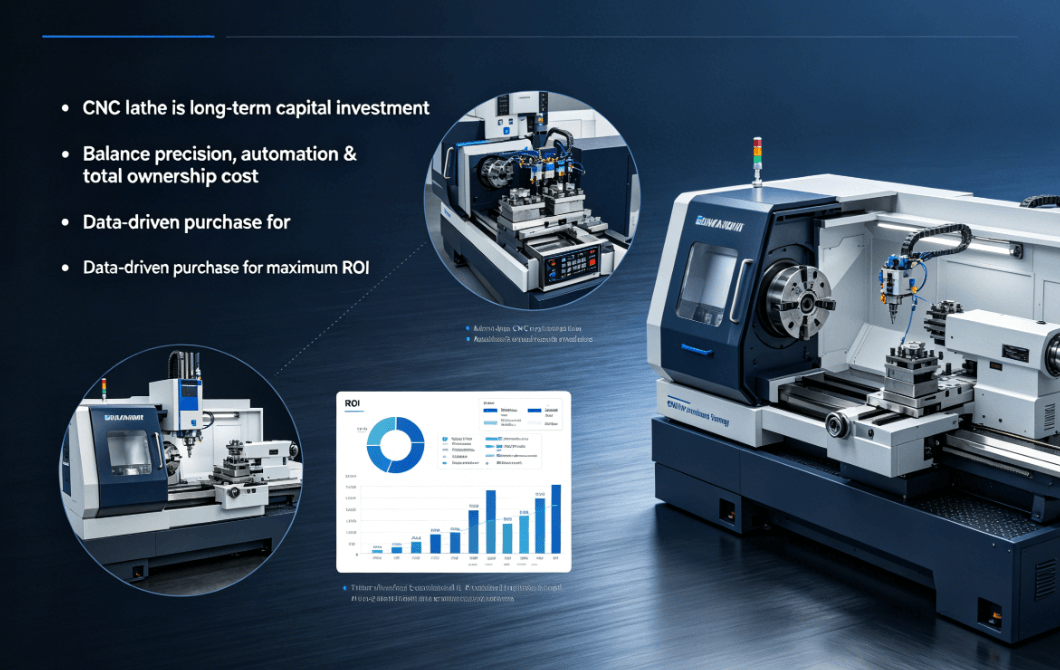
Understanding CNC Lathe Total Cost of Ownership (TCO)
A common mistake in industrial sourcing is focusing solely on the "sticker price." Experienced buyers know that the purchase price is only one component of the lifecycle cost. To achieve true procurement efficiency, one must evaluate:
- Acquisition Costs: Including the machine unit, specialized tooling, and initial shipping/insurance.
- Operational Expenses: Energy efficiency ratings, which in 2026 are critical due to rising industrial power costs.
- Maintenance and Downtime: The availability of local service technicians and the cost of proprietary vs. universal spare parts.
- Training and Software: The cost of upskilling operators to manage specific control systems like Fanuc, Siemens, or Heidenhain.
By calculating TCO over a five-to-ten-year period, procurement teams can justify the higher upfront cost of a premium machine that offers lower maintenance and higher resale value.
Technical Evaluation: Matching Specs to Production Needs
Before initiating a Request for Quote (RFQ), your technical requirements must be crystal clear. CNC lathes are highly specialized; selecting a machine with more features than necessary wastes capital, while under-speccing creates production bottlenecks.
Capacity and Workpiece Dimensions
The physical limitations of the lathe are the first filter in your search. You must consider the largest and smallest parts you intend to manufacture.
- Swing Over Bed: This defines the maximum diameter of the part that can be rotated.
- Maximum Turning Length: This dictates how long a shaft or workpiece can be held between the headstock and tailstock.
- Distance Between Centers: Crucial for long-shaft machining to ensure stability and precision.
Spindle Speed, Torque, and Bore Size
The spindle is the heart of the lathe. Its performance determines what materials you can cut efficiently.
- High RPM Spindles: Necessary for small-diameter parts and non-ferrous metals like aluminum or brass to achieve high-quality surface finishes.
- High-Torque Spindles: Essential for heavy-duty cutting of hardened steel, titanium, or large-diameter workpieces.
- Spindle Bore Diameter: For buyers utilizing bar feeders for automated, high-volume production, the spindle bore must be large enough to accommodate the raw material stock.
Tooling Capacity and Live Tooling Options
Modern CNC lathes often perform more than just turning.
- Turret Stations: Standard lathes usually offer 8, 12, or 16 stations. More stations mean fewer manual tool changes and faster setup times for complex parts.
- Live Tooling (Mill-Turn): This allows the lathe to perform secondary operations like drilling, tapping, and radial milling. For many procurement managers, investing in a "One-Hit" machining center reduces the need for additional milling machines, saving floor space and labor costs.
CNC Lathe Type Comparison Table
| Machine Type | Primary Application | Target Buyer Type | Sourcing Complexity |
|---|---|---|---|
| Horizontal CNC Lathe | General shaft and disk turning | All / Job Shops | Moderate |
| Vertical Lathe (VTL) | Heavy, large‑diameter parts | Bulk Buyers / Energy Sector | High |
| Swiss‑Type Lathe | Tiny, high‑precision long parts | Medical / Electronics Brands | High |
| Flat Bed CNC Lathe | Heavy‑duty, simple geometry | Small Buyers / Education | Low |
| Slant Bed CNC Lathe | High production, better chip flow | Bulk Buyers / Tier 1 Suppliers | Moderate |
Global Supplier Ecosystem and Regional Hubs
Geographic location often dictates the "build philosophy" of the machine. Understanding these clusters helps in narrowing down the supplier list.
- Japan and Germany: The gold standard for precision and longevity. These machines are built for 24/7 high-intensity production environments. Preferred by brand owners with strict quality requirements.
- Taiwan: Known for "Value-Precision." Taiwanese manufacturers offer robust iron casting and reliable electronics at a mid-range price point. This is the "sweet spot" for many sourcing businesses.
- Mainland China: The world's largest producer of CNC machinery. Clusters in Dalian, Jinan, and Ningbo offer unmatched lead times and competitive pricing. In 2026, top-tier Chinese brands are increasingly competitive in high-end multi-axis segments.
The Strategic Procurement Workflow
To ensure a successful onboarding process, procurement teams should follow a structured workflow that prioritizes verification and performance validation.
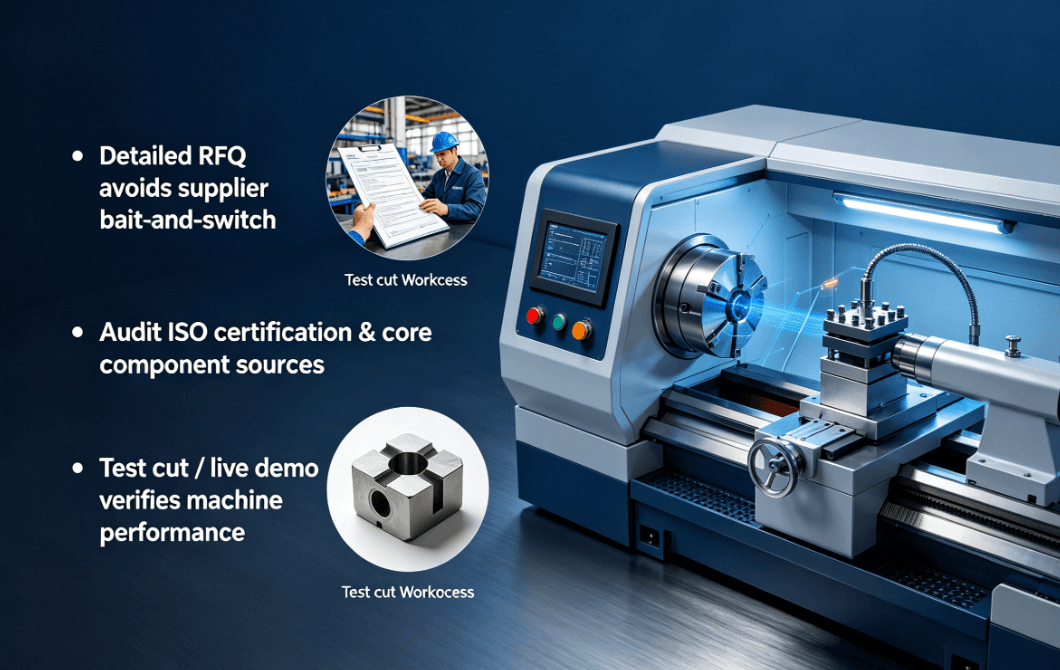
Step 1: Technical RFQ Alignment?
The RFQ should be exhaustive. Instead of a generic "CNC Lathe," specify the material hardness (HRC), required tolerance levels (e.g., +/- 0.005mm), and the specific controller brand your operators are trained on. This prevents "bait-and-switch" tactics where suppliers quote a low price for a machine with a generic, unsupported controller.
Step 2: Factory Audit and Verification?
For a machine costing upwards of $50,000, a factory audit is non-negotiable.
- Manufacturing Standards: Verify ISO 9001 certifications.
- QC Equipment: Does the factory use Renishaw ballbar testing and laser calibration for every machine?
- Sub-Component Transparency: Ask for the origin of critical components like bearings (e.g., NSK, SKF) and ball screws (e.g., HIWIN, THK).
Step 3: Performance Testing and Validation?
Request a "test cut" video or, ideally, send a sample of your material to the factory. Review the cycle time and inspect the finished part's dimensions. In the 2026 sourcing environment, many top-tier suppliers offer virtual "Live Demos" via high-definition streaming to satisfy international buyers.
Buyer-Specific Sourcing Strategies
Your procurement approach should change based on your business model:
- Small Buyers: Focus on "All-in-One" packages that include startup tooling and basic training. Look for suppliers with strong English-speaking technical support.
- Ecommerce Sellers: If you are selling specialized components, look for "Swiss-type" lathe manufacturers that specialize in high-volume micro-parts with low unit costs.
- Brand Owners / OEM: Negotiate for custom branding on the machine's exterior and software splash screen. Prioritize long-term exclusivity or priority service agreements.
- Bulk Buyers: Focus on "Factory Automation" compatibility. Ensure the lathes can be easily integrated with robotic arm loaders and centralized monitoring software.
Summary
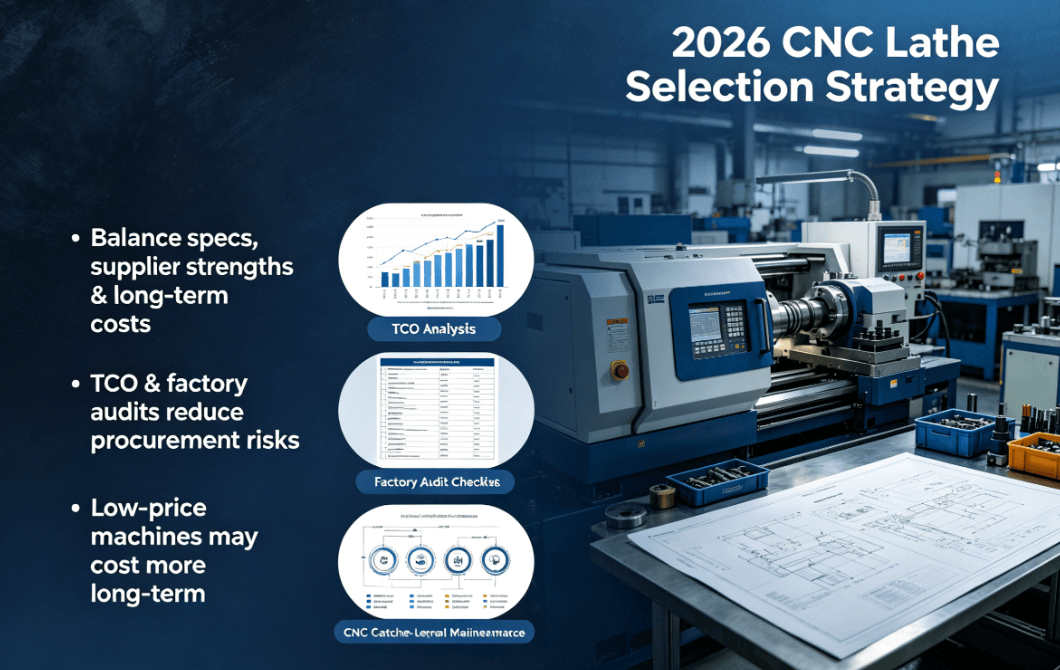
Choosing the right CNC lathe in 2026 requires a balance between technical specifications, supplier regional strengths, and long-term operational costs. By prioritizing the Total Cost of Ownership and conducting rigorous factory audits, procurement professionals can mitigate risks and ensure their production lines remain efficient and competitive. Remember that the cheapest machine often becomes the most expensive over time due to maintenance and precision loss.
Reference Sources
ISO Standards for Machine Tool Accuracy and Positioning