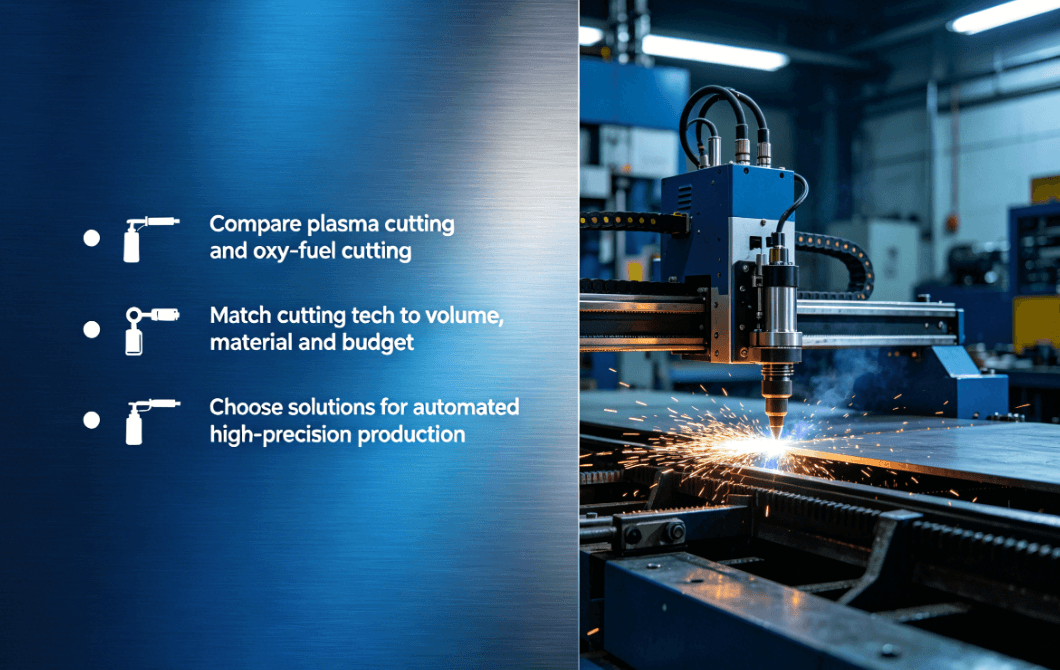
In the global metal fabrication ecosystem, efficiency is the baseline for survival. For procurement professionals and brand owners sourcing components or investing in a plasma cutting table, the fundamental debate often centers on plasma vs flame cutting (oxy-fuel cutting). As we move into 2026, the shift toward automation and higher precision requirements has altered the cost-benefit analysis of these two legacy technologies. This guide provides a deep dive into which method aligns with your specific sourcing volume, material requirements, and budgetary constraints.
Why Plasma Cutting is Dominating the 2026 Mid-Market
For many importers and ecommerce sellers, plasma cutting has become the default choice. Its versatility across different alloys makes it a "one-size-fits-all" solution for medium-duty fabrication. The ability to switch between stainless steel and carbon steel without changing the entire machine setup is a significant advantage for agile supply chains.
| Feature | Plasma Cutting | Flame (Oxy-Fuel) Cutting |
|---|---|---|
| Material Compatibility | Any conductive metal (SS, Aluminum, Copper, Mild Steel) | Primarily Carbon Steel and Low-alloy Steels |
| Ideal Thickness Range | 0.5mm to 50mm (High-definition up to 80mm) | 25mm to 300mm+ |
| Cutting Speed | Extremely fast on thin-to-medium materials | Slower, requires preheating the metal |
| Edge Quality | High precision, smaller kerf, minimal heat-affected zone (HAZ) | Significant HAZ, rougher finish on thin materials |
| Operating Cost | Higher consumable cost (electrodes/nozzles), high electricity | Lower upfront cost, high gas consumption (Oxygen/Acetylene) |
| Sourcing Suitability | High-volume precision parts, OEM branding | Heavy industrial plates, structural steel, scrap processing |
1. Is Material Versatility Critical for Multi-Category Sourcing?
Unlike flame cutting, which relies on a chemical reaction (oxidation) that only works with carbon steel, plasma uses an ionized gas to melt the metal. This allows buyers to source stainless steel brackets, aluminum automotive parts, and copper components from a single supplier using a high-end plasma cutting table. This consolidation of suppliers reduces logistics complexity and management overhead.
2. Can Plasma Reduce Secondary Processing Costs?
In a procurement workflow, Lead Time is often killed by secondary processes like grinding or deburring. Plasma cutting produces a much smaller Heat Affected Zone (HAZ). For a brand owner, this means parts coming off the machine are often ready for immediate welding or powder coating, reducing the labor hours billed by the factory and speeding up the time-to-market for new product lines.
3. Does it Meet the 2026 Precision Standard?
With the integration of AI-driven CNC controllers in 2026, modern plasma tables offer "High-Definition" (Hi-Def) cuts that rival laser quality at a fraction of the cost for materials thicker than 12mm. This makes it the ideal technology for OEM components that require strict tolerance adherence without the premium price tag of 10kW+ fiber lasers.
When Flame Cutting Remains the Correct Sourcing Choice
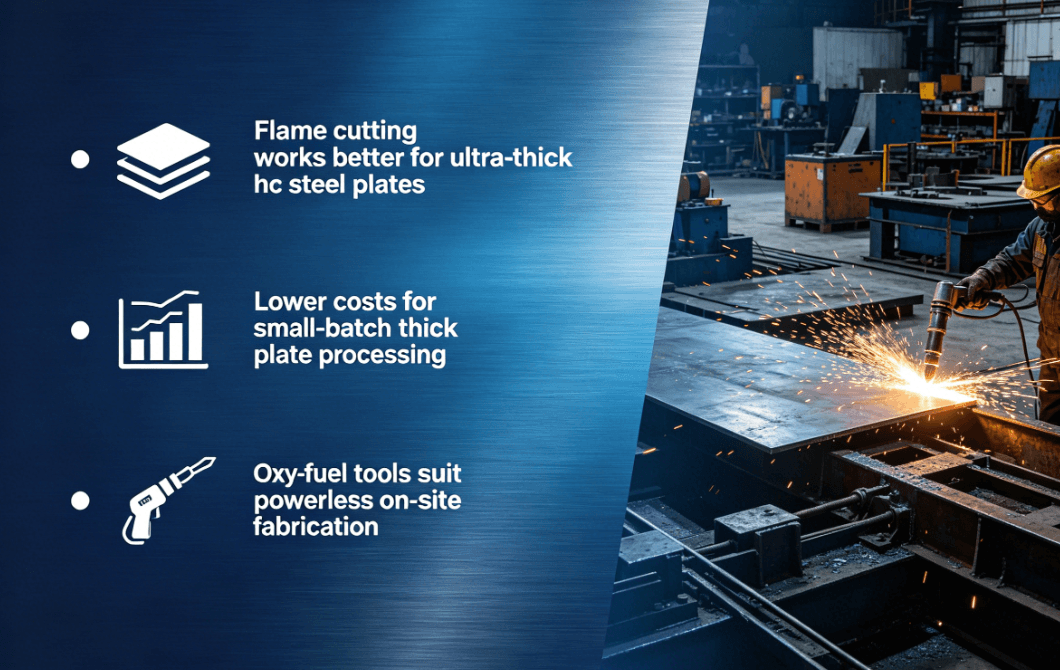
Despite the speed of plasma, flame cutting (oxy-fuel) remains the undisputed king of heavy industry. If your procurement portfolio involves infrastructure, bridge building, or heavy machinery, flame cutting is likely your primary method because it handles thickness that plasma simply cannot reach effectively.
1. Is there Superiority in Extreme Thickness?
Plasma's efficiency drops significantly once the material exceeds 50mm (2 inches). Flame cutting, however, can slice through 200mm or even 300mm steel plates with relative ease. If you are sourcing heavy-duty industrial gears or structural baseplates, flame cutting offers a cleaner, more vertical edge on thick sections than plasma.
2. Does it Offer Lower Capital Expenditure (CapEx) for Suppliers?
From a supplier ecosystem perspective, flame cutting setups are significantly cheaper to maintain than CNC plasma tables. This often translates to lower setup fees for small-batch, heavy-plate orders. For a bulk buyer focusing on simple carbon steel shapes, the lower overhead of a flame-cutting supplier can result in a lower per-unit price in highly competitive markets.
3. Is Portability Necessary for On-Site Fabrication?
If your sourcing needs involve on-site installation or repair (common in the oil and gas sector), oxy-fuel torches require no electricity—only pressurized gas cylinders. This makes it a critical tool for field-based procurement projects where power infrastructure is absent or unreliable, allowing for flexible project management in remote locations.
Evaluating the Sourcing Scenario: Which Fits Your Business?
Choosing between plasma vs flame cutting depends heavily on your buyer profile and the "Search Funnel" stage of your project. Each procurement scenario requires a different balance of speed, cost, and finishing quality.
1. Is it Best for Small Buyers & Ecommerce Sellers?
If you are sourcing customized decorative metal panels, shelving, or small mechanical parts, Plasma Cutting is the winner. The ability to handle diverse metals and provide a clean finish means you can go from prototype to "Amazon-ready" faster.
- Ask your supplier for a "nesting report" from their CNC plasma software to ensure you aren't paying for excessive material waste.
- Verify if the supplier offers automated deburring as part of the plasma service.
2. Is it Best for Brand Owners & OEMs?
For those developing proprietary hardware, High-Definition Plasma is the target. It offers the tightest tolerances, ensuring that parts sourced from different suppliers in a global chain will fit together during final assembly.
- Verify the age of the supplier's consumables. Worn plasma nozzles lead to "edge rounding."
- Request a sample cut of the most complex geometry in your design to test machine calibration.
3. Is it Best for Bulk Buyers & Importers?
If you are importing thousands of tons of structural steel components for the construction or shipping industry, Flame Cutting combined with multi-torch systems is the most cost-effective path.
- Focus on "Slag Management." Flame cutting produces significant dross (slag).
- Negotiate the "finish state" in your contract to ensure the supplier removes this slag before shipping, or you will pay for the weight of the waste in freight costs.
Total Cost of Ownership (TCO) Comparison
When comparing quotes from two different factories—one using plasma and one using flame—don't look only at the "Unit Price." Consider these procurement variables:
- Gas Costs: Flame cutting consumes high volumes of oxygen and fuel gas. In regions where gas prices are volatile, your supplier may include "fuel surcharges" that aren't visible in the initial quote.
- Consumable Lifecycle: Plasma nozzles and electrodes need frequent replacement. A factory with poor maintenance schedules will have high downtime, leading to potential lead-time delays.
- Electricity Consumption: Plasma tables are power-hungry. In countries with high industrial electricity rates, this cost is passed directly to the buyer as a manufacturing overhead.
- Labor Intensiveness: Flame cutting is slower. If your order is 10,000 units, the machine hours billed for flame cutting will far exceed those for plasma, potentially making plasma cheaper.
Logistics and Quality Inspection (The Sourcing Workflow)
Regardless of the method chosen, your Quality Control (QC) checklist must be adapted to the physics of the technology used. For procurement managers, these points should be included in the Pre-Shipment Inspection (PSI) criteria.
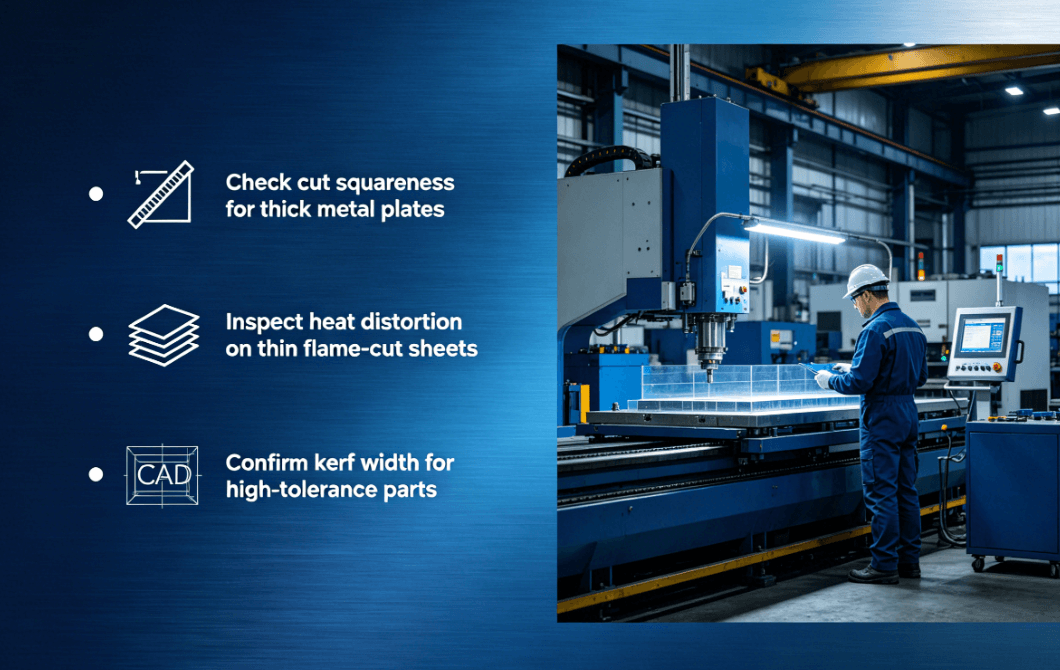
- Squareness: On thick plates, check if the cut is truly 90 degrees or if there is a "bevel" (common in lower-end plasma).
- Heat Distortion: For thin sheets cut with flame, check for warping. The intense heat of oxy-fuel often deforms thin carbon steel.
- Kerf Width: Ensure the supplier has accounted for the "kerf" (the width of the cut) in their CAD drawings, especially for tight-tolerance OEM parts.
Summary
In 2026, the boundary between these two technologies is clearer than ever for the strategic buyer. Plasma cutting is the high-speed, versatile workhorse for the majority of manufacturing, especially for materials under 40mm and non-ferrous metals like aluminum and stainless steel. Flame cutting remains a specialized, cost-effective powerhouse for the heaviest carbon steel applications where material thickness exceeds the efficient range of plasma. For a procurement professional, the goal is to match the technology to the material thickness and the required edge quality to ensure the lowest Total Cost of Ownership.
Reference Sources
FMA - Fabricators & Manufacturers Association