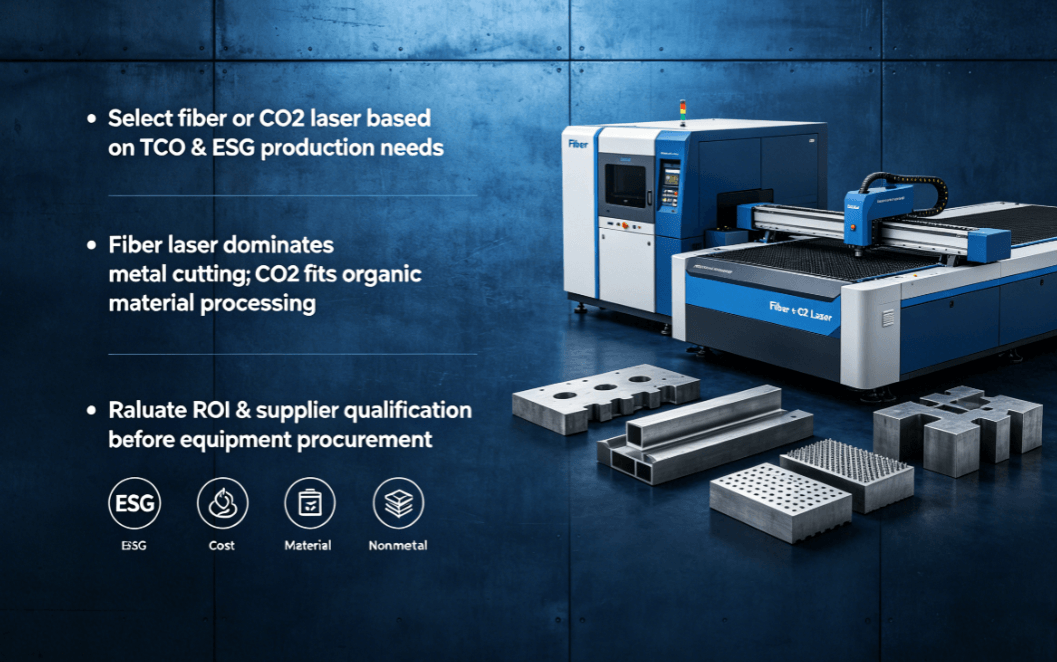
The global manufacturing landscape in 2026 demands more than just basic machinery; it requires high-efficiency systems that align with strict ESG (Environmental, Social, and Governance) standards and lean production goals. For procurement professionals, the debate between Fiber and CO2 laser technology is no longer about which technology is "new," but which one offers the lowest Total Cost of Ownership (TCO) for their specific product mix.
As we move into 2026, the industrial ecosystem has seen a massive surge in fiber laser adoption for metals, while CO2 systems have pivoted toward specialized high-end organic material processing. This guide provides a procurement-centric analysis of these two titans of the cutting world, focusing on operational realities, supplier verification, and ROI.
Understanding the Technology Through a Sourcing Lens
To make an informed buy, one must understand how the "source" impacts the floor. Fiber lasers utilize a solid-state laser source, generating a beam through laser diodes and delivering it via flexible fiber optic cables. This design is inherently more durable for industrial shipping and long-term factory use.
Conversely, CO2 lasers rely on a gas mixture—carbon dioxide, nitrogen, and helium—excited by an electrical discharge. The resulting beam is channeled through a series of precision-aligned mirrors. From a sourcing perspective, CO2 lasers involve a more complex logistical chain, requiring consistent access to high-purity gases and specialized maintenance technicians for mirror calibration.
The Comparison Table: Key Procurement Metrics (2026 Data)
| Metric | Fiber Laser (High Power) | CO2 Laser (Standard) |
|---|---|---|
| Primary Materials | Metals (Stainless, Carbon, Brass, Copper) | Non-metals, Wood, Acrylic, Textiles |
| Cutting Speed (< 5mm Steel) | Ultra-High (3x to 5x faster than CO2) | Moderate |
| Energy Efficiency | High (Wall-plug efficiency ~35-45%) | Low (Wall-plug efficiency ~8-12%) |
| Consumable Costs | Low (Nozzles, Protection glass) | High (Gas, Mirrors, Lenses) |
| Maintenance Interval | 20,000+ Hours (Minimal) | 2,000 - 4,000 Hours (Alignment required) |
| Initial Investment (CAPEX) | Higher for 12kW+ units | Lower for entry-level specialized units |
| Operational Ease | High (Highly automated) | Moderate (Requires skilled operator) |
Material Compatibility: Where Do You Sit in the Supply Chain?
The efficiency of your procurement choice is dictated by your bill of materials. Selecting the wrong wavelength leads to wasted energy, poor edge quality, and increased scrap rates.
Metal Fabrication: The Fiber Dominance
Fiber lasers operate at a wavelength of approximately 1.06 microns. This short wavelength is absorbed rapidly by most metallic structures. For procurement teams in the automotive, aerospace, or kitchenware industries, Fiber is the standard. It manages reflective metals like copper and brass without the risk of "back-reflection" damage that historically plagued earlier CO2 systems.
Non-Metals and Organics: The CO2 Niche
CO2 lasers operate at a 10.6-micron wavelength, which is absorbed exceptionally well by organics. If you are sourcing for the furniture, signage, or packaging industries, a CO2 laser provides a "flame-polished" edge on acrylic that Fiber simply cannot match. In 2026, many high-end brand owners still specify CO2 cutting for leather goods to avoid the intense charring caused by fiber beams.
Total Cost of Ownership (TCO): CAPEX vs. OPEX
In 2026, a procurement manager’s success is measured by the cost-per-part over a five-year horizon. The initial purchase price is often the least significant variable in this equation.
Energy Consumption
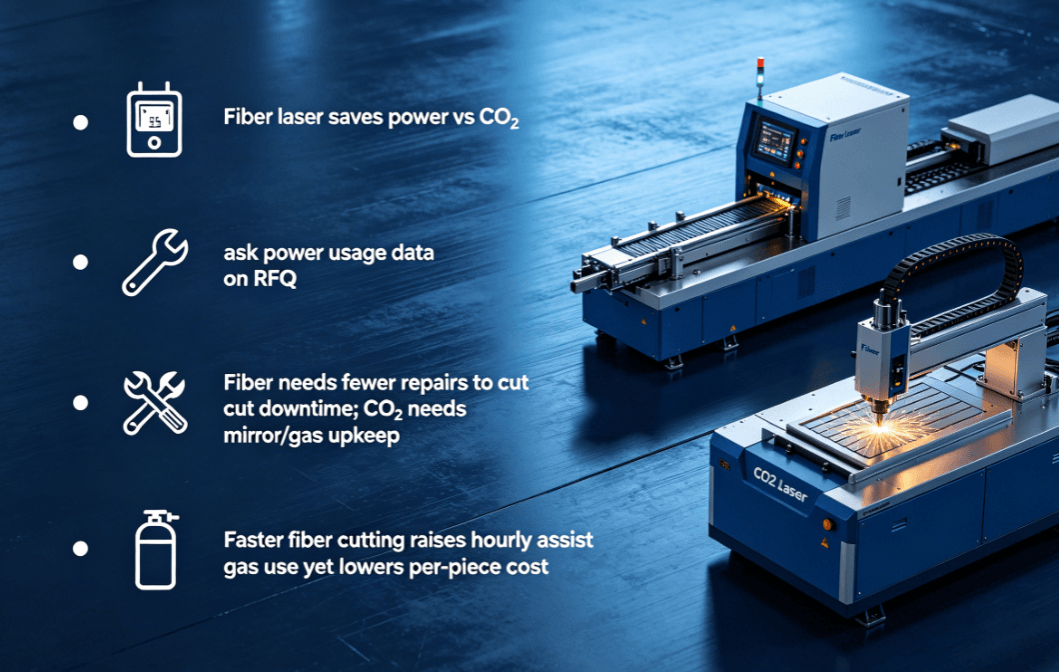
Fiber lasers are the champions of energy efficiency. A 6kW Fiber laser consumes significantly less electricity than a 6kW CO2 laser while producing higher output. In the current global economy, where energy price volatility is a major risk, switching to Fiber is a hedge against rising utility costs. Buyers should request "Power Consumption per Square Meter" data from suppliers during the RFQ process.
Maintenance and Downtime
Maintenance equals downtime, and downtime is the enemy of procurement efficiency. Fiber lasers have no internal moving parts in the laser source and no mirrors to clean. CO2 systems require periodic gas refills and mirror replacements. If your factory is located in a region where specialized laser technicians are scarce, the maintenance profile of a Fiber laser makes it a much safer long-term investment.
Gas Consumption
While Fiber lasers save on "laser gas," they still use "assist gas" (Nitrogen or Oxygen). Because Fiber lasers cut faster, they consume more gas per hour. However, the cost per finished part is usually lower because the machine completes the cut in a fraction of the time. 2026 trends show an increase in the use of high-pressure compressed air as an assist gas for Fiber lasers, further driving down operational costs.
Sourcing Workflow: How to Evaluate Suppliers in 2026
When sourcing machinery from international B2B marketplaces, procurement teams must look past the shiny exterior of the machine frame.
Core Components
A laser machine is only as good as its integrated components. A standard 2026 vetting checklist should include the following:
- The Source: Is it IPG, nLIGHT, or a reputable domestic brand like Raycus?
- The Head: Does it feature autofocus and active collision protection? (e.g., Precitec or Raytools).
- The Rack and Pinion: Are they precision-ground? (e.g., Atlanta or YYC).
Factory Verification
Avoid trading companies masquerading as manufacturers. A legitimate OEM (Original Equipment Manufacturer) will have an assembly line with a temperature-controlled "clean room" for optical integration. Request a live video audit of the testing area where the machine undergoes its 72-hour stress test before shipping.
Software Ecosystem
Modern procurement favors interoperability. Ensure the machine's software (like CypCut, Lantek, or Beckhoff) integrates with your existing ERP and CAD/CAM systems. In 2026, "Smart Factory" compatibility is a requirement, not a luxury.
Strategic Recommendations for Different Buyer Types
For Bulk Buyers and Wholesalers, Fiber lasers are the priority. The high throughput allows for faster inventory turnover and the ability to handle a wider variety of metal grades.
For Brand Owners in the Signage and Decor Industry, a CO2 laser remains the essential tool. The edge quality on wood and plastic is superior, reducing the need for secondary manual polishing, which saves labor costs.
For Ecommerce Sellers and Small Business Owners, entry-level Fiber lasers have become more affordable in 2026. However, if your business model involves "mixed-media" (cutting both thin steel and wood), you may actually need two specialized machines rather than a "hybrid" system, as hybrids often compromise on performance in both areas.
Risk Mitigation in the Sourcing Process
Procurement risks in the laser industry often center on logistics and after-sales support. Ensure that your contract includes a "Commissioning and Training" clause. Many importers find that while the machine is high quality, their local staff lacks the training to optimize the cutting parameters, leading to high nozzle consumption and poor finish.
Furthermore, clarify the warranty terms for the laser source specifically. The source is the most expensive component, often representing 30-40% of the total machine cost. A 2026 standard warranty should cover the source for at least 24 months.
2026 Trends: The Rise of AI-Integrated Cutting
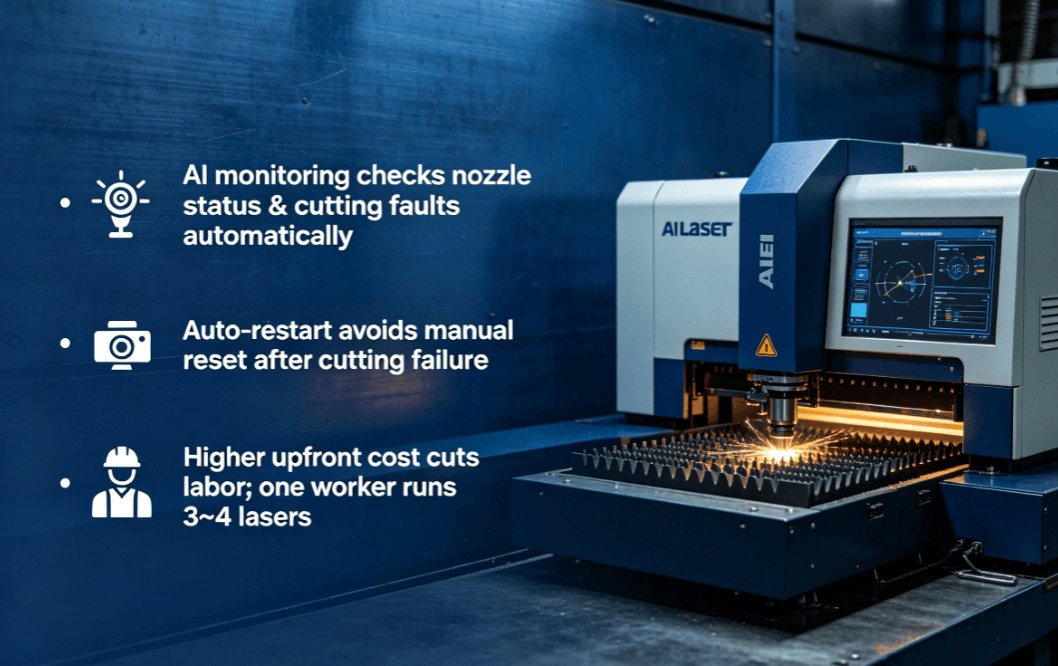
Suppliers are now offering AI-driven "Nozzle Health Monitoring" and "Auto-Restart" features. These systems use cameras and sensors to detect if a cut has failed or if a nozzle is damaged. For procurement, these features represent a higher CAPEX but a significant reduction in labor costs, as one operator can effectively manage 3-4 machines simultaneously.
Summary
In 2026, the choice between Fiber and CO2 lasers is determined by material type and production volume. Fiber lasers dominate the metal sector with superior speed and lower energy costs. CO2 lasers remain indispensable for non-metal industries where edge aesthetics are paramount. Procurement teams should prioritize Total Cost of Ownership and supplier technical support over the initial purchase price to ensure long-term manufacturing success.
Reference Sources
IPG Photonics: Industry leading high-power fiber lasers.