In the 2026 manufacturing landscape, the strategic procurement of metal fabrication equipment has shifted from simple hardware acquisition to complex ecosystem integration. For professionals managing supply chains, the term plasma applications now encompasses a wide range of automated, high-precision processes that define modern infrastructure. The plasma cutting table remains a fundamental asset for any industrial facility, but the criteria for selecting the right supplier have evolved alongside advancements in CNC technology and IoT connectivity.
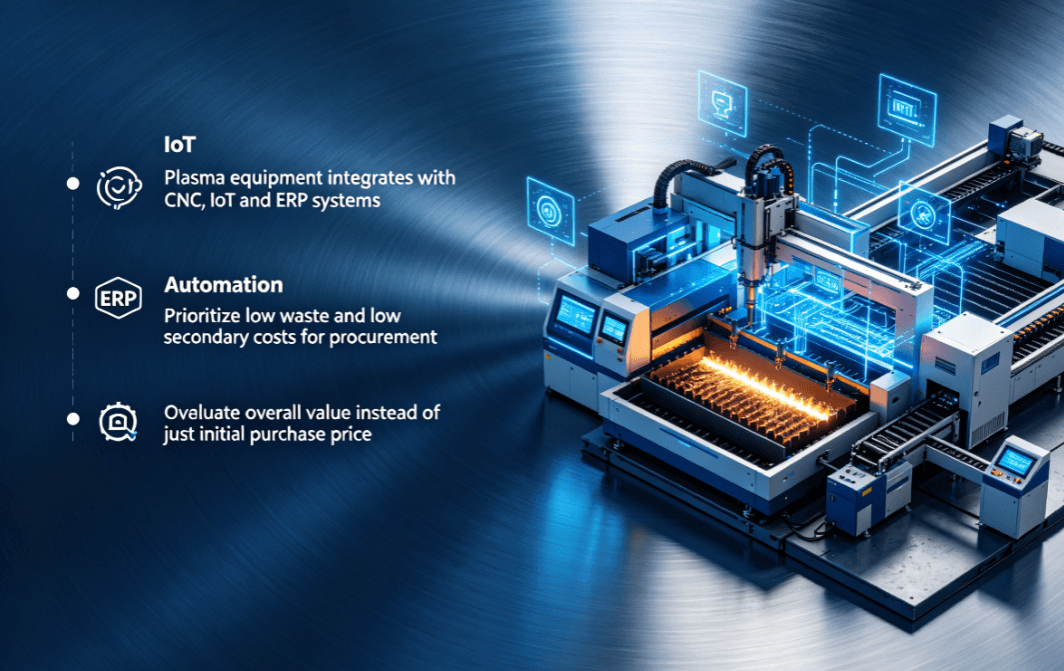
Procurement officers must look beyond the initial price tag. In today's market, "value" is defined by the machine’s ability to minimize material waste, reduce secondary finishing costs, and integrate seamlessly into a factory's existing Enterprise Resource Planning (ERP) software. This guide provides a deep dive into the sectors driving demand and the procurement logic required to secure high-performance equipment in a competitive global trade environment.
The Strategic Importance of Plasma in Global Trade
Why does plasma technology continue to dominate despite the rise of fiber lasers? The answer lies in the "thickness-to-cost" ratio. While lasers excel at thin-gauge precision, plasma remains the most efficient method for cutting conductive materials between 6mm and 50mm. In 2026, as global infrastructure projects in renewable energy and maritime transport surge, the demand for robust plasma solutions is at an all-time high.
For a sourcing business or a bulk buyer, understanding this niche is critical. Plasma systems are more tolerant of surface imperfections, such as rust or scale on carbon steel, which are common in heavy-duty sourcing environments. This tolerance makes plasma the "workhorse" of the industrial world, offering a level of versatility that laser systems cannot yet match at a similar price point.
Key Sector: Heavy Construction and Infrastructure
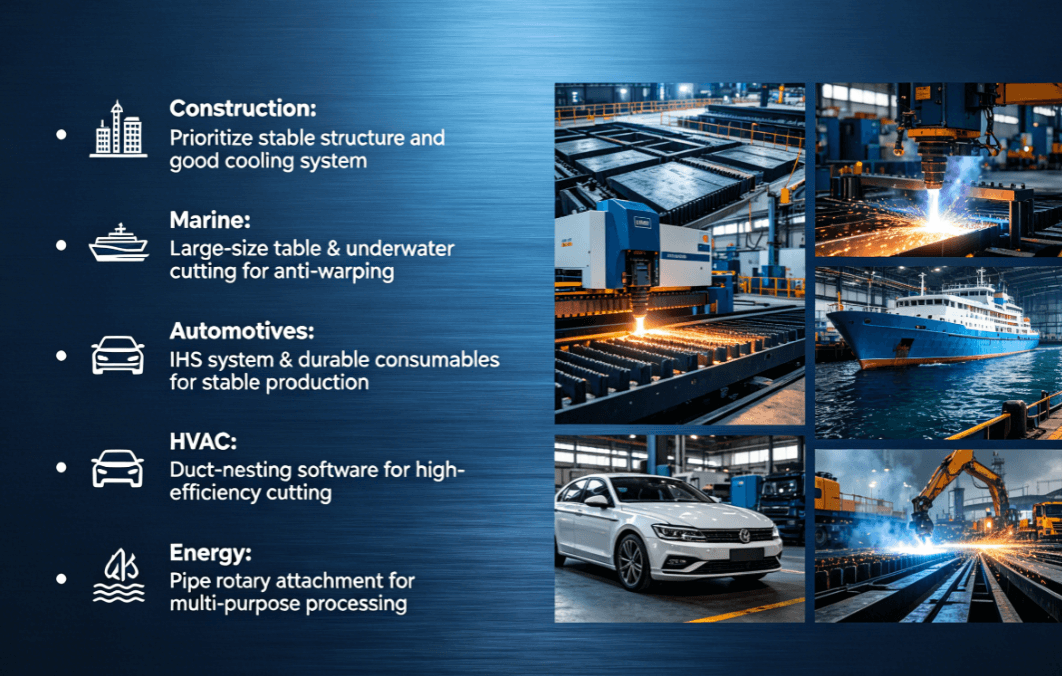
The construction industry remains the largest consumer of plasma-cut components. From structural gusset plates to massive base flanges for skyscrapers, the reliability of a CNC plasma table is paramount.
- Application Focus: Cutting structural steel beams, connector plates, and heavy-duty brackets.
- Buyer Concern: Duty cycle. In construction, machines often run for three shifts daily. Sourcing a table with an inferior cooling system leads to catastrophic downtime.
- Procurement Tip: When vetting suppliers, demand proof of the gantry’s structural integrity. A vibration-resistant frame is essential for maintaining accuracy over long production runs.
Key Sector: Shipbuilding and Marine Engineering
Marine engineering requires the processing of massive plates, often in environments where humidity and salinity can affect machinery.
- Application Focus: Hull sections, internal bulkheads, and deck reinforcements.
- Supplier Requirement: Large-format capability. Tables for this sector often exceed 12 meters in length.
- Strategic Sourcing: Many buyers now opt for "Underwater Plasma Cutting" tables. This specific application reduces noise pollution and prevents plate warping due to heat, which is a major concern for thin-skinned marine vessels.
Key Sector: Automotive and Transportation Systems
From heavy-duty truck chassis to the fabrication of specialized agricultural machinery, plasma cutting provides the necessary throughput for the transport sector.
- Application Focus: Chassis frames, trailer components, and suspension mounts.
- Manufacturing Realism: In the automotive supply chain, consistency is everything. Sourcing a table with an integrated "Initial Height Sensing" (IHS) system ensures that every cut starts at the perfect distance from the metal, regardless of plate bowing.
- Operational Cost: Buyers in this sector prioritize gas consumption efficiency. Systems that use "Long-Life" consumables are preferred to reduce the frequency of torch maintenance.
Key Sector: HVAC and Ductwork Fabrication
For smaller buyers or specialized HVAC contractors, the focus shifts from raw power to software-driven speed.
- Application Focus: Rapid cutting of galvanized steel for ventilation ducts and fittings.
- Technical Requirement: Integration with specialized "Duct-Nesting" software. This allows operators to input dimensions and automatically generate the most material-efficient layout.
- Market Insight: This is a high-volume area for OEM/ODM suppliers who provide "light-industrial" tables that are compact yet capable of high-speed tracking.
Key Sector: Renewable Energy Components
As we move through 2026, the solar and wind energy sectors have become primary drivers of plasma applications.
- Application Focus: Solar mounting racks and wind turbine internal components.
- Sourcing Trend: We are seeing an increase in the procurement of "Pipe and Tube" plasma rotaries. These attachments allow a standard flat-bed table to also process cylindrical shapes, providing a dual-purpose solution for energy infrastructure suppliers.
Evaluating the Plasma Cutting Table Ecosystem
When a sourcing agent or procurement manager receives an RFQ for a plasma cutting table, the evaluation process must be granular. A table is not a single product; it is a collection of subsystems that must work in harmony.
Critical Components for Technical Procurement
| Component | Industry Standard (2026) | Buyer Consideration |
|---|---|---|
| Power Source | High-Definition (HD) Inverter | HD units provide "laser-like" quality with zero bevel. |
| Drive Motors | Dual-Drive AC Servo Motors | Essential for high-speed accuracy; avoid stepper motors for industrial use. |
| CNC Controller | Multi-axis Industrial PC | Ensure it supports standard CAD/CAM formats and has remote diagnostics. |
| Torch Height Control | Automatic Voltage Sensing | Critically affects consumable life and cut quality. |
| Frame Design | Stress-Relieved Welded Steel | Prevents long-term warping and maintains mechanical precision. |
Software and IoT Integration in 2026
Modern procurement is increasingly focused on the "Digital Twin" of the machine. In 2026, top-tier suppliers offer tables with built-in sensors that monitor:
- Consumable Wear: Predicts when an electrode will fail, preventing ruined workpieces.
- Gas Pressure Stability: Ensures the arc remains stable throughout the cut.
- Electricity Consumption: Provides data for ESG (Environmental, Social, and Governance) reporting, which is now a requirement for many large-scale importers.
Procurement Workflow for Global Buyers
Successfully importing a plasma table requires a structured workflow that mitigates the risks of international trade, including logistics damage and sub-par technical support.
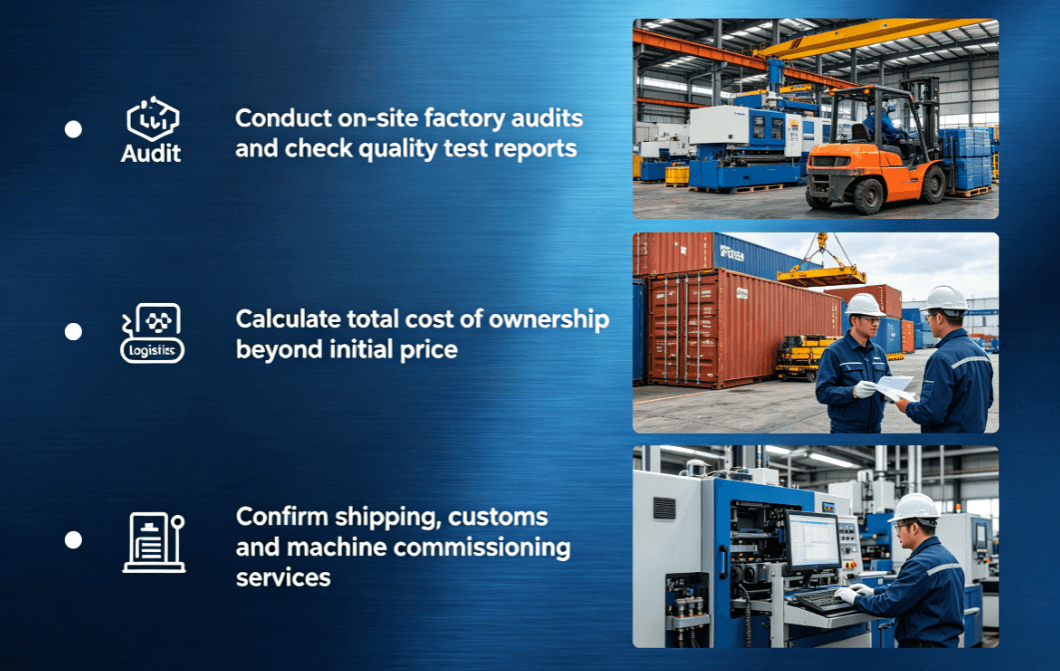
Step 1: Factory Audits and Verification
Never buy based on a digital catalog alone. A true manufacturer should be able to demonstrate:
- In-house Machining: Do they mill their own gantries or outsource the frame?
- Component Provenance: Are they using reputable brands for the electronics (e.g., Schneider, Siemens, or Delta)?
- Quality Control: Ask for the "Interferometer Test" report, which measures the mechanical accuracy of the table's movement.
Step 2: Total Cost of Ownership (TCO) Analysis
The cheapest machine often becomes the most expensive after six months of operation. A realistic TCO analysis includes:
- Consumable Costs: How many meters can an electrode cut before replacement?
- Secondary Operations: If a low-quality machine leaves heavy dross, your labor costs for grinding will skyrocket.
- Electricity and Gas: High-efficiency power sources can save thousands of dollars annually in high-volume settings.
Step 3: Logistics and Import Compliance
Shipping a 3-meter wide steel table is a logistical challenge.
- Packaging: Ensure the machine is shipped in a "Seaworthy" vacuum-sealed foil to prevent rust during sea transit.
- Customs: Verify the HS Code (Harmonized System) to understand import duties. In many regions, CNC machinery falls under specific trade agreements that can reduce taxes if the correct paperwork is provided.
- Commissioning: Determine if the supplier will send an engineer for setup or if they provide a "Plug-and-Play" remote video commissioning service.
Solutions for Bulk Importers and Wholesalers
Wholesalers are looking for "Marketable Reliability." They need a machine that is easy to sell and easy to support.
- The Focus: Standardized parts. If a wholesaler imports 50 units, they need a unified spare parts kit that covers all of them.
- Strategic Move: Negotiate for "White Label" branding. Having your own brand on the machine increases customer loyalty and allows for higher margins.
Customization for Brand Owners and OEM/ODM
For brand owners looking to enter the metal fabrication market, the focus is on differentiation.
- The Focus: Industrial design and software localization.
- OEM Advantage: Work with a manufacturer that can customize the table color, the UI (User Interface) of the controller, and add specific safety features (like light curtains or enclosed cabinets) required for your specific local market regulations.
Summary
The industrial landscape of 2026 rewards those who treat the procurement of a plasma cutting table as a strategic investment rather than a commodity purchase. By understanding the specific plasma applications relevant to your sector—whether it is the massive scale of shipbuilding or the rapid-fire production of HVAC components—you can align your sourcing strategy with your production goals. Remember that the "best" supplier is one who offers technical transparency, verified manufacturing depth, and a clear path for long-term support.
Reference Sources
American Welding Society Official Site (AWS)