In the world of metal fabrication and industrial procurement, precision starts with understanding machine capabilities. Whether you are a brand owner looking to bring production in-house or a bulk buyer evaluating supplier factory floors, the plasma thickness guide is your primary reference point for operational efficiency.
For 2026, plasma technology has evolved, offering cleaner cuts at higher speeds. However, the fundamental physics remains: your material thickness dictates your amperage requirements, gas selection, and ultimately, your machine's ROI. This guide provides a procurement-focused breakdown of what you need to know before committing to a plasma cutting table.
Understanding the Spectrum: Rated vs. Maximum Cut
When sourcing a plasma table, buyers often fall into the trap of looking only at the "maximum cut" capacity. In a professional procurement workflow, we categorize thickness into three distinct tiers:
- Production Cut: The thickness a machine can cut cleanly and consistently at high speeds (typically 15-20 inches per minute) without overheating the power source or excessive dross.
- Maximum (Pierce) Cut: The maximum thickness the machine can start from the middle of a plate without damaging the torch.
- Severance Cut: The absolute limit where the machine can cut through the metal, but the speed is extremely slow and the edge quality is poor, requiring significant post-process grinding.
Sourcing Tip: If your production line primarily handles 1/2" mild steel, do not buy a machine rated at a 1/2" maximum. You need a machine where 1/2" falls within the "Production Cut" range to ensure longevity and part consistency.
2026 Plasma Cutting Thickness Chart (Reference Guide)
The following data represents industry averages for modern CNC plasma systems using standard compressed air or oxygen.
| Material Type | Amperage (A) | Production Thickness | Max Pierce Thickness | Severance Thickness |
|---|---|---|---|---|
| Mild Steel | 30A | 1/8" (3mm) | 3/16" (5mm) | 3/8" (10mm) |
| Mild Steel | 45A | 1/4" (6mm) | 1/2" (12mm) | 3/4" (19mm) |
| Mild Steel | 65A | 1/2" (12mm) | 5/8" (16mm) | 1" (25mm) |
| Mild Steel | 85A | 5/8" (16mm) | 3/4" (19mm) | 1-1/4" (32mm) |
| Mild Steel | 105A | 3/4" (19mm) | 7/8" (22mm) | 1-1/2" (38mm) |
| Stainless Steel | 45A | 3/16" (5mm) | 3/8" (10mm) | 1/2" (12mm) |
| Stainless Steel | 85A | 1/2" (12mm) | 5/8" (16mm) | 3/4" (19mm) |
| Aluminum | 45A | 3/16" (5mm) | 3/8" (10mm) | 1/2" (12mm) |
| Aluminum | 85A | 1/2" (12mm) | 5/8" (16mm) | 3/4" (19mm) |
How Material Type Influences Sourcing Decisions
A common mistake for new importers is assuming "metal is metal." In reality, the thermal conductivity and melting points vary significantly across alloys, impacting how you use the plasma thickness guide.
Mild Steel (Carbon Steel)
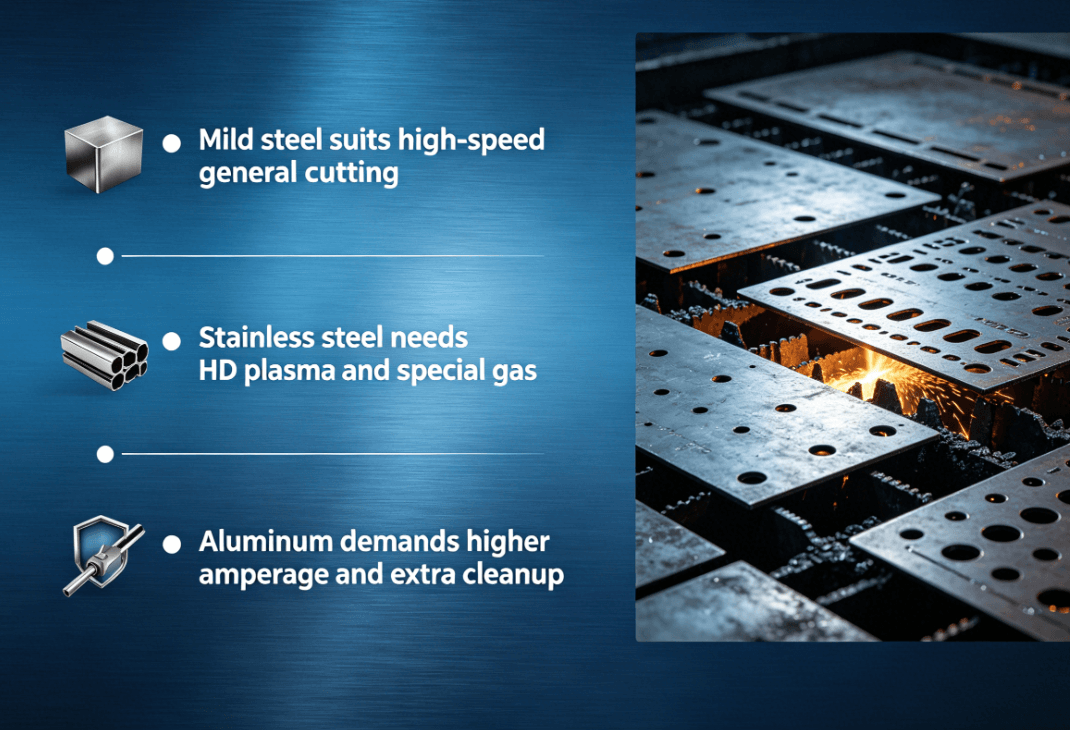
This is the "gold standard" for plasma cutting. It absorbs heat well and allows for high-speed processing. Most sourcing agents prioritize mild steel capacity when selecting a general-purpose plasma table.
Stainless Steel
Stainless requires more energy to cut cleanly. Because it is a poor heat conductor, the heat stays localized, which can cause warping on thinner sheets. Buyers sourcing for the food service or medical industry should look for "High Definition" (Hi-Def) plasma systems that use specific gas mixes (like H35) to prevent oxidation on thicker sections.
Aluminum
Aluminum is highly reflective and has a high thermal conductivity. It dissipates heat so quickly that you often need more amperage than you would for an equivalent thickness of steel. Furthermore, the edge quality on aluminum often includes "dross" (hardened slag) that requires more cleanup unless using a water table or specialized gas.
Key Factors Affecting Cutting Capacity and Quality
When evaluating a supplier's machine or a factory's capability, look beyond the chart. These variables determine if the theoretical thickness matches real-world output:
- Duty Cycle: This is a procurement metric. A 60% duty cycle means the machine can run for 6 out of 10 minutes at a specific amperage. For bulk buyers, a 100% duty cycle at the required production thickness is essential to prevent downtime.
- Gas Pressure and Quality: Moist air kills consumables (nozzles and electrodes). Ensure the sourcing package includes an integrated refrigerated air dryer.
- Torch Height Control (THC): On thicker materials, the torch must maintain a precise distance from the plate. Without a high-quality THC, you risk crashing the torch into the material as it warps from heat.
- Consumable Life: High-amperage cutting on thick plates wears out copper nozzles quickly. When negotiating with an OEM, ask for the "cost per foot of cut" regarding consumable consumption.
Sourcing Workflow: Matching Table Size to Thickness
The physical size of the plasma table often correlates with the thickness it’s designed to handle.
- Entry-Level (4x4 or 2x2 Tables): Usually paired with 30A-45A power units. Best for small buyers, hobbyists, or light architectural work. Max thickness is usually 1/2".
- Mid-Range Industrial (4x8 or 5x10 Tables): The "workhorse" for most metal service centers. Paired with 65A-105A units. Designed for 1/2" to 3/4" production work.
- Heavy Industrial / Gantry Systems: Large-scale tables often using 200A-400A high-definition power sources. These are the machines sourced by bulk importers for heavy machinery manufacturing, capable of piercing 2" or more.
Procurement Logic: Evaluating the Supplier
If you are sourcing a CNC plasma table from an overseas manufacturer (OEM/ODM), use these criteria to verify their "thickness claims":
- Ask for Raw Video Footage: Don't rely on edited marketing clips. Request a "live" cut video of the machine piercing the maximum rated thickness.
- Verify the Power Source: Many suppliers build the table but outsource the plasma cutter. Is it a reputable brand like Hypertherm, or a generic IGBT inverter? This significantly changes the accuracy of the plasma thickness guide.
- Software Compatibility: Does the nesting software optimize the lead-in and lead-out for thick materials? Poor software leads to "blowouts" when piercing thick plate.
The 2026 Trend: Integration of Fiber Laser
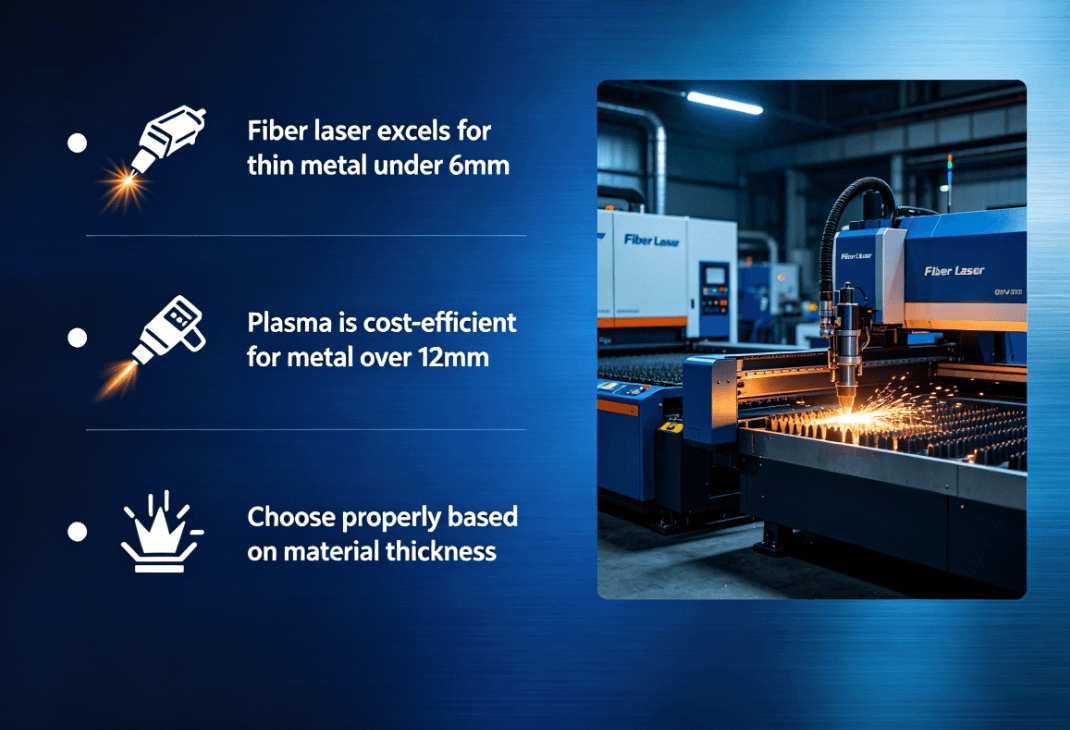
While this guide focuses on plasma, professional buyers should be aware that fiber laser prices are dropping. For materials under 1/4" (6mm), fiber laser is becoming the preferred sourcing choice for high-volume brand owners due to its speed and lack of dross. However, for anything over 1/2", plasma remains the most cost-effective solution for capital expenditure (CAPEX).
Summary
Matching the right plasma table to your production requirements requires a balance of amperage, material knowledge, and supplier verification. By prioritizing production cut capacity over severance limits and ensuring high duty cycles, procurement professionals can secure equipment that delivers long-term reliability and high-quality output for 2026 projects.
Reference Sources
Hypertherm official plasma cutting charts and specifications
ESAB industrial plasma systems and material thickness guides