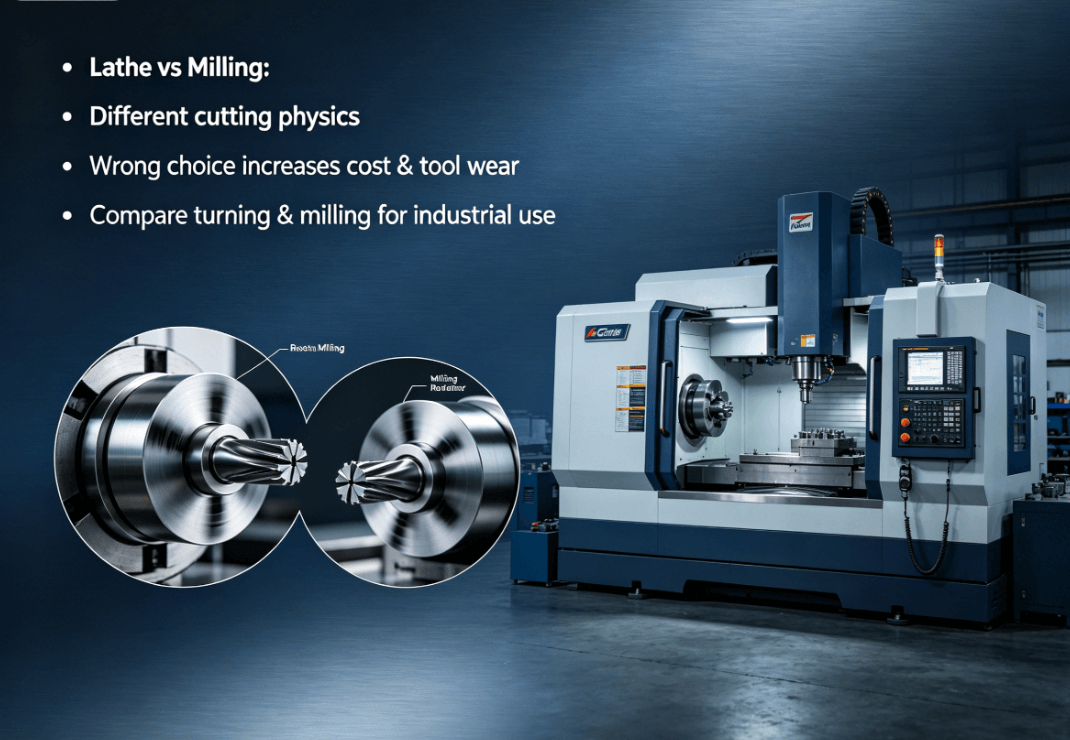
In the landscape of subtractive manufacturing, the debate of lathe vs milling is about physics. While both processes remove material using CNC technology, the way the tool meets the workpiece differs entirely. Choosing the right process is critical for cost and precision.
For engineers, selecting the wrong machine leads to high cycle times and tool wear. This guide examines the mechanical distinctions and application-specific advantages of both CNC turning and milling.
The Fundamental Mechanical Distinction
The core difference lies in which component provides the primary cutting motion. This mechanical logic determines the shapes each machine can produce.
The Physics of Motion in CNC Turning
In a CNC lathe, the workpiece rotates while the cutting tool remains stationary. The part is held in a chuck and spun at high RPMs. A single-point tool then moves along the X and Z axes to shave off material.
The Dynamics of CNC Milling
In a milling machine, the cutting tool rotates while the workpiece is secured to a table. The table moves in multiple directions (X, Y, and Z) to feed the part into the spinning cutter. This allows the tool to approach the material from various angles.
Comparison of Technical Specifications
| Feature | CNC Lathe (Turning) | CNC Milling Machine |
|---|---|---|
| Primary Motion | Workpiece rotates | Cutting tool rotates |
| Tool Type | Single‑point cutter | Multi‑point (End mills, face mills) |
| Common Geometry | Cylindrical, conical, symmetrical | Prismatic, flat, complex pockets |
| Axis Standard | Usually 2‑axis (X, Z) | 3, 4, or 5‑axis |
| Surface Finish | Excellent for diameters | Dependent on stepover/tool path |
| Chip Removal | Continuous ribbon chips | Discontinuous, small chips |
When to Choose a Lathe?
The CNC lathe is the undisputed king of rotational symmetry. If a part is spun around a central axis, it is a candidate for a lathe.
- Cylindrical and Conical Parts
- High-Speed Material Removal for Rounds
- Precision Threading
High-Precision Rotational Symmetry
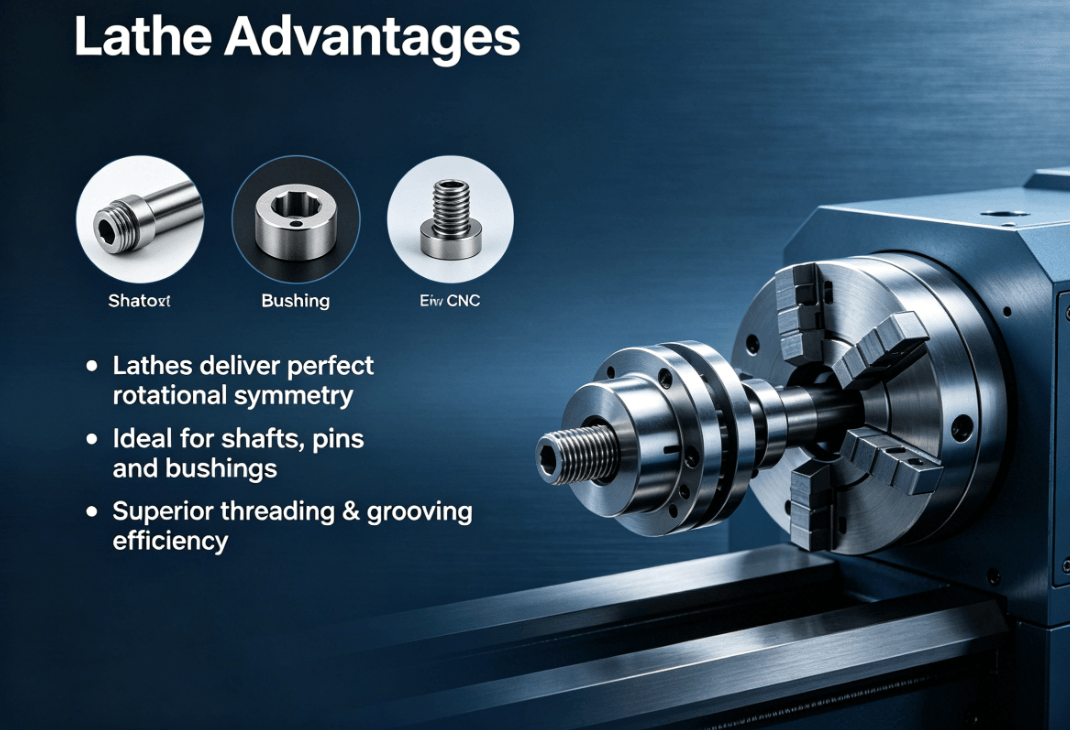
Components such as shafts, pins, and bushings are natively suited for turning. Because the part rotates, achieving perfect concentricity is easier on a lathe than a mill. The process ensures high accuracy for external and internal diameters.
Threading and Grooving Efficiency
Lathes excel at cutting external and internal threads through single-point threading. This ensures high pitch accuracy and superior thread strength. Grooving is also simplified as the tool plunges directly into the rotating diameter.
When to Choose a Milling Machine?
Milling machines offer versatility that lathes cannot match. They are essential for non-round geometries and intricate internal features.
- Complex Prismatic Shapes
- Secondary Features on Turned Parts
- Deep Pockets and Cavities
Handling Prismatic Geometries
If your part is square, rectangular, or features irregular contours, a milling machine is required. This includes engine blocks and brackets. The tool moves across multiple axes to create complex 3D surfaces.
Internal Pockets and Cavities
Milling machines are designed to clear out internal volumes. Using end mills and pocketing routines, they create precise slots and grooves. This is impossible to achieve with a lathe's stationary tool.
Technical Factors: Tooling and Axis Logic
The divergence between these processes extends to tooling types and how the CNC controller calculates movement.
Single-Point vs. Multi-Point Cutting
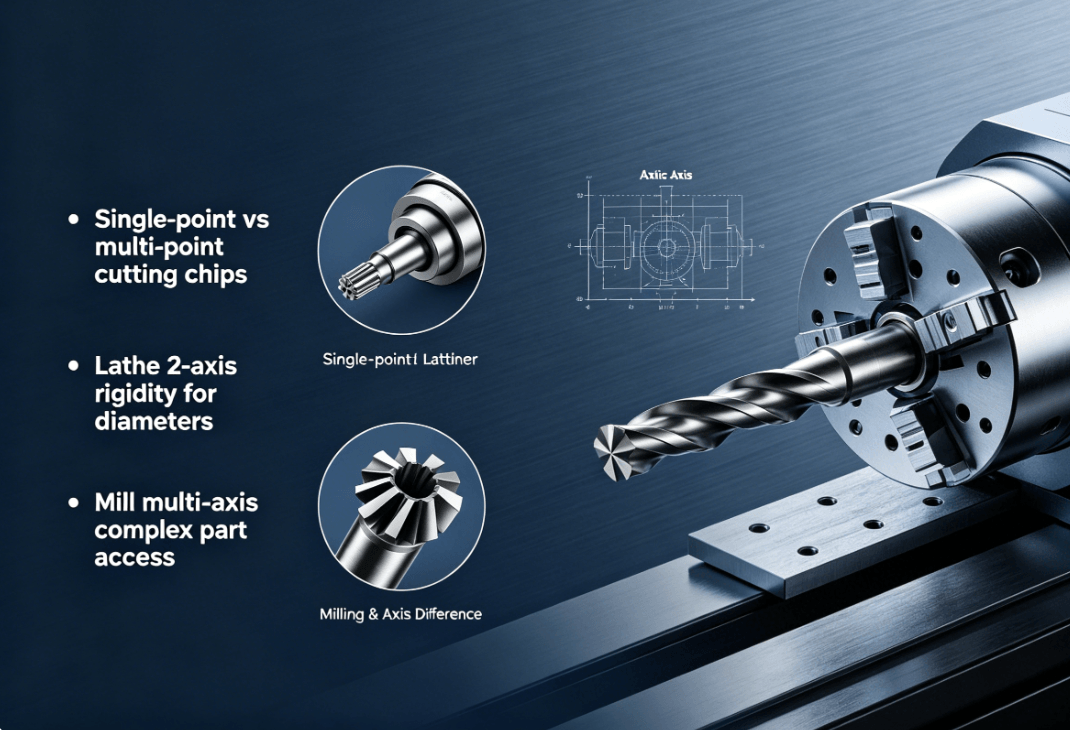
Lathe tools are typically single-point, meaning one cutting edge contacts the material. This creates continuous chips. Milling tools are multi-point, where each flute takes a bite of material, creating discontinuous chips.
Axis Movement and Precision
Lathes operate on two axes, resulting in higher rigidity for diameters. Milling machines start at three axes but frequently scale to 5 axes. This complexity allows the tool to reach almost any point without re-fixturing.
Cost Drivers in B2B Production
Selecting between lathe vs milling impacts the bottom line through several key factors.
- Setup Time
- Tooling Costs
- Cycle Time
Understanding these drivers helps in optimizing the manufacturing workflow. For round parts, turning is significantly faster. For complex prismatic parts, a mill is the more efficient choice.
Summary
The decision between a lathe and a milling machine depends on part symmetry. Lathes are best for cylindrical components requiring high concentricity. Milling machines are required for complex, non-rotational shapes and internal cavities. Often, these machines work together in a single production line to finish complex parts.
Reference Sources
SME - Society of Manufacturing Engineers