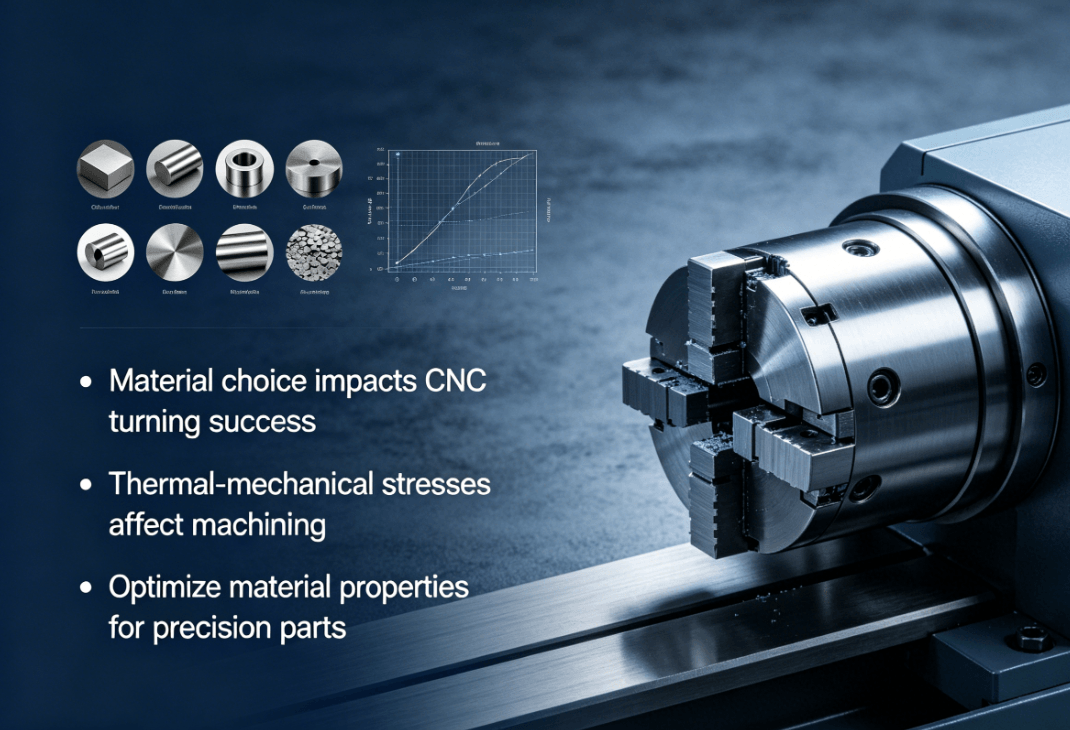
In the landscape of modern subtractive manufacturing, the selection of cnc lathe materials serves as the primary determinant for project success. CNC turning—a process where the workpiece rotates at high speeds while a stationary tool removes material—imposes unique mechanical and thermal stresses on the substrate. Selecting the wrong material can lead to catastrophic tool failure, poor surface integrity, or dimensional instability. This guide examines the metallurgical and chemical properties of common turning materials and provides engineering insights into their behavior during the machining cycle.
Understanding Material Classes in CNC Turning
The material chosen for a lathe project dictates the tool path strategy, spindle speeds, and feed rates. In industrial CNC turning, we generally categorize workpieces into three distinct classes: Ferrous Metals, Non-Ferrous Metals, and Engineering Plastics. Each class presents different challenges regarding chip control, heat dissipation, and abrasive wear.
Ferrous Metals (Iron-Based)
Ferrous metals are essential for structural applications due to their high tensile strength and durability.
- Carbon Steels (e.g., 1018, 1045): 1018 is a low-carbon steel often used for its weldability and ease of formability. However, it can be "gummy" on a lathe, requiring high-pressure coolant to prevent built-up edge (BUE). 1045 is a medium-carbon steel that provides higher strength and a better response to induction hardening.
- Alloy Steels (e.g., 4140, 4340): These contain Chromium and Molybdenum, which enhance toughness. Turning 4140 in its annealed state is relatively straightforward, but in its heat-treated (Q&T) state, it requires rigid setups and ceramic or coated carbide inserts.
- Stainless Steels (e.g., 303, 304, 316): Grade 303 is considered "free-machining" because of added sulfur, which helps break chips. Grade 316 is the standard for medical and marine environments due to its molybdenum content, though its low thermal conductivity makes it prone to work hardening during turning operations.
Non-Ferrous Metals
Non-ferrous materials are favored in aerospace and electronics for their weight-to-strength ratios and conductivity.
- Aluminum Alloys (e.g., 6061, 7075): 6061 is the most common material for CNC turning, offering excellent corrosion resistance. 7075 is much harder and stronger, often used in aircraft components where weight is a critical factor.
- Brass and Copper Alloys: C360 Brass is the benchmark for machinability, allowing for maximum spindle speeds and minimal tool wear. Pure copper is significantly more difficult to turn because of its extreme ductility and heat-sinking properties.
- Titanium (e.g., Grade 5 / Ti-6Al-4V): Titanium is widely used in medical implants and aerospace. It requires low cutting speeds (Vc) and positive rake angles to prevent the material from "springing back" against the tool.
Engineering Plastics
For insulators, seals, and lightweight mechanical parts, engineering plastics are often turned on CNC lathes.
- POM (Acetal/Delrin): This is the preferred plastic for turning due to its high stiffness and low friction. It produces consistent, manageable chips.
- PEEK (Polyether ether ketone): A high-performance polymer used in extreme environments. It maintains its mechanical properties at high temperatures but is expensive and requires precise heat management.
- PTFE (Teflon): Known for its chemical inertness. It is very soft and requires careful chucking to avoid crushing the part during the turning process.
Key Factors Influencing CNC Lathe Material Machinability
Machinability is a complex metric that evaluates how easily a material can be cut while maintaining an acceptable surface finish and tool life. When selecting cnc lathe materials, several technical factors must be considered to optimize the production cycle.
Chip Formation and Breakage
In turning, the goal is to produce "6-shaped" or "C-shaped" chips. Continuous, stringy chips (common in soft aluminum or low-carbon steel) can wrap around the chuck, leading to "bird-nesting." This is hazardous for both the operator and the machine. Materials with "free-machining" additives like sulfur or lead are engineered to prevent this issue.
Thermal Conductivity and Heat Management
The heat generated during turning is concentrated at the interface of the tool tip and the workpiece. Aluminum has high thermal conductivity, meaning the heat moves into the chips and the workpiece, keeping the tool cooler. Conversely, stainless steel and titanium have low thermal conductivity, which forces the heat to stay at the cutting edge, necessitating advanced PVD or CVD tool coatings.
Work Hardening Tendencies
Work hardening occurs when the material becomes harder and more brittle as it is deformed by the cutting tool. If the feed rate is too shallow, the tool "rubs" rather than "cuts," creating a hardened surface layer that can destroy the tool on the next pass. This is a critical consideration for austenitic stainless steels and high-nickel alloys like Inconel.
Comparison Table: CNC Lathe Material Properties
|
|---|
How Material Selection Impacts the Turning Process
The metallurgical identity of the workpiece dictates the CNC programming logic. A CNC programmer must adjust the "cutting data" to match the specific material properties.
Spindle Speed and Surface Footage
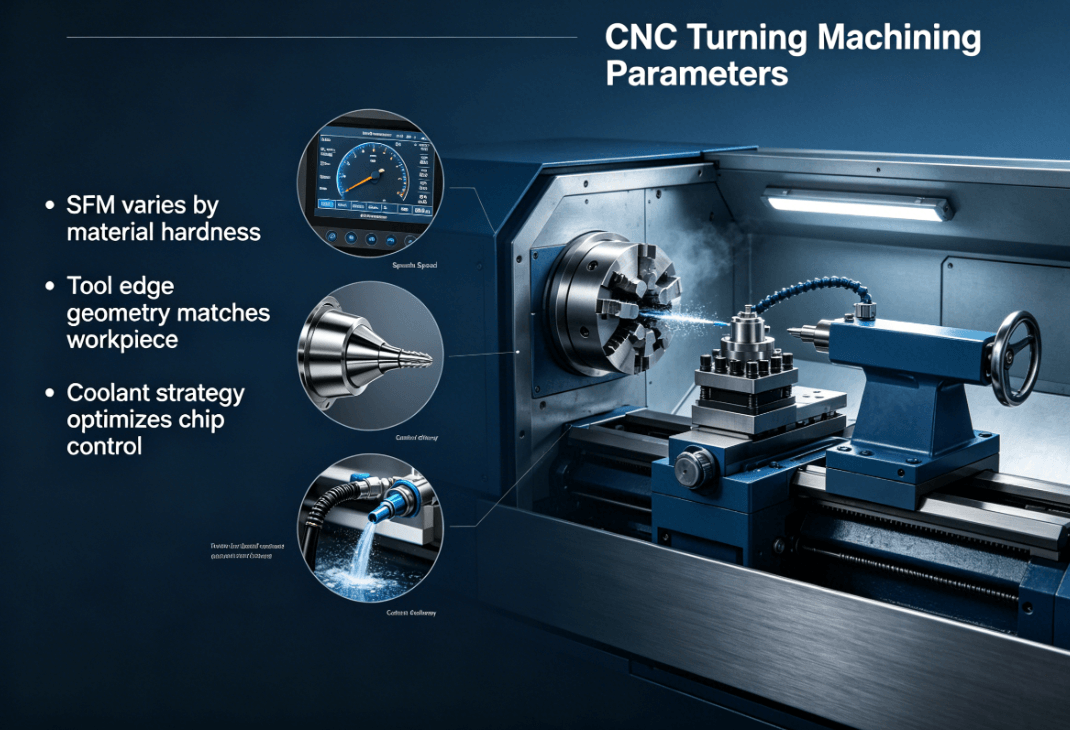
Surface Footage (SFM) represents the speed at which the material moves past the tool. Softer materials like Aluminum can be turned at over 1,000 SFM, while hard materials like Titanium may be restricted to 150 SFM. Improper speed selection can lead to premature tool cratering or thermal cracking of the insert.
Tooling Geometry and Material Hardness
Harder materials require a "honed" or "T-land" edge preparation to provide strength to the tool. Softer, more ductile materials require a "dead sharp" edge with a high positive rake angle to slice through the material without smearing. The nose radius of the tool must also be selected based on the material's ability to resist vibration and chatter.
Coolant Strategy and Chip Control
The delivery of coolant is vital for lubrication and temperature control. For materials like 316 Stainless Steel, through-spindle high-pressure coolant is often the only way to ensure the tool does not overheat. For materials like Cast Iron, turning is often done dry, as the graphite in the iron acts as a natural lubricant, and coolant can create an abrasive paste.
Advanced Considerations: Surface Finish and Tolerances
Achieving a specific Ra (Roughness Average) is a function of the material's grain structure and the feed rate.
- Grain Structure: Fine-grained materials like tool steels generally allow for much smoother finishes compared to coarse-grained cast materials.
- Ductility: Extremely ductile materials like pure copper or gold are prone to "tearing," which leaves a ragged surface regardless of the tool's sharpness.
- Thermal Expansion: This is particularly critical for plastics. A POM part may expand significantly during machining due to friction. If the operator measures the part while it is warm, it may be undersized once it cools to room temperature.
Industry-Specific Material Recommendations
Different industries prioritize different material characteristics based on the operational environment of the finished component.
- Automotive Industry: Focuses on 12L14 (lead-added steel) for high-volume, low-cost fasteners and 1045 steel for drivetrain components that require surface hardening.
- Aerospace Industry: Prioritizes 7075-T6 Aluminum and Titanium alloys. These materials offer the necessary strength-to-weight ratio to reduce fuel consumption.
- Medical Industry: Primarily uses 316L Stainless Steel and Titanium Grade 5 due to their non-reactive properties within the human body.
- Electronics Industry: Often selects C360 Brass or Tellurium Copper for connectors and pins that require high electrical conductivity and precise tolerances.
Summary
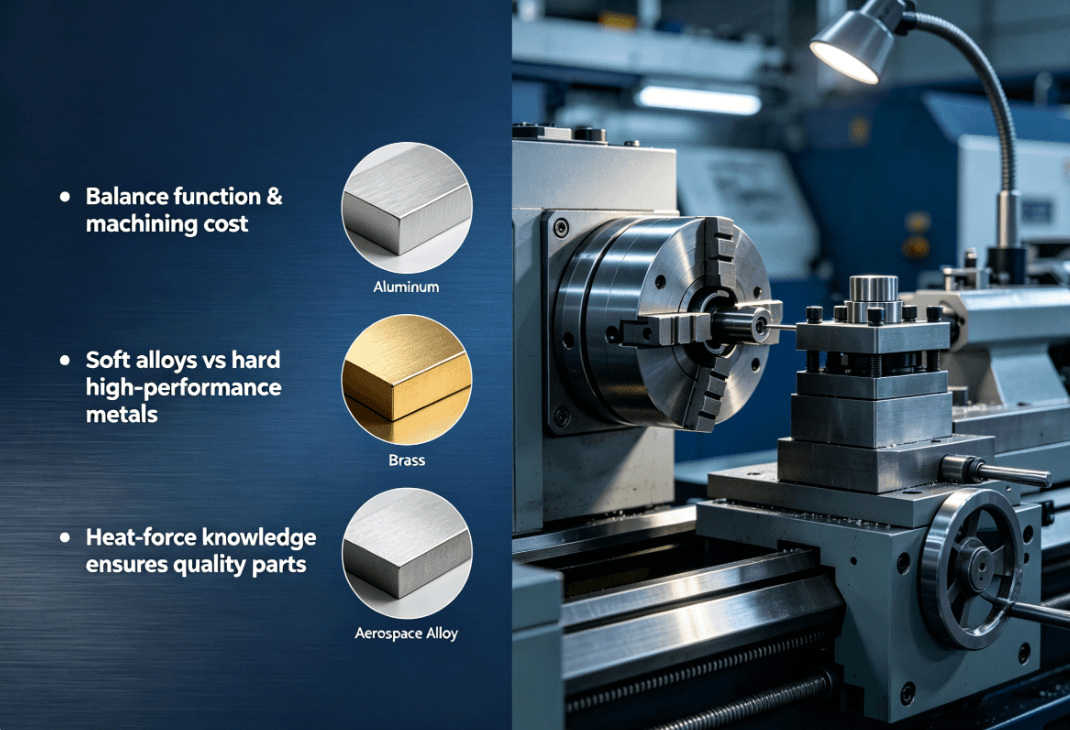
Selecting the appropriate cnc lathe materials is a balancing act between the functional requirements of the part and the economic realities of the machining process. While Aluminum and Brass provide the fastest cycle times and lowest tool costs, the high-performance requirements of the aerospace and medical sectors often necessitate the use of difficult-to-machine alloys. Understanding how these materials react to heat, pressure, and cutting forces is the hallmark of a skilled manufacturing engineer and is essential for producing high-quality turned components efficiently.
Reference Sources
ASM International offers technical data on material machinability.
The ISO organization sets geometric product specifications for turning.
SGS provides material testing and industrial certification services.