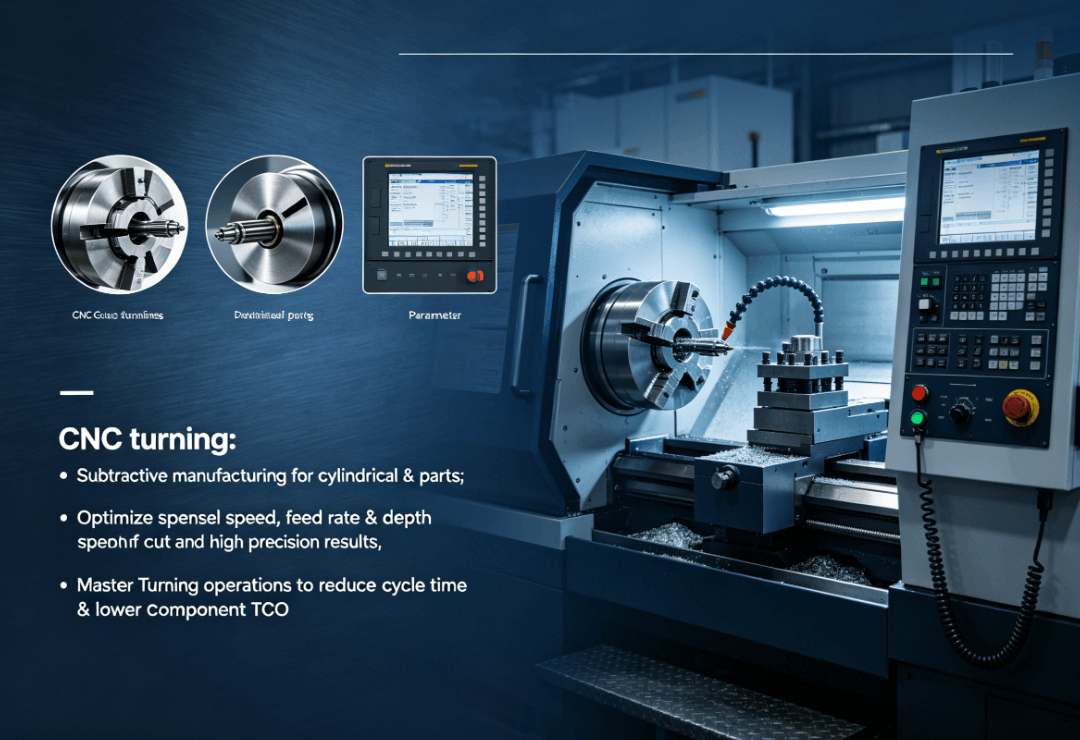
In the landscape of modern industrial manufacturing, CNC turning stands as a cornerstone technology. It is a subtractive manufacturing process where a workpiece rotates at high speeds while a stationary cutting tool removes material to create cylindrical, conical, or flat surfaces. For engineers and procurement managers, a granular understanding of common turning operations is not merely academic—it is essential for reducing cycle times, ensuring dimensional stability, and optimizing the total cost of ownership (TCO) for precision components.
The efficiency of a CNC lathe machine depends heavily on the synchronization of the spindle speed, feed rate, and depth of cut. While the fundamental mechanics remain constant, the specific operation chosen determines the final geometry and functional integrity of the part. This technical exploration breaks down the core operations that define professional turning today, focusing on the real-world manufacturing logic required for high-precision output.
Technical Fundamentals of the Turning Process
Before examining specific operations, it is necessary to address the physics of the cutting zone. Turning relies on the principle of "relative motion." On a CNC lathe, the workpiece is held in a chuck or collet, providing the primary motion (rotation). The cutting tool, mounted on a turret, provides the feed motion along the X and Z axes.
The interaction between the tool's rake angle and the material's shear strength dictates chip formation. In high-volume production, managing heat through proper coolant application and selecting the correct carbide grade for inserts are non-negotiable factors. The objective is to balance the Material Removal Rate (MRR) with the tool life and surface integrity. The following sections detail how these principles are applied to specific geometries.
Facing and End-Surface Preparation
Facing is often the inaugural operation in a machining sequence. The tool moves radially from the outer diameter toward the center of the workpiece (or vice versa) to produce a flat surface perpendicular to the axis of rotation.
Why is Facing Critical for Precision?
Facing establishes the "Z-axis zero" or the reference datum. If the face is not perfectly flat, every subsequent axial measurement will be flawed. In an industrial setting, facing is also used to remove the rough, oxidized layer of raw bar stock, providing a clean surface for further machining.
How to Avoid the Center "Pip"?
A common technical challenge in facing is the "pip"—a small nub of material left at the center of the part. This occurs if the tool height is not perfectly aligned with the spindle centerline. Professional machinists ensure tool center-height accuracy to within microns to eliminate this defect, which could otherwise interfere with assembly or subsequent drilling.
Straight Turning and Diameter Control
Straight turning, often called cylindrical turning, involves moving the tool parallel to the workpiece's axis of rotation. This operation reduces the outside diameter (OD) to a specified size.
Roughing vs. Finishing Cycles
In a standard manufacturing workflow, straight turning is divided into two phases:
- Roughing: Focuses on maximum material removal rate (MRR). Deep cuts and high feed rates are used, leaving a small amount of "stock" for the final pass.
- Finishing: Uses a lower feed rate and a shallower depth of cut to achieve the final tolerance and the required surface roughness (Ra).
How to Manage Part Deflection?
When turning long, slender shafts, the force of the tool can cause the workpiece to push away, leading to a "tapered" effect where the middle of the shaft is thicker than the ends. To counter this, engineers utilize tailstocks or steady rests to provide additional support, ensuring the cylinder remains perfectly uniform.
Taper Turning for Conical Geometries
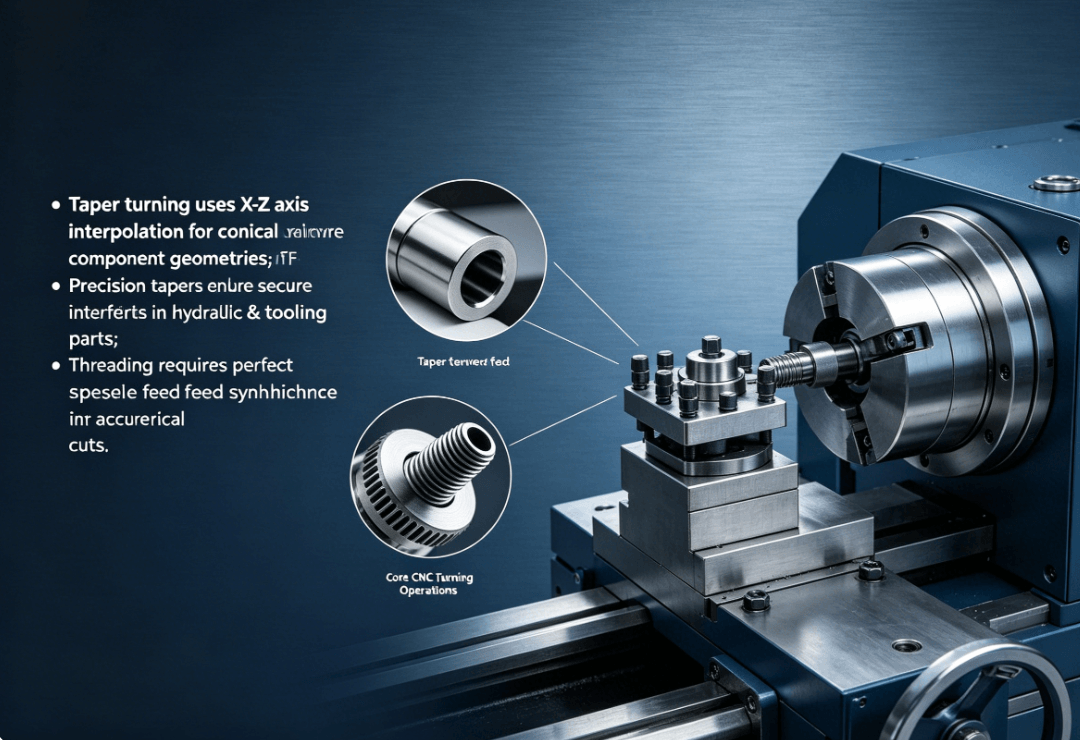
Taper turning creates a gradual reduction in diameter along the length of the part, resulting in a conical shape. In CNC machines, this is achieved through linear interpolation, where the X and Z axes move simultaneously at a calculated ratio.
Where are Tapers Applied in Industry?
Tapers are vital for components like Morse taper tool holders or conical valves used in hydraulic systems. The precision of the taper angle is critical for "interference fits," where two parts must wedge together securely without the need for mechanical fasteners.
Threading and Helical Cutting
Threading is perhaps the most complex common turning operation. It requires the tool to move longitudinally in perfect synchronization with the spindle's rotation. This ensures that the tool enters the exact same groove on every pass.
What is Single-Point Threading Logic?
Unlike using a manual die, CNC single-point threading allows for the creation of custom pitches, multi-start threads, and tapered threads (like NPT). The CNC controller uses a G76 or G32 cycle to manage the "lead" of the thread.
- The tool must follow a precise helical path.
- Multiple passes are required to reach the full thread depth.
- Tool geometry must match the thread form (e.g., 60 degrees for Metric/Unified threads).
Grooving and Parting Operations
Grooving creates a narrow cutout on the surface, while parting (or cut-off) is the final operation used to sever the finished part from the remaining bar stock.
How are O-Ring Seats Machined?
Internal and external grooving are frequently used to create seats for O-rings or snap-rings. Face grooving requires a specialized curved tool to clear the arc of the groove as it enters the flat face of the part.
What is the Physics of Parting Off?
Parting is a high-pressure operation. Because the parting tool is usually very thin to minimize material waste, it is susceptible to vibration (chatter). Constant Surface Speed (CSS) is often used here; as the tool moves toward the center, the spindle RPM increases to maintain a consistent cutting speed, ensuring a clean break-off.
Internal Operations: Boring and Drilling
When the interior of a part requires machining, the process shifts to internal operations. This typically begins with a drilling cycle to create a starting hole, followed by boring.
What is the Role of Boring in Precision Manufacturing?
Boring is used to enlarge an existing hole and, more importantly, to correct its concentricity and diameter. While a drill can "walk" or drift off-center, a boring bar is a single-point tool that ensures the internal hole is perfectly aligned with the external diameter.
What are the Tooling Constraints in Deep Bores?
The primary constraint in boring is the Length-to-Diameter (L/D) ratio. A long, thin boring bar is prone to deflection and vibration. For bores deeper than 4 times the diameter, specialized carbide-reinforced or vibration-dampened boring bars are required to maintain surface finish.
Comparison of Turning Operation Parameters
The following table outlines the typical objectives and tool paths for the most common operations found in a CNC lathe machine environment.
|
|---|
Material Considerations in Turning Operations
The choice of operation is heavily influenced by the material being machined.
- Aluminum: Allows for extremely high cutting speeds but requires polished rake surfaces on tools to prevent "Built-Up Edge" (BUE).
- Stainless Steel: Known for work-hardening; it requires a constant feed rate and robust cooling to prevent the tool from rubbing and hardening the surface.
- Titanium: Has low thermal conductivity, meaning heat stays at the cutting edge. Turning operations for titanium must prioritize heat dissipation.
Summary
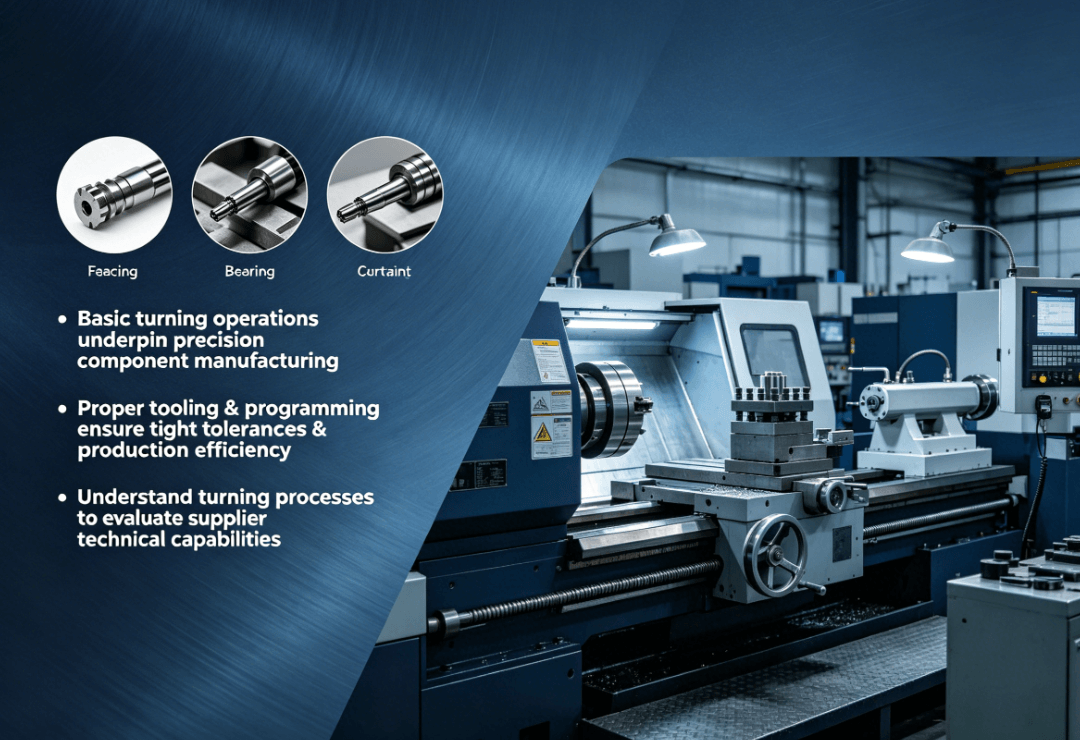
Common turning operations form the foundation of precision component manufacturing. From the initial facing pass to the delicate synchronization of threading, each operation requires specific tooling, strategic programming, and an understanding of material behavior. By selecting the appropriate operation—whether it is boring for concentricity or parting for final separation—manufacturers can ensure that parts meet strict industrial tolerances while maintaining production efficiency. For the B2B buyer and project manager, understanding these processes is key to evaluating a supplier's technical capability and ensuring the quality of the final delivered product.
Reference Sources
ASME - American Society of Mechanical Engineers