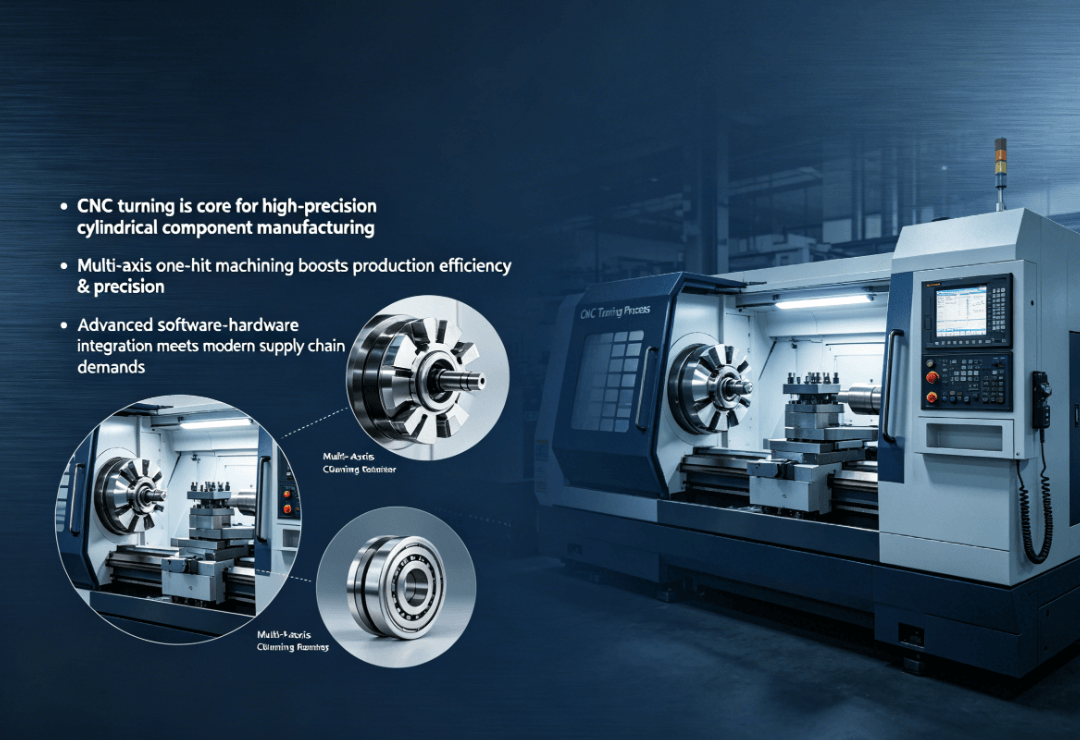
In the high-precision manufacturing landscape of 2026, the CNC turning process stands as a fundamental pillar for producing cylindrical and rotational components. From aerospace fasteners to automotive drive shafts, turning technology has evolved from simple manual lathes into sophisticated multi-axis centers capable of "one-hit" machining. For engineers and procurement professionals, understanding the intricate mechanics of this process is no longer just about knowing how a machine spins; it is about leveraging technical precision to drive commercial value.
As global supply chains demand shorter lead times and higher tolerances, the CNC turning process has integrated advanced software and hardware innovations. This guide provides an expert-level breakdown of the mechanics, the commercial logic of material selection, and the strategic considerations necessary for successful industrial production.
Understanding the Fundamentals of the CNC Turning Process
At its core, CNC turning is a subtractive manufacturing process. While CNC milling involves a rotating tool cutting into a stationary workpiece, turning reverses this logic. In the CNC turning process, the workpiece is held in a chuck and rotated at high speeds while a stationary cutting tool is fed into the material to remove layers and create the desired shape.
This rotational symmetry is the defining characteristic of turned parts. Modern CNC lathes operate on a Cartesian coordinate system, primarily utilizing the X-axis (radial movement) and the Z-axis (longitudinal movement). By 2026, the introduction of Y-axis and C-axis control has allowed lathes to perform off-center operations, effectively blurring the lines between turning and milling.
The Role of G-Code and Digital Twins
In today’s manufacturing environment, the process begins long before the spindle spins. Engineers utilize CAD (Computer-Aided Design) to create 3D models, which are then translated via CAM (Computer-Aided Manufacturing) software into G-code. This code serves as the precise instructional set for the machine's controller.
A significant advancement in 2026 is the widespread use of "Digital Twins." Before a single piece of metal is cut, the entire CNC turning process is simulated in a virtual environment. This allows for:
- Collision detection between the tool turret and the chuck.
- Optimization of toolpaths to reduce cycle time.
- Prediction of tool wear based on material hardness and cutting speed.
Subtractive Logic in Rotational Geometry
The subtractive nature of turning means that material efficiency is a primary commercial concern. Unlike additive manufacturing (3D printing), where material is built up, turning starts with a solid bar or blank. The goal is to reach the final dimensions with the fewest number of passes. This is achieved through a combination of roughing cycles, where heavy cuts remove the bulk of the material, and finishing cycles, where high-speed, light-pressure passes ensure the part meets strict dimensional and surface finish requirements.
Key Components of a Modern CNC Turning Center
To understand how CNC turning works, one must understand the anatomy of the machine itself. A 2026-era turning center is a miracle of rigid engineering and electronic precision.
The Spindle and Workholding Assembly
The spindle is the heart of the lathe, providing the torque and RPM necessary for cutting. It is equipped with a workholding device, typically a chuck or a collet.
- Three-Jaw Chucks: These are the most common, providing a secure grip on round or hexagonal stock.
- Collets: Used for smaller diameter parts where high precision and high RPM are required, offering better concentricity.
- Hydraulic Actuators: In high-volume industrial settings, hydraulic systems ensure consistent clamping pressure, preventing part deformation while maintaining safety during high-speed rotation.
The Tool Turret and Live Tooling
The turret holds the various cutting tools required for a job. In a standard CNC turning process, the turret indexes to bring the correct tool into contact with the workpiece.
One of the most critical developments for commercial efficiency is "Live Tooling." This allows the turret to house small, powered spindles that can drill, tap, or mill features into the part while the main spindle is indexed in a specific position (C-axis control). This eliminates the need for a secondary operation on a milling machine, significantly reducing labor costs and handling errors.
Comparing CNC Turning Operations for Industrial Use
Different geometries require specific cutting strategies. The following table highlights the primary operations performed within a modern CNC turning center and their typical commercial applications.
| Operation | Description | Commercial Use Case |
|---|---|---|
| Facing | Machining a flat surface at the end of the workpiece. | Establishing accurate part length and datum surfaces. |
| Taper Turning | Creating a conical shape by moving the tool at an angle. | Used in nozzles, valve needles, and tapered pins. |
| Threading | Cutting internal or external grooves for fasteners. | Critical for assembly components and fluid connectors. |
| Grooving | Cutting a specific channel into the workpiece. | Essential for O-rings, retaining rings, and oil seals. |
| Boring | Enlarging or finishing an existing internal hole. | High-precision internal diameters for bearing housings. |
| Knurling | Pressing a pattern onto the surface for grip. | Standard for hand tools, adjustment knobs, and handles. |
Material Selection and Its Impact on Commercial Outcomes
The choice of material is perhaps the most significant driver of cost in the CNC turning process. Machinability—a measure of how easily a material can be cut—directly affects cycle time, tool life, and surface quality.
Metal Alloys: Aluminum, Steel, and Titanium
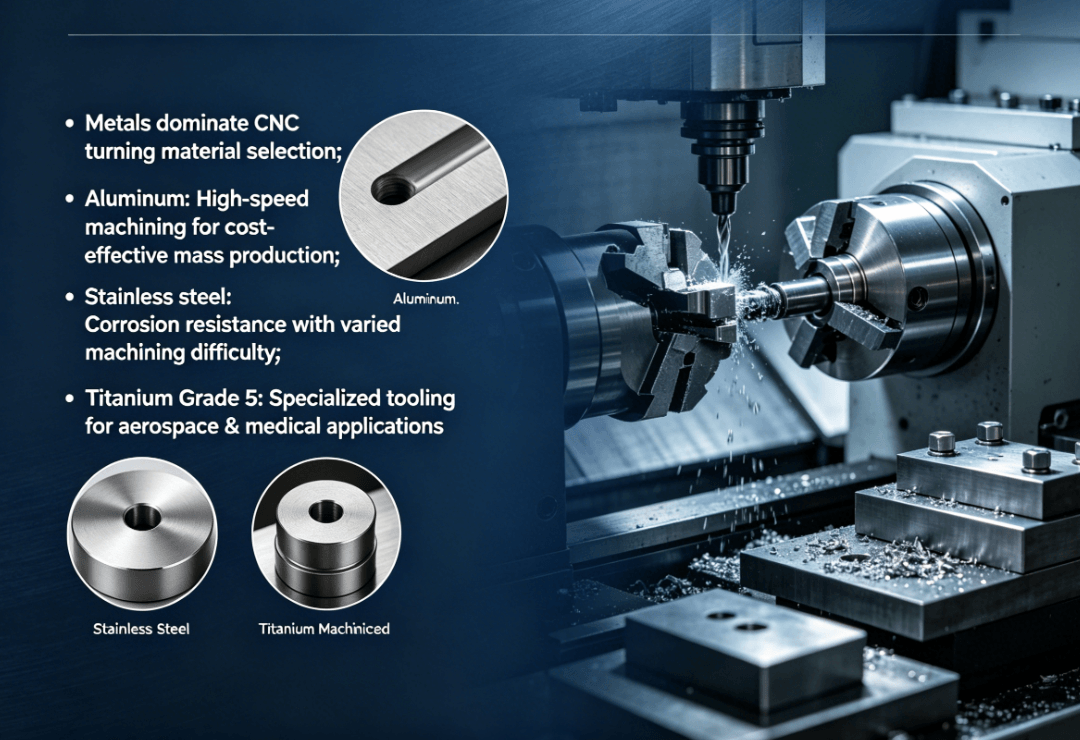
In the industrial sector, metals remain the dominant choice for turned parts.
- Aluminum (6061/7075): Renowned for its excellent machinability and high strength-to-weight ratio. It allows for high spindle speeds, which lowers the cost per part in high-volume runs.
- Stainless Steel (303/304/316): While 303 is "free-machining," 316 offers superior corrosion resistance but requires slower speeds and specialized cooling, leading to higher unit costs.
- Titanium Grade 5: Frequently used in aerospace and medical sectors. Its low thermal conductivity means heat stays at the cutting edge, requiring expensive carbide or ceramic tooling and high-pressure coolant systems.
Engineering Plastics and High-Performance Polymers
As we move through 2026, plastics like PEEK, Delrin (POM), and PTFE are increasingly turned for their chemical resistance and insulating properties.
- Dimensional Stability: Some plastics absorb moisture or expand significantly with heat, requiring the machinist to adjust tolerances during the CNC turning process.
- Burr Management: Unlike metals, plastics can "smear" or create flexible burrs that are difficult to remove, often requiring specialized tool geometries.
Strategic Cost Drivers in CNC Turning Procurement
For procurement managers and OEM project leads, the "price per part" is a complex calculation of machine time, material waste, and setup complexity.
Design for Manufacturability (DFM) Tips
Optimizing a design for the CNC turning process can result in 20-40% cost savings.
- Minimize Internal Sharp Corners: Boring bars have a nose radius; designing internal corners with a matching or larger radius allows for faster, single-pass machining.
- Reduce Part Complexity: Features that require live tooling or Y-axis movement increase the machine's hourly rate. If a feature is not functional, removing it can simplify the setup.
- Standardize Tolerances: While a CNC lathe can achieve ±0.005mm, requiring this level of precision on a non-critical dimension unnecessarily increases the scrap rate and inspection time.
Cycle Time vs. Precision Requirements
The "Commercial" search intent often centers on balancing quality with speed. In high-volume production, a 5-second reduction in cycle time per part can save thousands of dollars over a production year. This is achieved by:
- Utilizing high-feed milling tools on the turret.
- Implementing bar feeders for continuous, unattended "lights-out" manufacturing.
- Selecting "free-machining" grades of raw materials wherever application-appropriate.
Future Trends: CNC Turning in 2026 and Beyond
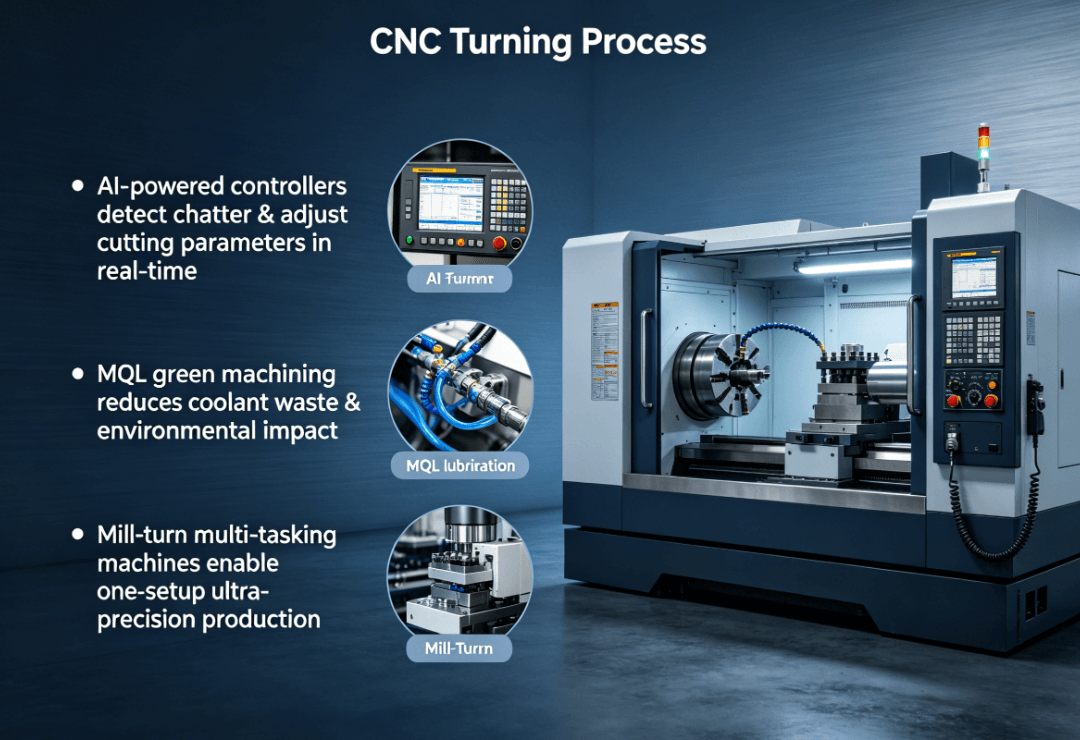
The evolution of the CNC turning process is currently focused on autonomy and sustainability. We are seeing the rise of AI-integrated controllers that can "hear" tool chatter before it ruins a part, automatically adjusting the feed rate in real-time. Additionally, the shift toward "Green Machining" has led to the development of MQL (Minimum Quantity Lubrication) systems, which reduce the environmental impact and cost of traditional flood coolants.
As multi-tasking machines (Mill-Turn) become the industry standard, the distinction between different machining disciplines continues to fade. The ability to complete a complex part in a single setup is the ultimate goal for 2026 manufacturing, ensuring the highest level of concentricity and precision for global industrial applications.
Summary
The CNC turning process is a sophisticated blend of mechanical force and digital intelligence. By rotating the workpiece against a precision-controlled tool, manufacturers can produce highly accurate, symmetrical parts with exceptional efficiency. For the commercial buyer, success lies in understanding how material choice, machine capabilities, and DFM principles intersect to influence the final bottom line. As technology continues to advance, the flexibility and precision of CNC turning will remain vital to the success of modern industrial engineering.
Reference Sources
Standards for CNC machine safety and geometric dimensioning (ISO 230).
Technical resources on subtractive manufacturing and lathe optimization.
Material specifications for industrial alloys used in CNC machining.