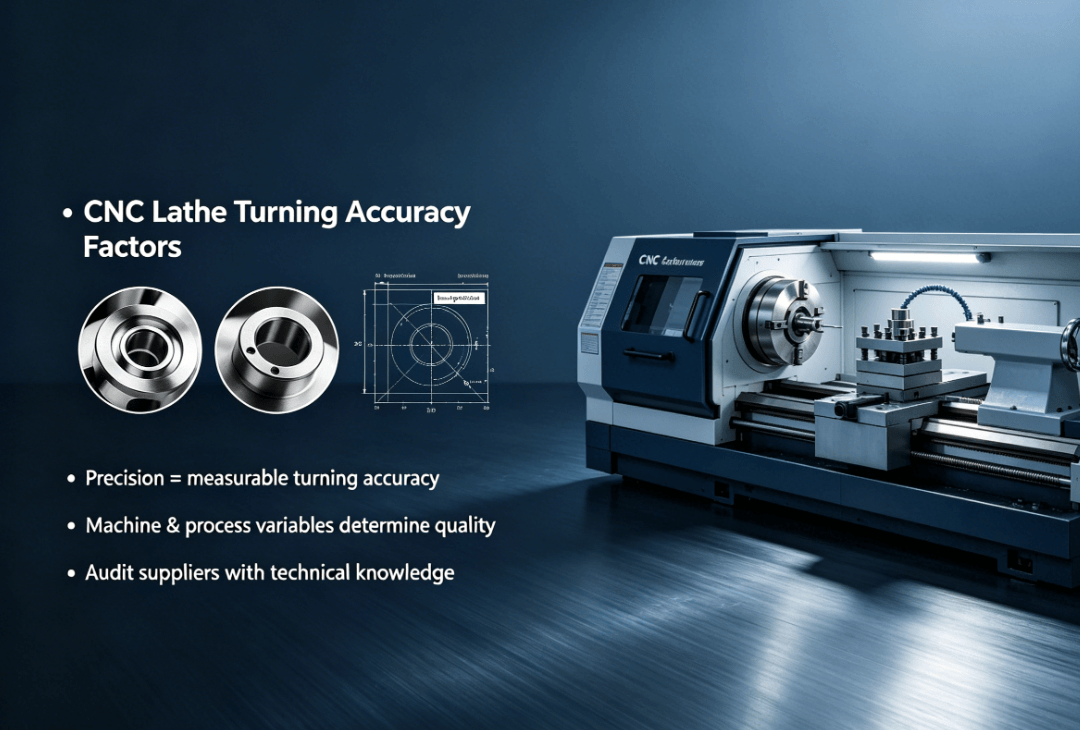
In the landscape of global manufacturing, "precision" is often used as a marketing buzzword. However, for procurement officers and brand owners sourcing machined components, turning accuracy is a quantifiable technical requirement that directly impacts assembly, product longevity, and brand reputation.
Turning accuracy in CNC (Computer Numerical Control) machining is the degree of conformity between the actual dimensions of a finished part and its design specifications. Achieving high-level CNC lathe precision is not merely a matter of owning an expensive machine; it is the result of managing a complex ecosystem of mechanical, environmental, and process-related variables.
This guide breaks down the critical factors affecting turning accuracy to empower buyers with the technical literacy needed to audit suppliers and manage quality expectations in 2026.
1. Geometric Accuracy of the Machine Tool
The foundational factor of turning accuracy is the inherent "geometric health" of the CNC lathe itself. If the machine's skeleton is out of alignment, the parts it produces will invariably carry those errors.
- Spindle Runout: This refers to the deviation of the spindle from its ideal axis of rotation. Both radial and axial runout will cause roundness errors and surface finish issues. For high-precision sourcing (tolerances below ±0.005mm), buyers should inquire about the spindle's TIR (Total Indicator Reading).
- Guideway Parallelism: The carriage must move perfectly parallel to the spindle axis. Any deviation results in "tapering," where a cylindrical part ends up with a different diameter at each end.
- Positioning Accuracy: This is the machine's ability to move the cutting tool to a specific coordinate. Over time, ball screws can wear down, leading to "backlash"—a lost motion when the tool reverses direction, which is a primary cause of dimensional inconsistency.
2. Thermal Deformation: The Invisible Precision Killer
Perhaps the most overlooked factor in high-volume procurement is thermal stability. As a CNC lathe operates, internal friction in motors, bearings, and hydraulic systems generates heat.
- Expansion of Components: Heat causes the machine's metal components to expand. A spindle can grow several microns in length over a four-hour shift. If a supplier does not have a "warm-up" protocol or thermal compensation software, parts produced in the morning may differ significantly from parts produced in the afternoon.
- Cutting Heat: The friction between the tool and the workpiece generates intense localized heat. If the cooling system (coolant type, pressure, and aim) is inadequate, the workpiece may expand during cutting and shrink once cooled, leading to undersized dimensions.
Sourcing Tip: How to Audit Thermal Drift?
When auditing a factory, ask how they manage "thermal drift." Leading OEM manufacturers use temperature-controlled workshops or advanced real-time thermal compensation sensors.
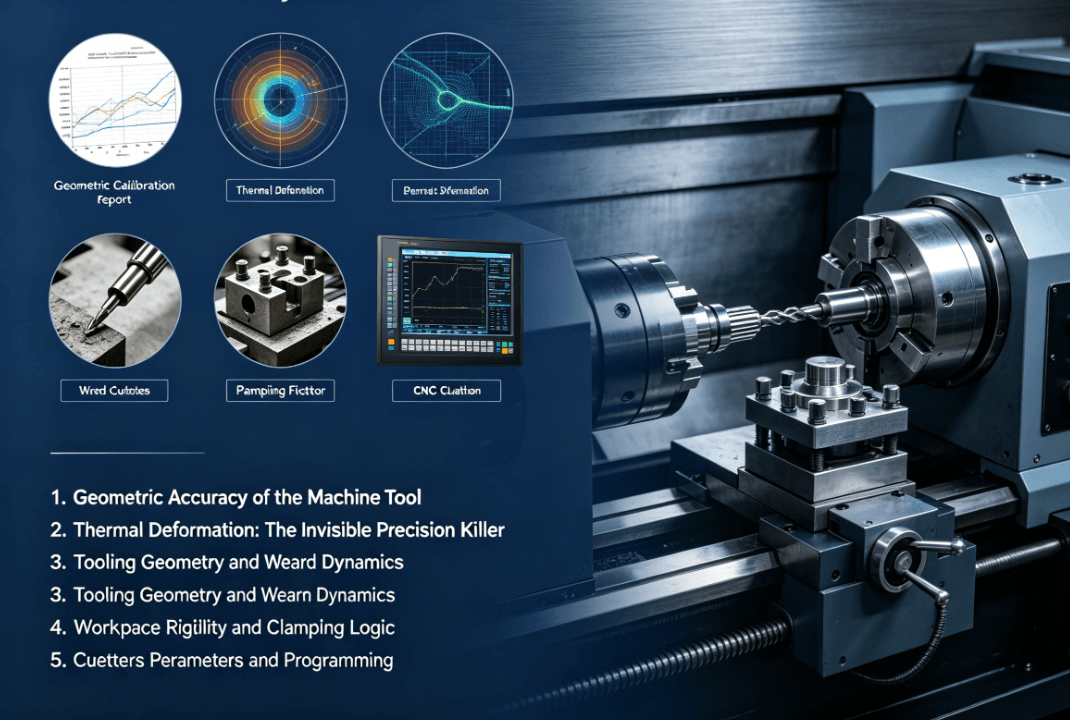
3. Tooling Geometry and Wear Dynamics
The cutting tool is the point of contact where precision is realized. CNC lathe precision is highly sensitive to the condition and selection of the cutting bit.
- Tool Nose Radius: A larger radius can improve surface finish but increases radial cutting forces, which can lead to "chatter" or deflection on slender parts.
- Rake and Clearance Angles: These angles determine how easily the tool "bites" into the material. Incorrect angles lead to excessive cutting force and heat.
- Tool Wear: As the edge dulls, cutting forces increase. High-quality suppliers use "Tool Life Management" systems to automatically swap tools or adjust offsets before the wear affects part tolerance.
4. Workpiece Rigidity and Clamping Logic
Even the most precise machine cannot produce an accurate part if the workpiece is vibrating or deforming under pressure.
- The Slenderness Ratio: Long, thin parts are prone to bending away from the tool (deflection). In these scenarios, the use of a "Steady Rest" or "Follower Rest" is mandatory for maintaining diameter consistency.
- Clamping Force: Over-tightening a hydraulic chuck can deform thin-walled parts. Once the part is released, it "springs back" into an oval shape.
- Material Internal Stress: Cold-rolled or improperly heat-treated metals contain internal stresses. As the outer layers are turned away, these stresses are released, causing the part to warp.
5. Cutting Parameters and Programming
The "recipe" used to cut the metal—speed, feed rate, and depth of cut—determines the stability of the turning process.
- Feed Rate: A feed rate that is too high increases the "scallop height" on the surface, ruining the finish.
- Cutting Speed (SFM): If the speed is too low for the material, "Built-Up Edge" (BUE) occurs, where bits of the workpiece weld themselves to the tool, causing sudden dimensional jumps.
- Depth of Cut: Taking too deep a "roughing" cut in a single pass can deflect the spindle or the tool holder, leaving insufficient material for the "finishing" pass to correct.
Comparison Table: Factors Impacting Turning Accuracy
| Factor Category | Key Variable | Impact on Quality | Procurement Concern |
|---|---|---|---|
| Machine Tool | Spindle Runout | Roundness & Surface Finish | High (Affects all parts) |
| Thermal | Thermal Drift | Dimensional Consistency | Medium (Affects long runs) |
| Tooling | Tool Wear | Tolerance Creep | High (Requires QC monitoring) |
| Workpiece | Rigidity/Deflection | Tapering & Chatter | Critical for slender parts |
| Process | Feed & Speed | Surface Roughness | Low (Easily adjusted) |
The Procurement Reality: How to Verify Precision Capability
For a bulk buyer or a brand owner, you cannot supervise every cut. Instead, you must evaluate the supplier's systems for managing the factors mentioned above.
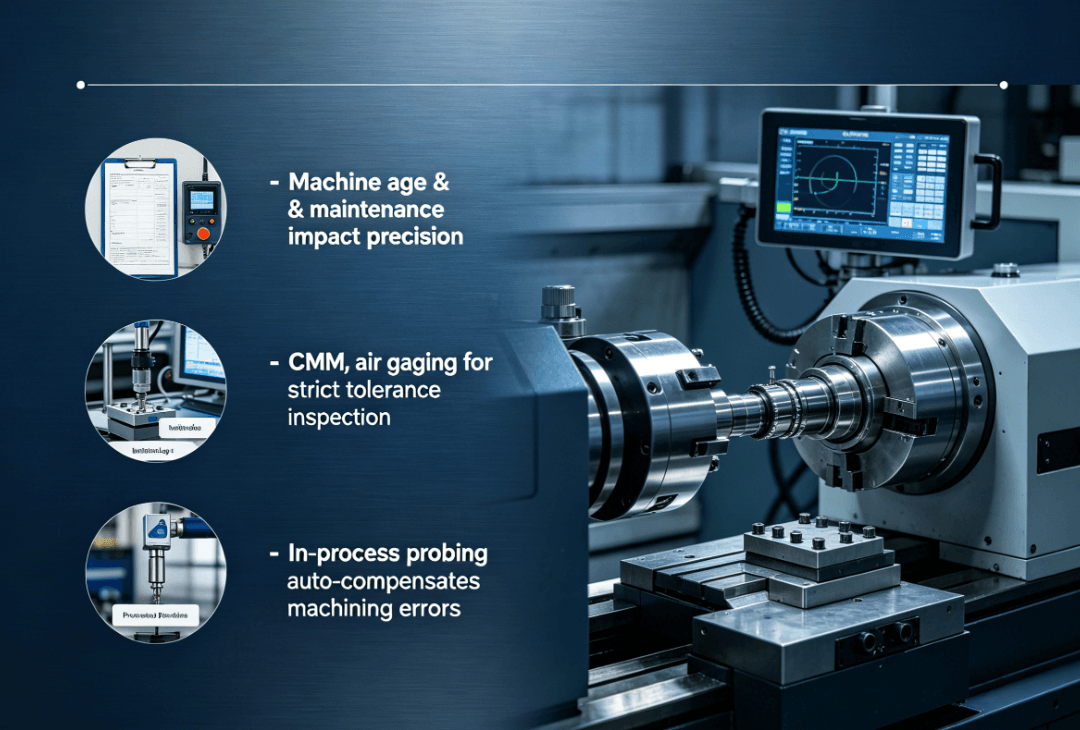
1. Equipment Age and Maintenance Logs
Precision degrades with age. Ask your supplier for their preventative maintenance (PM) schedule. A machine that hasn't had its guideways leveled or ball screws checked in three years is unlikely to hold tight tolerances.
2. Metrology and Inspection
Turning accuracy is meaningless if it cannot be measured. A reputable Sourcing Business should look for:
- CMM (Coordinate Measuring Machines): For complex geometries.
- Air Gaging: For extremely tight diameter tolerances.
- Surface Profilometers: To quantify Ra/Rz surface finish values.
3. Operator Skill vs. Automation
In 2026, the best factories combine skilled machinists with automated monitoring. Look for "In-process probing," where the lathe uses a touch-probe to measure the part while it's still in the chuck, automatically adjusting offsets to compensate for tool wear or thermal expansion.
Summary
Turning accuracy is a multi-dimensional challenge. For the procurement professional, understanding that CNC lathe precision is influenced by mechanical alignment, thermal management, and tooling logic is the key to moving beyond "price-only" negotiations. When sourcing high-precision components, your focus should be on finding a partner who acknowledges these variables and has established protocols to mitigate them.
Reference Sources
Modern Machine Shop: Managing Thermal Drift in Machining