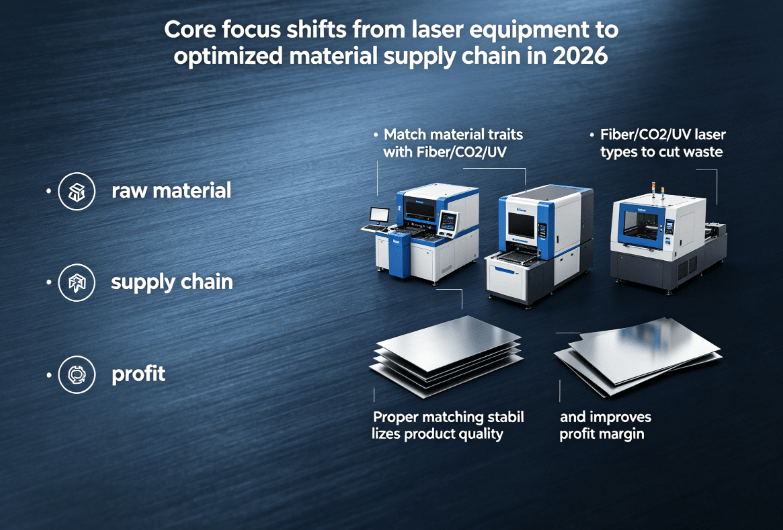
In the rapidly evolving landscape of industrial manufacturing, laser cutting remains a cornerstone technology. However, as we move into 2026, the focus has shifted from merely owning a machine to optimizing the laser materials supply chain. For procurement managers and business owners, understanding the interplay between material properties and laser technology—whether Fiber, CO2, or UV—is critical for reducing waste, ensuring quality, and maintaining healthy margins.
2026 Market Landscape for Laser Materials?
The global supply chain for laser-ready materials has become more specialized. No longer is "standard grade" sufficient for high-precision OEM/ODM projects. Today’s buyers are looking for materials with consistent chemical compositions that respond predictably to high-wattage fiber lasers.
From a procurement perspective, the market is divided into two primary ecosystems:
- Metal Stock Suppliers: Focusing on alloys, thickness tolerances, and surface finishes.
- Specialty Non-Metal Fabricators: Providing polymers, composites, and organic substrates designed for clean-edge finishes and low-fume emission.
Metals: The Backbone of Industrial Laser Cutting?
Metals remain the most sourced category for laser cutting. However, the rise of 30kW+ fiber lasers has changed the "machinability" profile of many traditional alloys.
Carbon Steel (Mild Steel)?
- Sourcing Insight: This is the most common material in bulk procurement. In 2026, buyers should prioritize "laser-grade" carbon steel, which features a specific silicon content to ensure consistent absorption of the laser beam.
- Procurement Tip: Always request Material Test Reports (MTRs) to verify carbon levels. Variations in carbon can lead to "dross" or slag, increasing post-processing costs.
Stainless Steel (304, 316, 430)?
- Sourcing Insight: Widely used in medical, food processing, and aerospace. The focus here is on the protective film. For laser cutting, specify "Laser Film" (typically white or blue) rather than standard PVC film, which can bubble and ruin the cut edge.
- OEM/ODM Considerations: If the part requires high corrosion resistance, 316 is the standard, but lead times for 316 L-grade may be longer due to nickel market fluctuations.
Aluminum and Reflective Alloys?
- The Challenge: Aluminum, Brass, and Copper are "reflective materials." While modern fiber lasers handle these well, they still require higher maintenance on the machine's optical path.
- Sourcing Logic: When sourcing aluminum for laser cutting, 5052 and 6061 grades are preferred for their structural integrity and clean-cut surface.
| Material Type | Preferred Laser Source | Typical Thickness (Sourcing Standard) | Common Industry |
|---|---|---|---|
| Carbon Steel | Fiber | 1mm - 25mm+ | Automotive, Construction |
| Stainless Steel | Fiber | 0.5mm - 20mm | Medical, Food Grade |
| Aluminum | Fiber | 1mm - 12mm | Aerospace, Signage |
| Copper/Brass | Fiber (High Power) | 0.5mm - 8mm | Electrical, Decorative |
Non-Metals: Diversifying the Product Portfolio?
For brands and e-commerce sellers, non-metals offer the most significant opportunity for customization and rapid prototyping.
Acrylic (PMMA)?
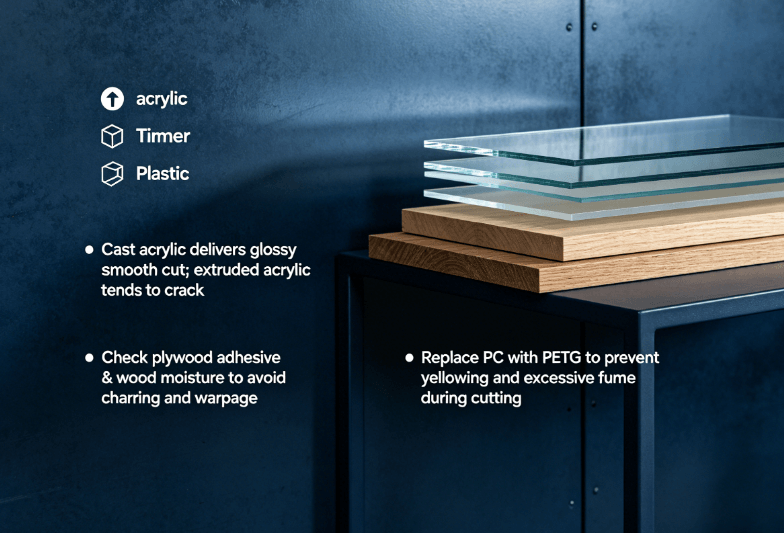
- Procurement Realism: Not all acrylic is equal. Cast acrylic is the gold standard for laser cutting, as it results in a "flame-polished" clear edge. Extruded acrylic is cheaper but can crack or produce a gummy edge.
- Buyer Warning: Ensure your supplier isn't substituting cast acrylic with lower-cost blends if high-end aesthetics are required.
Wood and Organic Substrates?
- Sourcing Ecosystems: Plywood and MDF are staples. However, the glue used in the plywood is what matters for laser cutting. "Laser-safe" plywood uses resins that don't char excessively or catch fire.
- Workflow Check: Verify the moisture content (MC) of the wood. High MC leads to warping and inconsistent cutting depths across a single sheet.
Technical Polymers (Engineering Plastics)?
- Suitability: POM (Delrin), ABS, and Polycarbonate.
- Risk Mitigation: Polycarbonate, while cuttable, often yellows and produces heavy smoke. Many procurement agents now steer buyers toward high-impact PETG as a cleaner-cutting alternative for clear components.
Materials to Avoid: The "No-Go" List in Procurement?
A critical part of supplier evaluation is knowing what not to cut. Cutting the wrong materials can void machine warranties and create toxic work environments.
- PVC (Polyvinyl Chloride): Releases chlorine gas. This is not just a health hazard; it chemically corrodes the motion system and optics of a $100,000 laser machine in a matter of hours.
- PTFE (Teflon): Releases toxic fumes.
- Carbon Fiber (Coated): While some can be cut, the resins often catch fire or produce hazardous dust that requires specialized filtration.
Supplier Evaluation Logic for Laser Materials?
When onboarding a new material supplier, use this 4-point verification framework:
I. Dimensional Tolerance and Consistency?
Does the 2.0mm sheet actually measure 2.0mm across the entire batch? For high-speed laser nesting, a 0.2mm variance can cause the laser head to crash or the focus to drift, leading to scrap.
II. Surface Quality and Treatment?
For metals, check for "mill scale" or heavy oil. For plastics, check for scratches under the protective masking. In the B2B world, surface defects are the #1 cause of rejected lots in the signage and architectural sectors.
III. Certification and Compliance?
In 2026, "Green Procurement" is a major trend. Buyers should look for:
- RoHS/REACH Compliance: Especially for electronics components.
- FSC Certification: For wood products to meet ESG (Environmental, Social, and Governance) targets.
IV. Logistics and Packaging?
Laser materials, especially thin-gauge metals and polished acrylics, are prone to transit damage. Evaluate the supplier’s palletizing methods. Are they using edge protectors? Is the material moisture-sealed for sea freight?
Sourcing Workflow: From RFQ to Quality Inspection?
To ensure successful procurement of laser materials, follow this structured workflow:
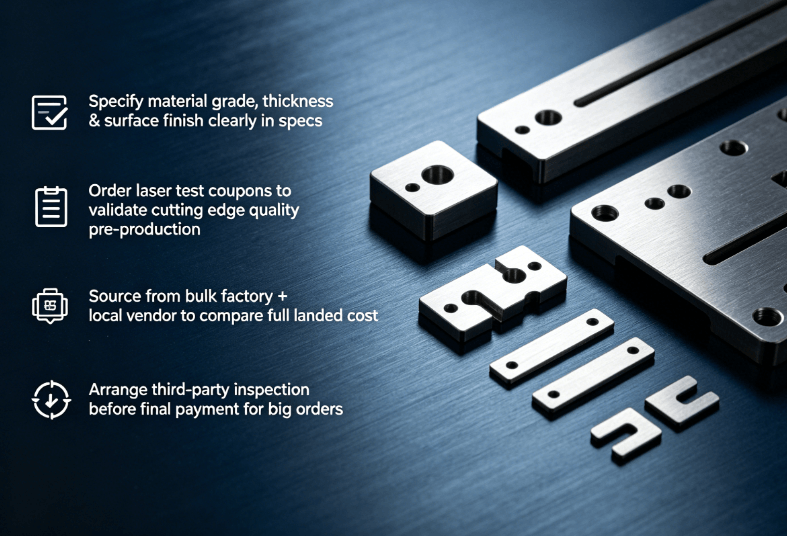
- Requirement Definition: Define the exact alloy/grade, thickness, and finish. Do not leave this to the supplier's discretion.
- Sample Validation: Request a "Laser Test Coupon." This is a small sample cut using your specific machine settings (or the supplier's) to verify edge quality.
- Tiered RFQ: Send RFQs to a specialized manufacturer (for bulk) and a local distributor (for JIT - Just In Time delivery) to compare total landed costs.
- On-Site or Third-Party Inspection: For large-scale imports, use an inspection service to check for surface oxidation and flatness before the balance payment is made.
Summary
As we look toward the remainder of 2026, AI-integrated laser machines are becoming common. These machines use sensors to detect material density and adjust power in real-time. This technology makes material consistency more important than ever. If you source low-quality, inconsistent materials, the AI will constantly throttle the machine speed, negating the efficiency gains of your hardware investment.
Reference Sources
Official laser safety standards and ILDA technical guides.
Global steel market reports and industrial procurement data.
International standards for material quality and management.