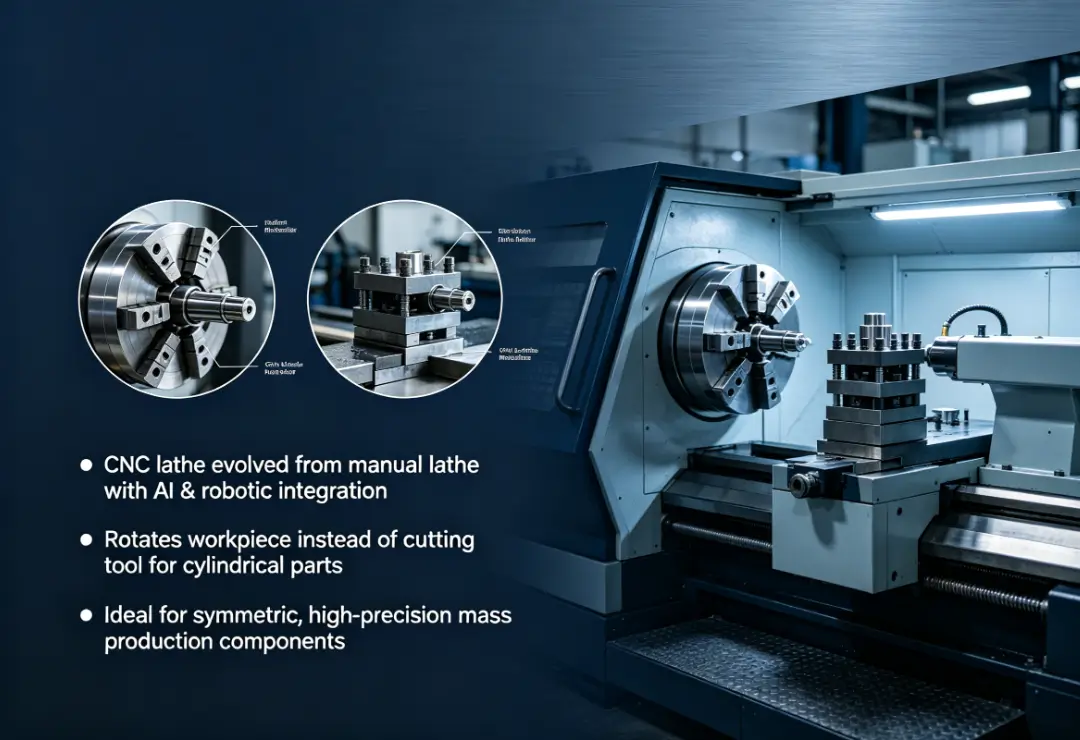
The CNC (Computer Numerical Control) lathe machine is the fundamental evolution of the traditional manual lathe, a tool that has been used for centuries to shape materials. In 2026, the CNC lathe has moved beyond simple turning, integrating advanced robotics and AI-driven sensors to become a high-precision turning center. It is primarily used for creating cylindrical or rotational parts with extreme accuracy and repeatability.
Unlike a milling machine where the tool rotates, a lathe rotates the material itself. This core mechanical difference defines its utility in the manufacturing funnel. For project managers and engineers, selecting a CNC lathe is often a decision based on the required symmetry, surface finish, and volume of the production run.
Understanding the Core Logic of CNC Turning
The primary function of a CNC lathe is "Turning." This is a subtractive manufacturing process where a bar of raw material—whether metal, plastic, or composite—is held in a chuck and rotated. As the material spins at high speeds, a stationary cutting tool is brought into contact with it to remove material and create the desired shape.
Because the process relies on rotation, CNC lathes are the go-to solution for parts that are symmetrical about a central axis. This includes everything from simple bolts and shafts to complex aerospace components. The "CNC" designation means that every movement is controlled by a computer, interpreting digital designs (CAD/CAM) into G-code instructions that drive the machine’s servo motors.
Key Components of a Modern CNC Lathe
To appreciate the precision of a CNC lathe, one must understand its anatomy. Modern machines are designed for rigidity, as even the slightest vibration can ruin the surface finish of a high-tolerance part.
The Machine Bed and Damping Properties
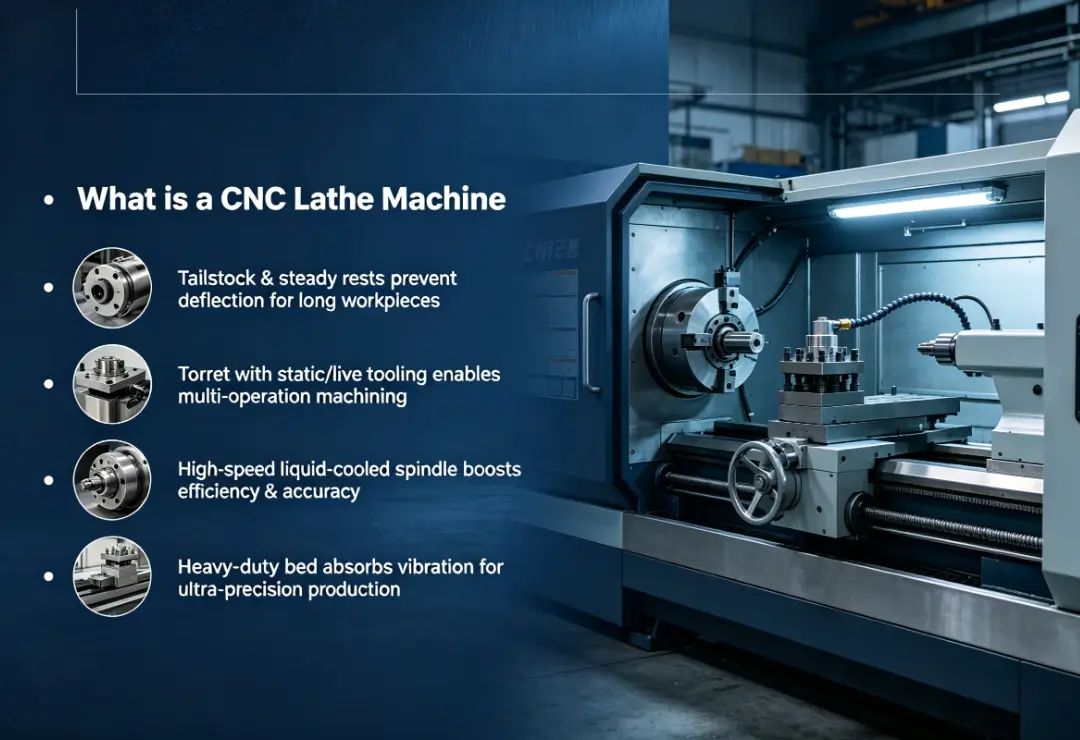
The bed is the foundation upon which all other components are mounted. In high-performance 2026 models, beds are often constructed from heavy-duty cast iron or specialized mineral casting. This provides the necessary damping properties to absorb the harmonics and vibrations generated by high-speed rotation. A stable bed is essential for maintaining sub-micron tolerances over long production cycles.
The Headstock and Spindle Assembly
The headstock houses the main spindle, which is the heart of the lathe. The spindle is driven by a high-torque motor and is responsible for holding and rotating the workpiece. Modern spindles often feature "built-in" motor designs that allow for faster acceleration and deceleration, significantly reducing cycle times. Additionally, liquid cooling is now common in the headstock to manage thermal expansion, ensuring that the machine's accuracy does not drift as it warms up.
The Turret and Tooling Logic
The turret is where the cutting tools are mounted. In a CNC environment, the turret can index (rotate) automatically to bring a new tool into position in a matter of milliseconds. We distinguish between "Static Tooling," which is used for basic turning, and "Live Tooling," which allows the turret to host powered tools like drills or small mills. This enables the machine to perform auxiliary operations like cross-drilling or slotting without transferring the part to another machine.
The Tailstock and Steady Rest
For longer parts, such as drive shafts, the tailstock provides critical support at the end of the workpiece. Without this support, the material would deflect or "whip" under the pressure of the cutting tool. Steady rests are also used in the middle of long parts to prevent sagging and ensure the diameter remains consistent throughout the entire length.
Classifying CNC Lathes by Axis and Configuration
Not all CNC lathes are built for the same tasks. The complexity of the part often dictates the number of axes required on the machine.
The Standard 2-Axis CNC Lathe
The most common configuration is the 2-axis lathe. It operates on the X-axis (diameter) and the Z-axis (length). These machines are ideal for straightforward turning, facing, and boring. They are the workhorses of the automotive and fastener industries due to their high speed and lower operating costs compared to multi-axis centers.
Multi-Axis Turning Centers
As part complexity increases, manufacturers turn to 3-axis, 4-axis, or even 5-axis lathes. A 3-axis machine typically adds a C-axis, which allows for precise rotation of the spindle for indexing. A 4-axis machine might add a Y-axis to the turret, allowing for off-center milling operations. These machines are often called "Turn-Mill" centers because they combine the capabilities of both a lathe and a milling machine.
Horizontal vs. Vertical CNC Lathes
The orientation of the spindle determines the machine's classification. Horizontal lathes are the industry standard for most parts. However, for extremely large, heavy, or short parts, a Vertical Turret Lathe (VTL) is used. In a VTL, the spindle stands upright like a pottery wheel, using gravity to help seat the massive workpiece into the chuck.
Comparison of CNC Lathe Types
| Lathe Type | Spindle Orientation | Primary Advantage | Best Application |
|---|---|---|---|
| Horizontal Lathe | Horizontal | Versatility & Speed | General shafts, bushings, bolts |
| Vertical Lathe (VTL) | Vertical | Weight capacity | Large engine rings, heavy wheels |
| Swiss‑Type Lathe | Horizontal | Extreme Precision | Medical screws, micro‑electronics |
| Multi‑Spindle Lathe | Multiple | Mass Production | High‑volume automotive parts |
The CNC Lathe Operating Workflow
Operating a CNC lathe in 2026 involves a sophisticated digital-to-physical workflow. It starts with the creation of a 3D model in CAD software. This model is then processed through CAM (Computer-Aided Manufacturing) software, which generates the toolpaths.
Once the G-code is uploaded to the machine's controller, the setup phase begins. This involves mounting the correct cutting inserts into the turret, setting "tool offsets" to tell the computer exactly where the tip of each tool is, and securing the raw material in the chuck. During the run, the machine uses a "Closed-Loop" feedback system, where sensors constantly communicate with the controller to adjust for tool wear or material resistance in real-time.
Industrial Applications and Material Compatibility
The versatility of the CNC lathe makes it indispensable across multiple sectors. Its ability to work with almost any rigid material—from aerospace-grade Titanium to high-performance polymers like PEEK—is a key factor in its dominance.
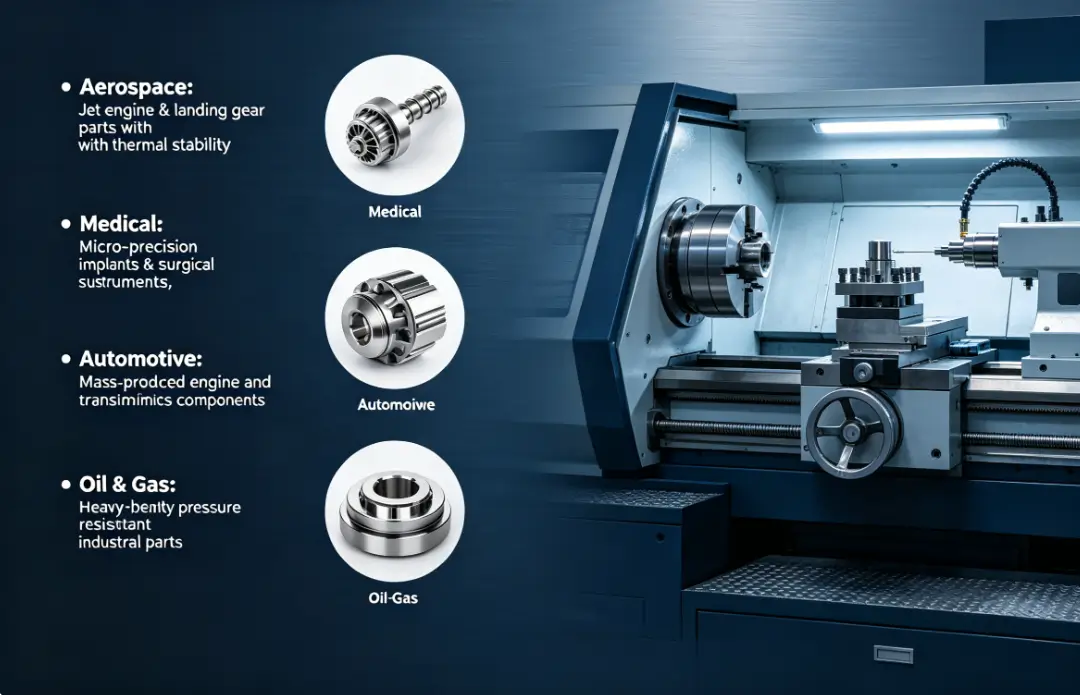
- Aerospace: Production of jet engine components, fasteners, and landing gear parts where thermal stability is critical.
- Medical: Manufacturing of bone screws, dental implants, and surgical instruments using Swiss-type lathes for micro-accuracy.
- Automotive: High-volume production of pistons, cylinders, crankshafts, and transmission components.
- Oil & Gas: Crafting heavy-duty valves, couplings, and drill bits that must withstand extreme pressures.
Summary
In summary, the CNC lathe machine is a powerhouse of rotational manufacturing. By spinning the workpiece and utilizing computer-controlled tool movements, it achieves a level of precision and efficiency that manual processes cannot replicate. From the foundational stability of the bed to the complex logic of multi-axis turrets, every component is engineered to maximize throughput and minimize error. As we look further into 2026, the integration of real-time monitoring and smart tooling is only making these machines more vital to the global supply chain.
Reference Sources
ISO 23125:2015 - Machine tools Safety - Turning machines