In the rapidly evolving landscape of global manufacturing, the ability to process a vast array of waterjet materials has become a decisive factor for procurement success. As we look toward 2026, supply chain resilience depends on a buyer’s ability to switch between material types without reinvesting in new machinery. Waterjet technology remains the "universal tool" of the factory floor because it uses a non-thermal, high-pressure erosion process.
For procurement managers and sourcing agents, the primary value proposition of waterjet cutting is its "cold-cutting" nature. Unlike laser or plasma cutting, waterjets do not create a Heat Affected Zone (HAZ). This preserves the mechanical properties of the raw material, reducing the need for secondary heat treatments or edge grinding. This guide explores the market categories for these materials and how to navigate the supplier ecosystem effectively.
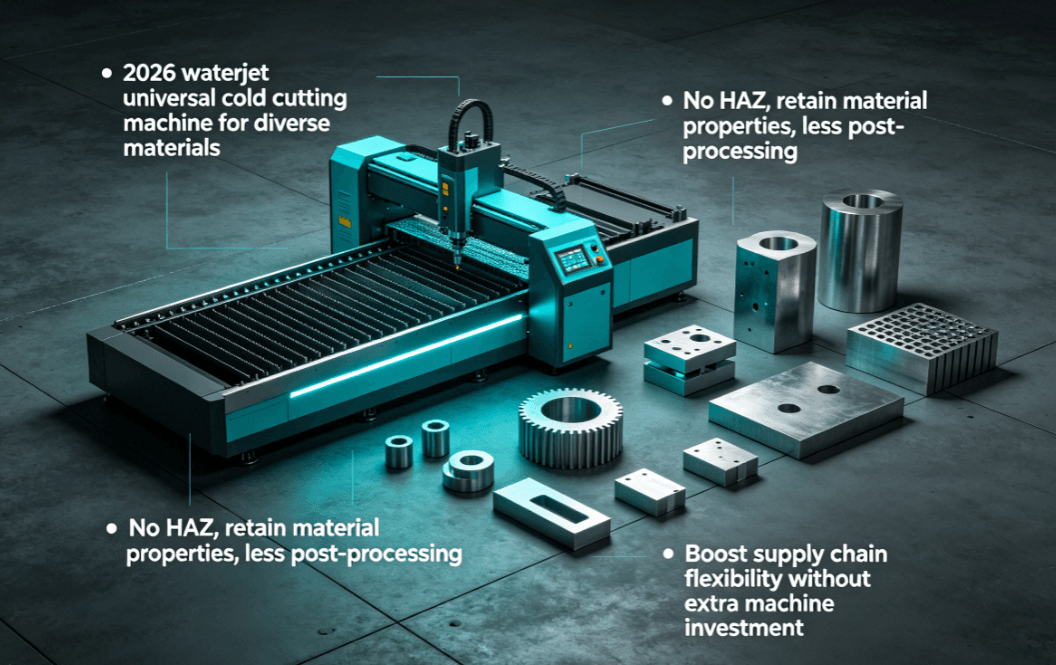
Industrial Metals: The Backbone of Waterjet Procurement
Metals constitute the largest segment of the waterjet materials market. From heavy infrastructure to precision aerospace parts, the versatility of abrasive waterjet cutting allows for the processing of metals that are otherwise difficult to machine.
How does Waterjet Handle Stainless and Carbon Steel?
Steel is the most commonly sourced material in the B2B sector. Waterjets are particularly effective for thick plates where lasers lose efficiency.
- Sourcing Advantage: Suppliers can cut stainless steel up to 150mm thick while maintaining a burr-free edge.
- Cost Logic: Since there is no thermal distortion, parts are "ready-to-weld" immediately after cutting, significantly lowering the total cost of ownership (TCO).
Why is Aluminum Sourcing Easier with Waterjets?
Aluminum is highly reflective and thermally conductive, making it a challenge for many fiber lasers. Waterjets, however, do not rely on light absorption.
- Procurement Insight: Buyers sourcing 6061 or 7075 aluminum for automotive or electronics components prefer waterjet cutting because it avoids the micro-cracking often caused by heat-based methods.
- Lead Time: Because aluminum is a softer metal, waterjet cutting speeds are high, allowing for faster turnaround on high-volume RFQs.
Is Titanium Sourcing Cost-Effective via Waterjet?
Titanium is an expensive, high-performance metal used in medical and aerospace sectors. Material waste in titanium sourcing can destroy a project’s budget.
- Nesting Efficiency: Modern waterjet software allows for ultra-tight nesting (parts placed close together). With a narrow kerf (cut width) of roughly 1mm, buyers can extract more parts from a single expensive titanium sheet compared to traditional milling.
Stone, Glass, and Ceramics: Architectural Sourcing Logic
The architecture and interior design industries rely heavily on waterjet materials for custom inlays and complex decorative elements.
Can Waterjets Handle Large Stone Slabs?
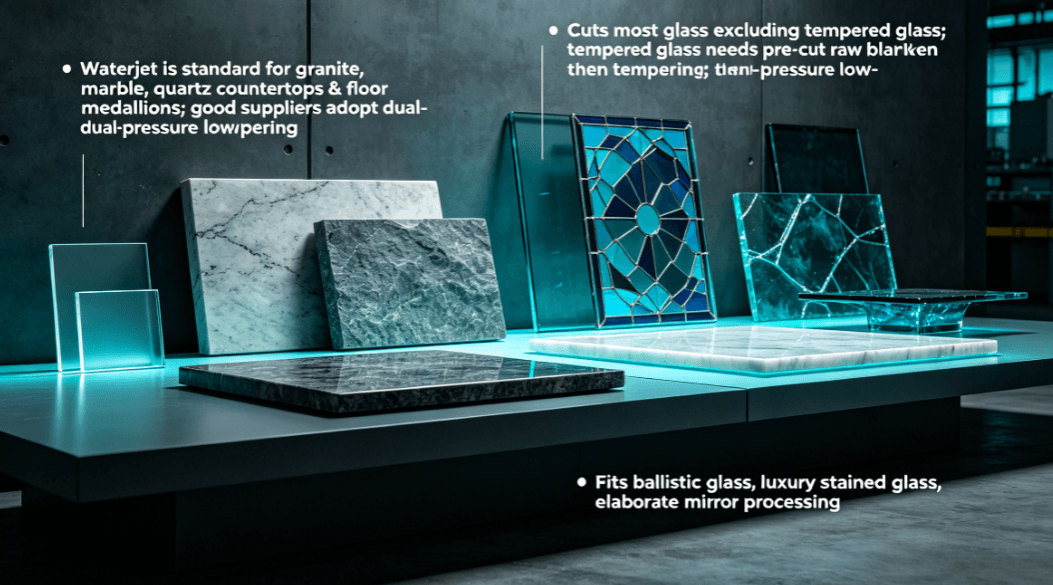
From granite and marble to engineered quartz, waterjets are the industry standard for countertop and floor medallion production.
- Supplier Evaluation: When auditing a stone supplier, check their "low-pressure piercing" capabilities. Fragile stones like marble can crack if the machine starts at full pressure. A high-quality supplier will use a dual-pressure system to gently pierce the stone before ramping up to cutting speed.
What are the Risks When Sourcing Glass Components?
Waterjets can cut almost any type of glass except tempered glass.
- Buyer Alert: Tempered glass is designed to shatter under stress. If your project requires tempered glass, it must be cut to size while in its "raw" state and then sent for tempering afterward.
- Applications: Ideal for sourcing ballistic glass, stained glass for high-end hospitality projects, and intricate mirrors.
Material Compatibility & Sourcing Comparison Table
|
|---|
Advanced Composites and Engineering Plastics
As industries move toward lightweighting, the demand for composite materials has skyrocketed. Waterjet cutting is uniquely suited for these "sensitive" materials.
Why Choose Waterjet for Carbon Fiber Procurement?
Carbon Fiber Reinforced Polymers (CFRP) are sensitive to heat and mechanical vibration. Traditional drilling or sawing often leads to delamination—the separation of the material's layers.
- Procurement Realism: Waterjet cutting applies very little vertical force and zero heat, ensuring the structural integrity of the carbon fiber remains intact. This is critical for sourcing components in the EV (Electric Vehicle) and UAV (Drone) sectors.
Which Plastics Benefit Most from Cold Cutting?
While thin plastics are often laser-cut, thicker engineering plastics like UHMW, Polycarbonate, and Acrylic are better suited for waterjet.
- Sustainability Note: Lasers can produce toxic fumes when cutting certain plastics. Waterjet is a "green" alternative, producing no smoke or hazardous gases, which is increasingly important for ESG (Environmental, Social, and Governance) compliance in 2026.
Soft Materials and High-Volume Gasket Production
For soft materials, the abrasive garnet is removed from the process, using only a supersonic stream of pure water.
- Rubber and Silicone: Used for industrial gaskets and seals.
- Foam and Gaskets: Waterjet suppliers can "stack cut" thin materials. By layering 10 or 20 sheets of foam or rubber, the machine can produce thousands of parts in a fraction of the time, making it ideal for bulk buyers and wholesalers.
Strategic Procurement Workflow for Waterjet Materials
To optimize your sourcing strategy, follow this structured evaluation process for every RFQ.
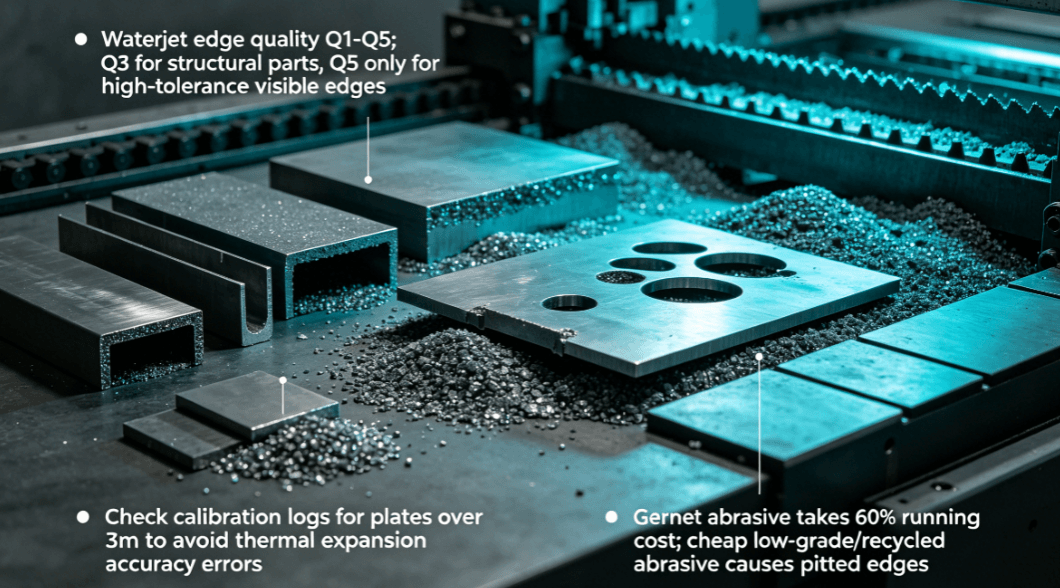
- Define Edge Quality (Q-Levels): Don't overpay for precision. Waterjet quality is rated from Q1 (rough) to Q5 (precise). Specify Q3 for internal structural parts and Q5 only for visible, high-tolerance edges.
- Verify Machine Calibration: For large-format sourcing (plates over 3 meters), ask the supplier for their calibration logs. Thermal expansion of the machine bridge can affect accuracy over long distances.
- Analyze Abrasive Consumption: The cost of garnet abrasive accounts for up to 60% of the operating cost. If a supplier’s price is suspiciously low, they may be using recycled or low-grade abrasive, which can result in a "pitted" edge finish.
Summary
Sourcing waterjet materials in 2026 requires a balance of technical knowledge and commercial transparency. Whether you are procurement for aerospace titanium or architectural marble, the core advantage remains the same: a versatile, cold-cutting process that preserves material integrity and maximizes yield. By understanding the specific needs of different material categories—from metals to composites—buyers can better evaluate supplier capabilities, reduce secondary processing costs, and ensure a high-quality end product.
Reference Sources
Official website of the Waterjet Technology Association (WJTA)
Industry standards for abrasive waterjet material processing
Technical specifications for global waterjet cutting systems