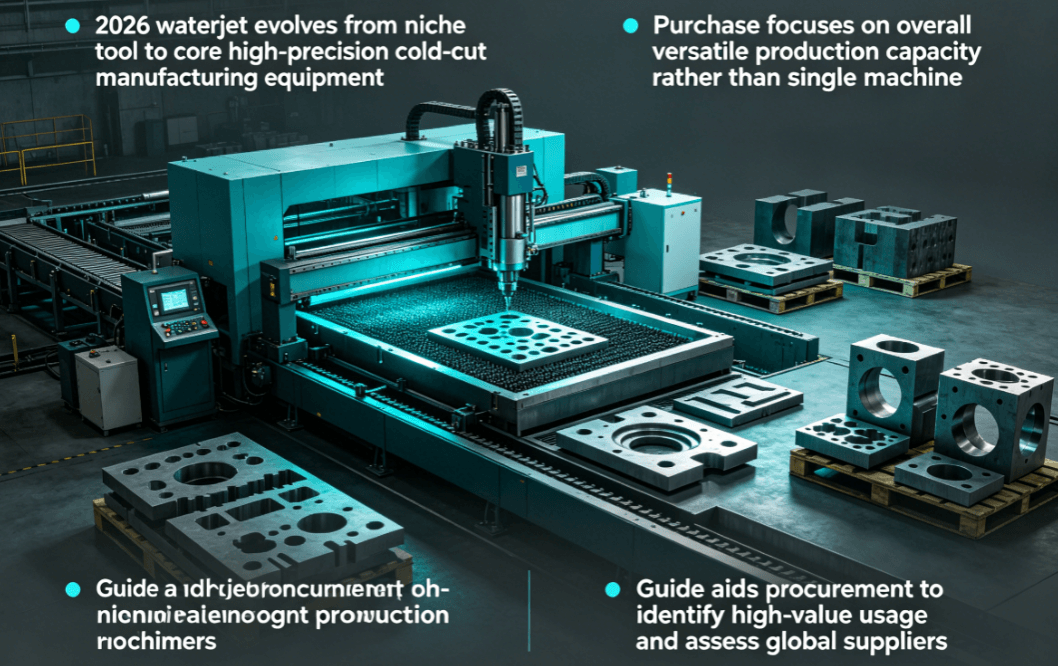
For procurement officers and manufacturing heads, the decision to integrate waterjet cutting technology into a production line is rarely about a single machine; it is about versatile capacity. As we move into 2026, the global waterjet market has shifted from being a niche "specialty tool" to a cornerstone of high-precision, cold-cutting manufacturing.
This guide outlines the critical applications of waterjet machines from a sourcing perspective, helping buyers understand where this technology adds the most value and how to evaluate suppliers within the current global ecosystem.
What Defines the 2026 Waterjet Market?
Before diving into applications, it is essential to understand the current technological landscape. Unlike laser or plasma cutting, waterjet technology utilizes a high-pressure stream of water—often mixed with an abrasive like garnet—to erode material.
From a procurement realism standpoint, the primary draw in 2026 is the absence of a "Heat Affected Zone" (HAZ). As aerospace and EV (Electric Vehicle) manufacturers demand more complex alloys, the ability to cut without altering the material's chemical properties has become a non-negotiable requirement for high-tier suppliers.
Key Terminology for Buyers
- Pure Waterjet: Used for soft materials (foam, rubber, food).
- Abrasive Waterjet: Used for hard materials (metals, stone, glass).
- Intensifier Pump: The traditional high-pressure standard, preferred for ease of maintenance in heavy industrial settings.
- Direct Drive Pump: Gaining popularity in 2026 for its higher energy efficiency and lower noise levels.
Strategic Industrial Applications of Waterjet Machines?
The versatility of waterjet technology allows it to span across drastically different sectors. Understanding these applications helps procurement teams identify whether a specific supplier’s machine is optimized for "high-speed thin cutting" or "heavy-duty thick plate processing."
A. Aerospace and Defense: High-Performance Alloys
In the aerospace sector, waterjet machines are utilized for cutting titanium, Inconel, and various composite materials.
- Sourcing Advantage: Because waterjet cutting does not produce thermal stress, components like engine parts and wing structures do not require extensive secondary finishing to remove heat-damaged edges.
- Buyer Insight: Sourcing managers in this space should look for 5-axis waterjet systems capable of complex 3D geometries.
B. Automotive Industry: From Gaskets to Interior Trim
The automotive supply chain uses waterjets for both metal components and interior materials.
- Interior Components: Pure waterjets are ideal for high-speed cutting of headliners, carpets, and door panels.
- Evolution in 2026: We are seeing an increase in robotic-arm waterjet integration for EV battery housing components, where precision and safety (no spark) are paramount.
C. Architecture and Stone Fabrication
This remains one of the largest segments for bulk buyers and wholesale distributors.
- Applications: Intricate marble floor medallions, granite countertops, and architectural glass.
- Procurement Tip: Buyers catering to the construction industry often prioritize "Table Size" and "Garnet Recovery Systems" to manage the high volume of waste generated during stone cutting.
D. Food Processing: The Sanitary Solution
A lesser-known but vital application is in food manufacturing. Pure waterjets are used to portion meats, slice vegetables, and cut confectionery products.
- Why it Matters: It eliminates the need for blade sharpening and significantly reduces the risk of cross-contamination.
- Compliance Note: For this application, sourcing must focus on stainless steel construction and food-grade components.
The Global Supplier Ecosystem: Where to Source?
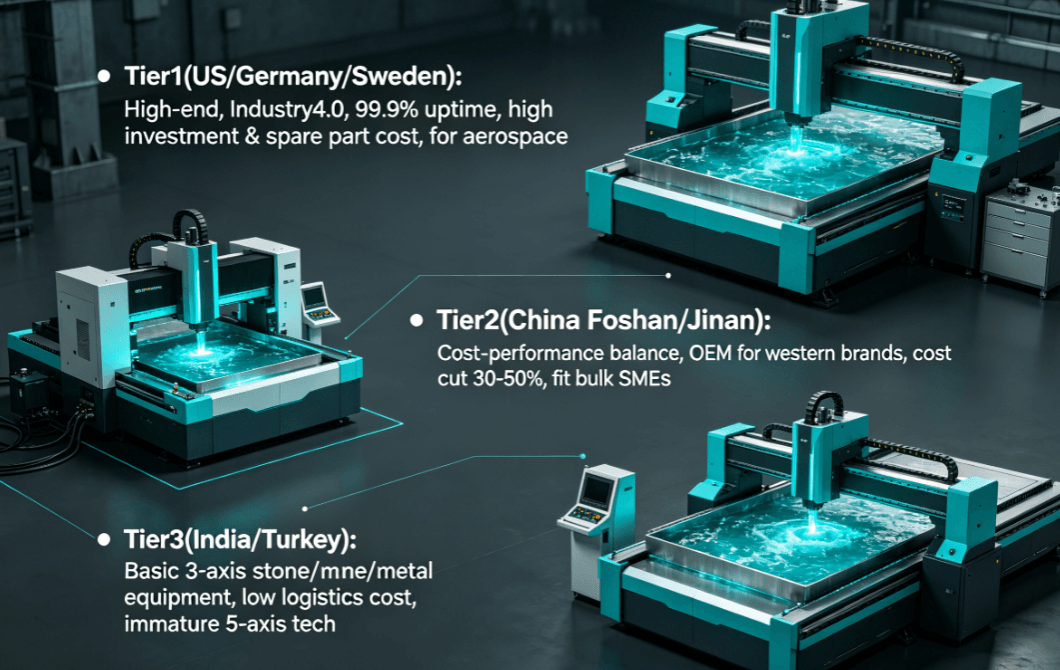
For a global procurement team, knowing where to source is as important as knowing what to source. The 2026 market is characterized by three primary manufacturing clusters.
Tier 1: High-End Innovation
Located primarily in the USA, Germany, and Sweden. This tier is best for brand owners and aerospace contractors who require 99.9% uptime and cutting-edge software integration (Industry 4.0). The main considerations here are the highest CAPEX and expensive proprietary spare parts.
Tier 2: The "Value" Engineering Hub
Centered in China (Foshan & Jinan). Best for bulk buyers and SMEs looking for a balance between performance and cost. Many "Western" brands now OEM their frames and mechanical components from these clusters. Buying directly from top-tier Chinese manufacturers can reduce costs by 30-50%.
Tier 3: Emerging Markets
Sourcing from India or Turkey is best for standard 3-axis machines for stone and basic metal fabrication. This is ideal for local sourcing to save on logistics, though advanced 5-axis technology is still maturing in these regions.
Supplier Evaluation Logic for Procurement Managers
When issuing an RFQ (Request for Quote) for waterjet machines, price should not be the leading metric. Instead, use a Total Cost of Ownership (TCO) model.
| Evaluation Metric | Importance | Why it Matters for Buyers |
|---|---|---|
| Pump Reliability | Critical | The pump is the heart of the machine. Downtime costs more than the machine itself. |
| Software Intuition | High | Can your current operators use it, or is a 6-month training period required? |
| Spare Parts Accessibility | Critical | Check if the nozzles and seals are universal or proprietary. |
| Garnet Consumption Rate | Medium | Abrasive is your highest ongoing OPEX. Efficiency here saves thousands annually. |
| After-Sales Support | High | Does the supplier have local technicians or robust remote AR support? |
2026 Trends: Green Sourcing and Automation?
The 2026 landscape is heavily influenced by sustainability mandates. Procurement teams are increasingly tasked with finding "Green" manufacturing solutions.
- Closed-Loop Water Systems: Modern waterjet machines now often include filtration systems that recycle 90% of the water used.
- Abrasive Recycling: Advanced shops are sourcing machines that can separate used garnet from the sludge, allowing it to be reused up to three times.
- AI-Optimized Nesting: Software now automatically calculates the most efficient way to lay out parts on a sheet, reducing material waste by up to 15%.
Sourcing Workflow: From RFQ to Installation?
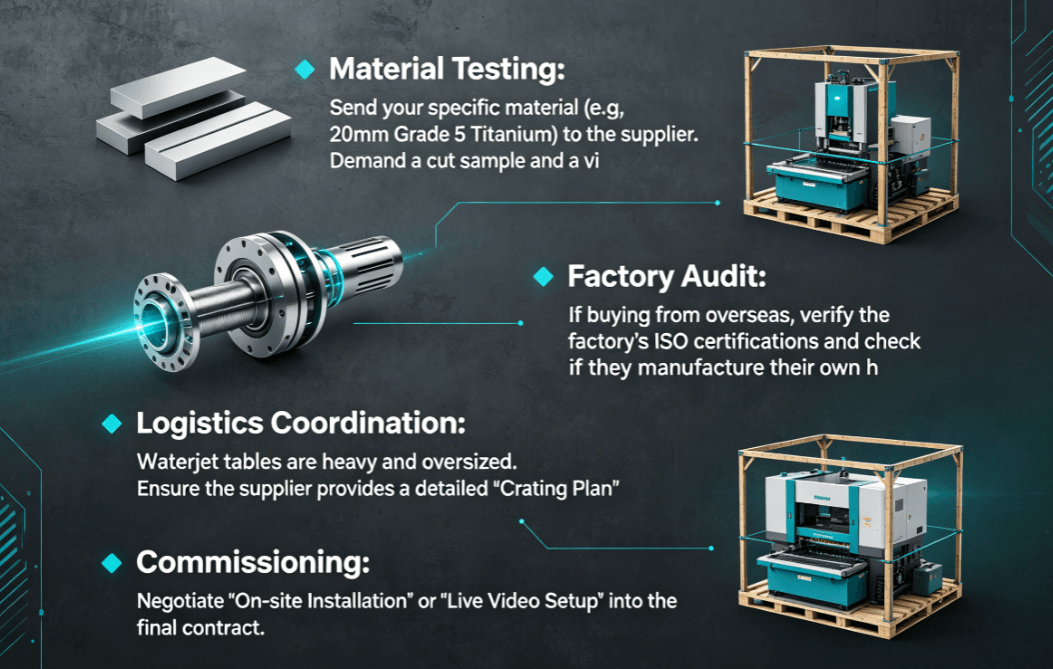
To ensure a smooth procurement cycle, follow this validated workflow:
- Material Testing: Send your specific material (e.g., 20mm Grade 5 Titanium) to the supplier. Demand a cut sample and a video of the cutting speed.
- Factory Audit: If buying from overseas, verify the factory's ISO certifications and check if they manufacture their own high-pressure intensifiers.
- Logistics Coordination: Waterjet tables are heavy and oversized. Ensure the supplier provides a detailed "Crating Plan" to prevent table warping during sea freight.
- Commissioning: Negotiate "On-site Installation" or "Live Video Setup" into the final contract.
Summary
Waterjet applications in 2026 have moved beyond simple cutting. They are now integral to precision engineering, sustainable manufacturing, and complex material processing. For the all-around buyer, the key is matching the machine's technical specs to the specific industry application while maintaining a keen eye on the long-term cost of consumables.
Reference Sources
Flow Waterjet: Global leader in waterjet technology systems.
OMAX Corp: Advanced abrasive waterjet systems for machining.