The global supply chain for stainless steel flatware has entered a new era of specialization. As we move into 2026, the strategy for sourcing cutlery from China has shifted from simple price-hunting to sophisticated "Category Matching." For procurement professionals, the decision is no longer just about finding a factory, but about identifying which industrial cluster and supplier tier aligns with your specific business model—be it high-volume retail, private label e-commerce, or hospitality wholesale.
China remains the dominant force in the cutlery industry, producing over 70% of the world's stainless steel utensils. However, the internal landscape is bifurcated. This guide breaks down the top manufacturing hubs, compares sourcing platforms like 1688 with direct export factories, and provides a realistic workflow for professional buyers.
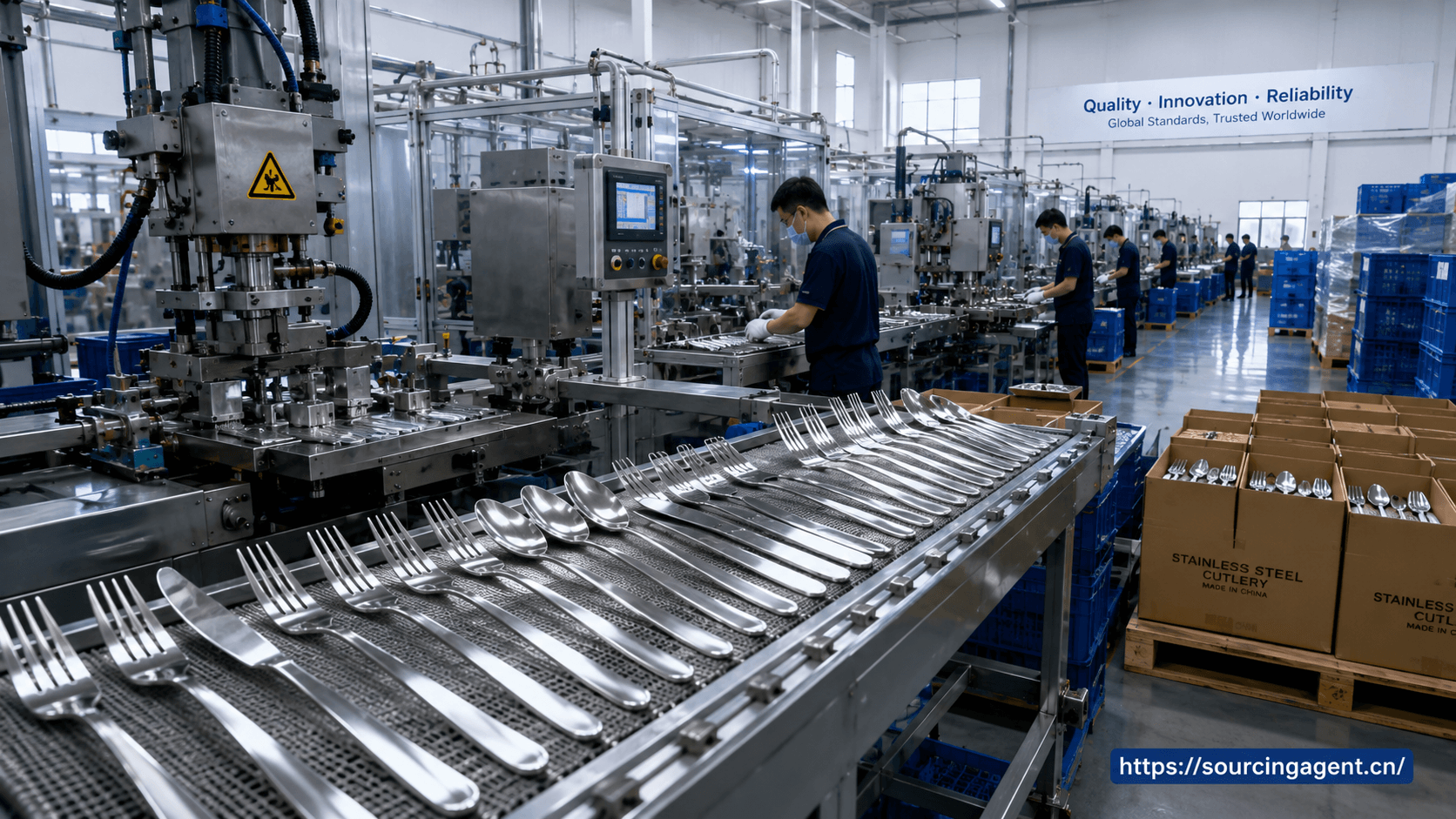
1. The Geography of Excellence: Jieyang vs. Yangjiang
In the world of procurement, geography is destiny. China’s cutlery production is concentrated in two primary hubs, each with a distinct manufacturing DNA.
The Jieyang Cluster: The Stainless Steel Powerhouse
Jieyang is the undisputed capital of stainless steel flatware. If you are looking for spoons, forks, and knives made through stamping and high-speed polishing, this is your destination.
- Specialization: Mass-produced 18/0 (430) and 18/8 (304) stainless steel sets.
- Strengths: Extreme cost-efficiency, massive daily output, and a complete local supply chain for PVD (Physical Vapor Deposition) coating.
- Ideal for: Large-scale wholesalers, supermarkets, and budget-friendly e-commerce brands.
The Yangjiang Cluster: The Hardware and Knife Specialists
While Yangjiang is world-famous for knives, its cutlery manufacturers focus on "Hardware-plus" products.
- Specialization: Multi-material cutlery (wood handles, resin inserts, or forged bolsters) and high-end steak knives.
- Strengths: Superior craftsmanship in forging and handle integration.
- Ideal for: Premium brands, gift set retailers, and high-end hospitality suppliers.
2. Sourcing Channel Comparison: 1688 vs. Direct Export Factories
Understanding where to place your order is as important as the order itself. The following table highlights the procurement realities of 2026.
| Feature | 1688 Source Suppliers | Direct Export-Grade Factories |
|---|---|---|
| Target Buyer | Small-to-Mid Sellers / Amazon FBA | Large Importers / Brand Owners |
| Minimum Order (MOQ) | 50 – 500 units | 1,200 – 3,000 units per style |
| Communication | Domestic-focused (Needs Agent) | Export-ready (English-speaking sales) |
| Quality Control | Varied; relies on in-stock batches | High; customized production runs |
| Lead Time | 3–10 Days (In-stock) | 35–55 Days (Production) |
| Compliance | Often missing FDA/LFGB | Full BSCI, ISO, and Food-Grade Certs |
3. Top Manufacturer Tiers in the China Ecosystem
Tier 1: The Integrated Industrial Giants
These are the "Big Players" often found exhibiting at the Canton Fair. They own the entire workflow, from stainless steel coil processing to final packaging.
- Operational Style: They operate massive, automated facilities. They are the OEM partners for global household names.
- Why Choose Them: Absolute consistency and social compliance (BSCI/SMETA). If your brand requires strict ethical auditing, these are your only options.
- Procurement Note: Expect rigid pricing and high MOQs. They rarely entertain "test orders."
Tier 2: Specialized OEM/ODM Factories
These manufacturers focus on design and trend-following. They are often located in the outskirts of Jieyang and are highly responsive to Western design trends (e.g., matte champagne gold finishes or ultra-minimalist Nordic silhouettes).
- Why Choose Them: They are more flexible than Tier 1 giants but offer better quality than 1688 traders. They are perfect for "Private Label" brands looking for unique molds.
- Sourcing Reality: These factories are the sweet spot for professional sourcing agents.
Tier 3: 1688 "Verified Source" Factories
These are smaller, highly efficient workshops that list their inventory on the 1688 platform.
- Why Choose Them: Speed to market. For an e-commerce seller testing a new "Rose Gold Flatware" trend, these suppliers allow you to buy 200 sets to test the water.
- The Risk: Technical specifications like "weight per piece" and "nickel content" can fluctuate between batches.
4. The Professional Buyer’s Evaluation Logic (EEAT Principles)
When vetting a cutlery manufacturer, skip the generic questions. Use this procurement-focused checklist to identify a high-quality partner.
A. Material Integrity (The 18/10 Fallacy)
Many suppliers claim "18/10" (18% Chrome, 10% Nickel), but deliver 18/0. Nickel is expensive; it provides the corrosion resistance and deep luster.
- Pro Tip: Request a SPECTRO test on the raw material before production begins. For 2026, with fluctuating raw material costs, ensure your contract locks in the grade of steel.
B. Polishing Grades: The "Mirror" Test
The cost of a fork is largely determined by the time spent on the polishing wheel.
- Grade A (Mirror Polish): No visible "polishing lines," smooth between the tines, and a crystal-clear reflection.
- Grade B (Hand Polish): Good shine but may have slight "shadows" on curved surfaces.
- Grade C (Tumble Polish): Used for economy canteen-style cutlery; edges may be slightly rough.
C. Edge and Tine Finishing
Run your finger through the inner edges of the fork tines. A high-quality manufacturer uses a specialized "tine-polishing" machine. If it feels sharp or "burred," it is a low-end product that will lead to customer complaints and potential safety issues.
5. Sourcing Workflow: From RFQ to Shipping
To ensure success in the 2026 market, follow this structured onboarding process:
-
Technical RFQ: Don't just ask for a price. Provide a spec sheet including:
- Weight (e.g., Dinner Knife: 105g)
- Thickness (e.g., 3.0mm)
- Material Grade (e.g., SS304)
- Polishing Requirement (e.g., Mirror Finish)
- Sample Consolidation: Use a sourcing agent to collect samples from 3 different clusters. Compare them side-by-side in natural light.
- The "Rust" Test: Submerge samples in a high-salt water solution for 24–48 hours. This mimics years of dishwasher cycles and reveals the true quality of the stainless steel.
- Pre-Shipment Inspection (PSI): Never ship without a third-party inspection. For cutlery, the AQL (Acceptable Quality Level) should be strict on "pitting" and "scratches."

6. Navigating Logistics in 2026
Cutlery is heavy and high-density. This makes it sensitive to sea freight fluctuations.
- Bulk Buyers: Utilize FCL (Full Container Load) to minimize per-unit landing costs.
- Ecommerce Sellers: If using 1688, consolidate multiple small orders into one LCL (Less than Container Load) shipment to save on "first-mile" costs.
Reference Sources
- Global Sourcing Reports: Quarterly updates on the Guangdong manufacturing corridor.
- LME (London Metal Exchange): For tracking the price of Nickel and Chromium.
- Jieyang Stainless Steel Association: Annual capacity and export data.
- ISO/TC 186 Standard: International standards for cutlery and table holloware.