The global demand for high-quality bakeware continues to rise, driven by the expansion of home baking trends and the professional food service industry. For procurement professionals and brand owners, China remains the primary hub for bakeware manufacturing due to its mature supply chain, material diversity, and unmatched OEM/ODM capabilities.
However, "sourcing from China" is not a singular task. The landscape is divided into specialized clusters—ranging from silicone specialists in Dongguan to carbon steel giants in Ningbo. Navigating this ecosystem requires an understanding of regional strengths, compliance standards (FDA/LFGB), and manufacturer-specific MOQs.
This guide identifies the top bakeware manufacturers in China for 2026 and provides a strategic framework for evaluating your next supply partner.
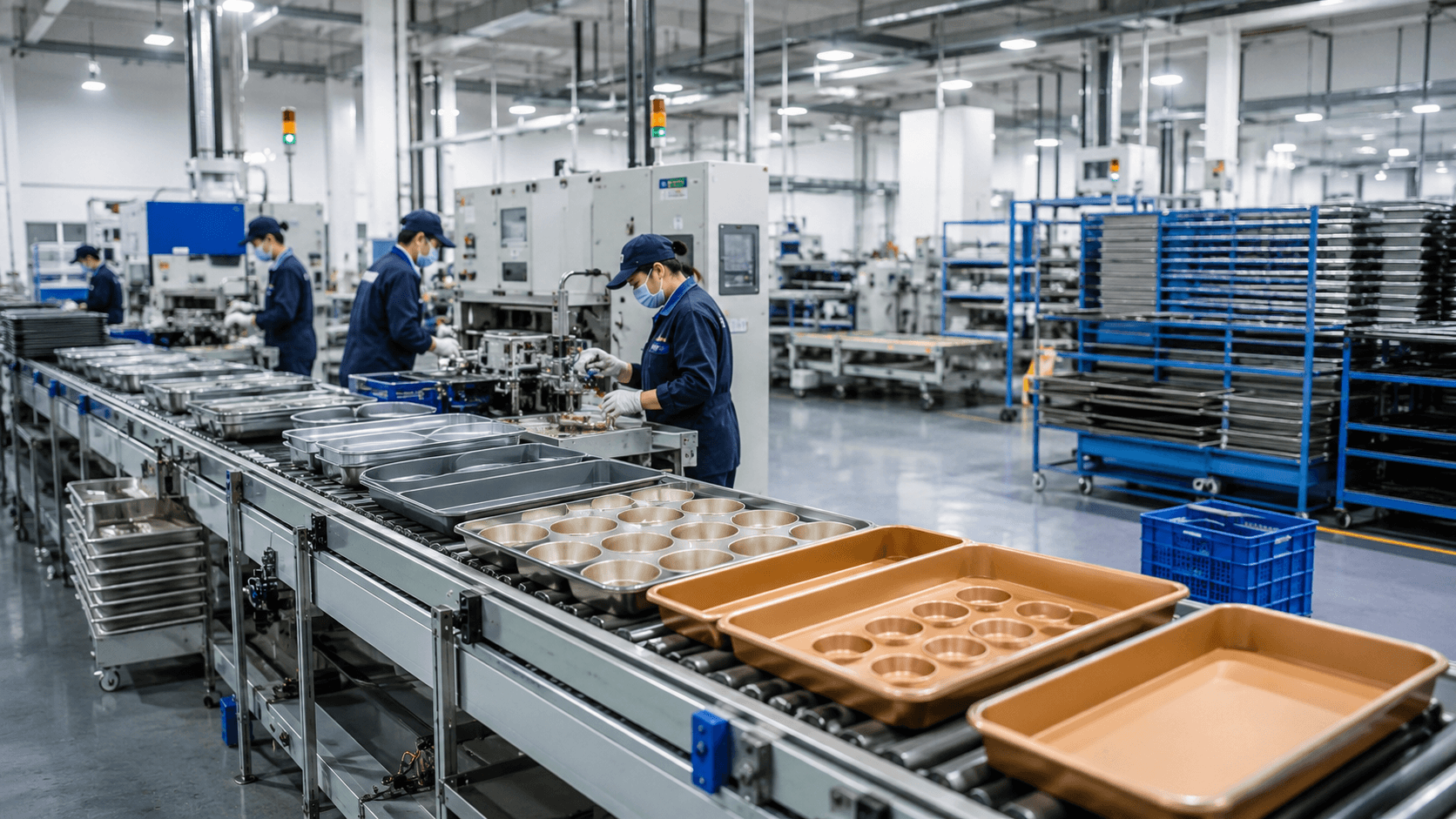
The Bakeware Manufacturing Ecosystem in China
Before diving into specific manufacturers, it is critical to understand where these factories are located. China’s bakeware production is largely concentrated in three industrial clusters:
- Zhejiang Province (Ningbo & Yongkang): The heart of metal bakeware. Most carbon steel pans, non-stick cookie sheets, and aluminum muffin tins originate here.
- Guangdong Province (Yangjiang): Known as the "Hardware Capital." Yangjiang excels in stainless steel baking tools, kitchen gadgets, and mid-to-high-end knives/spatulas.
- Guangdong Province (Shenzhen & Dongguan): The center for silicone and plastic bakeware. If you are looking for food-grade silicone molds or mats, these regions offer the highest technical precision.
Top Bakeware Manufacturers in China: 2026 List
The following manufacturers have been selected based on their export volume, certification status (BSCI, ISO 9001), and ability to handle complex OEM requirements.
1. Ningbo Master Sourcing (Metal Bakeware Specialists)
Located in the manufacturing powerhouse of Ningbo, this type of factory represents the pinnacle of carbon steel production. They focus on high-volume exports for major retail chains.
- Specialization: Non-stick carbon steel, aluminized steel, and heavy-duty commercial bakeware.
- Best For: Bulk Buyers and Retail Chains (Walmart, Target style).
- Sourcing Suitability: High-capacity production lines with automated coating systems.
- Limitations: High MOQs (typically 3,000+ pieces per SKU).
- Compliance: FDA, LFGB, REACH, and BPA-Free certifications.
2. Yangjiang Top-Win Hardware (Baking Tools & Accessories)
Yangjiang factories are indispensable for "baking sets" that include more than just pans. They specialize in the "hard" accessories of the baking world.
- Specialization: Stainless steel whisks, offset spatulas, cooling racks, and cookie cutters.
- Best For: Brand Owners looking to create comprehensive baking kits.
- Sourcing Suitability: Excellent for ODM; they have thousands of existing molds for small tools.
- Limitations: May struggle with large-scale silicone production compared to Dongguan factories.
3. Dongguan Silicone Pro-Tech (Silicone Bakeware Experts)
For modern bakeware brands, silicone is a high-growth category. This region offers the best R&D for LFGB-grade silicone.
- Specialization: Silicone baking mats (fiberglass reinforced), cake molds, and collapsible bakeware.
- Best For: Ecommerce Sellers (Amazon/Shopify) and Private Label brands.
- Sourcing Suitability: Lower MOQs (500–1,000) for standard colors; high precision for custom shapes.
- Limitations: Unit prices are higher than metal, and quality varies wildly—buyer verification of "platinum-cured" silicone is essential.
4. Foshan Grand Kitchenware (Commercial & Industrial Bakeware)
Foshan focuses on the "Professional" side of the market—items designed for bakeries and hotels rather than home kitchens.
- Specialization: Perforated baguette trays, trolley racks, and large-scale industrial pans.
- Best For: B2B Sourcing Businesses and Hospitality Suppliers.
- Sourcing Suitability: Focus on durability and gauge thickness.
- Limitations: Aesthetics are functional; packaging is often minimal (bulk packed).
Buyer Matching: Which Manufacturer Fits Your Business?
| Buyer Type | Priority | Recommended Region | Key Consideration |
|---|---|---|---|
| Ecommerce Seller | Speed & Trends | Dongguan / Shenzhen | Look for factories with in-house photography & low MOQ. |
| Brand Owner | Customization (OEM) | Ningbo | Prioritize factories with strong R&D and tooling capabilities. |
| Bulk Wholesaler | Price & Volume | Yongkang | Focus on high-speed automated production for thin-gauge steel. |
| Commercial Buyer | Durability | Foshan | Ensure material thickness (gauge) meets professional standards. |
Critical Sourcing Logic: Evaluating a Bakeware Factory
When vetting a supplier in this category, price is often the third or fourth most important factor. In bakeware, "cheap" usually means thin materials or toxic coatings.
1. Coating Quality & Safety
The most expensive part of a metal pan is the non-stick coating.
- The Trap: Some factories use low-grade PTFE that flakes easily.
- The Standard: Ask for specific coating brands (e.g., Whitford, Chemours) and request a "Cross-Cut Tape Test" report to verify adhesion.
2. Material Gauge (Thickness)
Weight equals quality in the baking world.
- Scenario: A 0.4mm carbon steel pan will warp in a 400°F oven. A premium pan should be 0.6mm to 0.8mm for home use, and 1.0mm+ for commercial use. Always specify the "Gauge" in your RFQ.
3. Compliance Documentation
Bakeware is a "Food Contact Material" (FCM).
- Europe: Must pass LFGB (stricter than FDA).
- USA: Must pass FDA (21 CFR 177.1550).
- Procurement Tip: Don't just ask "Do you have a certificate?" Ask for a report dated within the last 12 months for the specific material they are using for your order.
The Procurement Workflow: From RFQ to Shipping
Navigating the bakeware supply chain requires a structured approach to minimize quality risks.
- RFQ Phase: Define your material (Carbon steel, Aluminum, Silicone), coating type, and required gauge. Provide a 3D drawing or a physical sample of a "benchmark" product.
- Sample Evaluation: Test samples in a real oven. Measure heat distribution and check for "popping" (warping) during rapid temperature changes.
- Onboarding & Audit: Perform a Social Compliance audit (BSCI or SEDEX). This is increasingly required for entry into Western markets (especially for Ecommerce and Big Retail).
- Production Monitoring: For large orders, insist on an Initial Production Check (IPC) to verify the coating application process.
- Final Inspection: Use a third-party inspector (like QIMA or V-Trust) to perform a "Leach Test" and check for scratches, which are common in bulk-packed bakeware.
Why 2026 is the Year for "Hybrid Bakeware" Sourcing
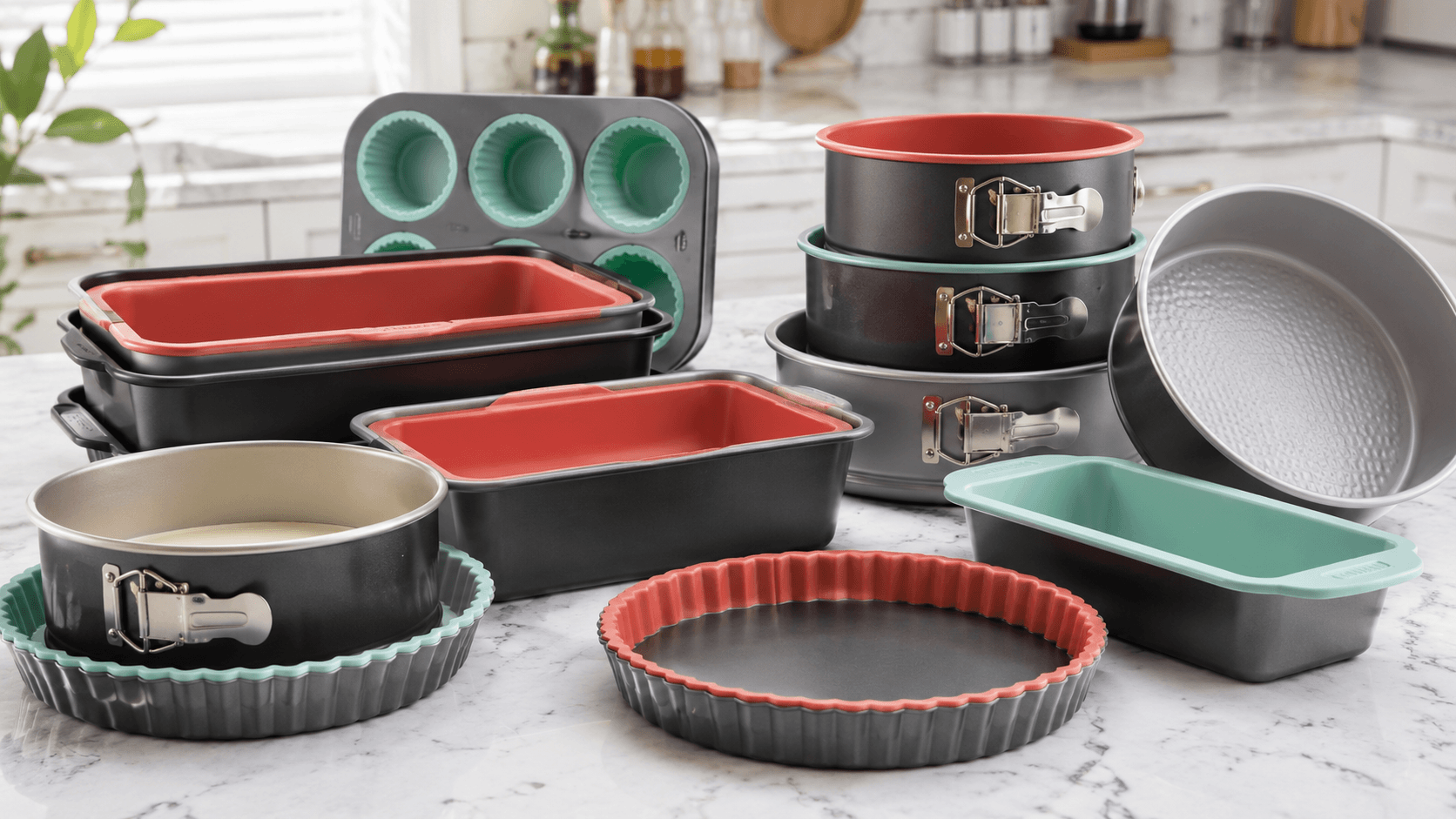
As we move into 2026, the market is shifting toward Hybrid Bakeware—products that combine materials (e.g., carbon steel frames with silicone inserts or ceramic-coated aluminum). China’s advanced manufacturing clusters are uniquely positioned to handle these multi-material assemblies.
Importers should look for "Full-Solution" factories that manage both metal and silicone under one roof. This reduces logistics friction and ensures that parts from different materials fit together perfectly (essential for items like springform pans).
Reference Sources
- General Administration of Customs of China (GACC): Export data for cookware and kitchenware (HS Code 7323).
- The National Health Commission (NHC) of China: GB 4806 series standards for Food Contact Materials.
- International Housewares Association (IHA): Global trends in bakeware manufacturing and material safety.
- Standard Certification Bodies: SGS, Intertek, and TUV Rheinland (Bakeware testing protocols).