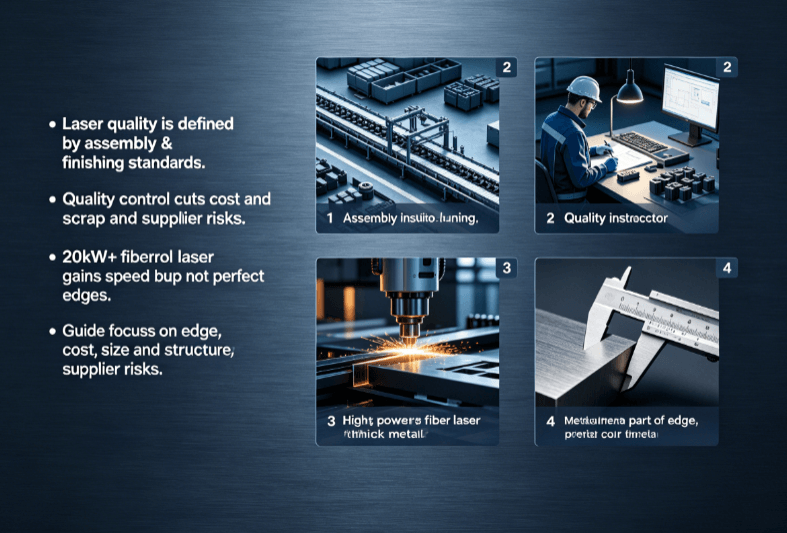
In the world of industrial fabrication, "laser quality" is often a subjective term until it meets the rigorous demands of assembly and finishing. For procurement managers and brand owners, understanding the factors affecting laser cutting quality is not just about physics—it is about reducing secondary processing costs, minimizing scrap rates, and ensuring supplier reliability.
As we move through 2026, the shift toward high-power fiber lasers (exceeding 20kW) has redefined what is possible in terms of speed and thickness. However, increased power does not automatically guarantee a superior finish. This guide breaks down the critical variables that determine the edge quality, dimensional accuracy, and structural integrity of your laser-cut components.
The Physics of the Beam: Power, Mode, and Focus
From a sourcing perspective, the "heart" of the laser cutting machine dictates the baseline quality. When evaluating a supplier’s equipment, procurement teams should look beyond just "wattage."
Laser Power and Beam Stability
Higher power allows for faster cutting speeds and the ability to penetrate thicker materials. However, the stability of that power is more critical. If a supplier’s laser source is aging or poorly maintained, power fluctuations will lead to inconsistent "kerf" (the width of the cut), resulting in parts that may not fit into precision assemblies.
Beam Mode (The M² Factor)
The beam mode refers to the distribution of energy across the laser spot. A "TEM00" (Gaussian) mode is the industry gold standard, providing a concentrated point of heat. In 2026, many top-tier manufacturers use adjustable beam profiles to switch between thin-sheet precision and thick-plate penetration.
Focal Position
The focal point—whether it sits on the surface, above it, or inside the material—determines the shape of the cut edge.
- Surface Focus: Ideal for thin materials to ensure a narrow kerf.
- Negative Focus (Inside the material): Used for thicker plates to help the melt flow out of the bottom, reducing "dross."
Dynamic Parameters: Speed and Feed Rate
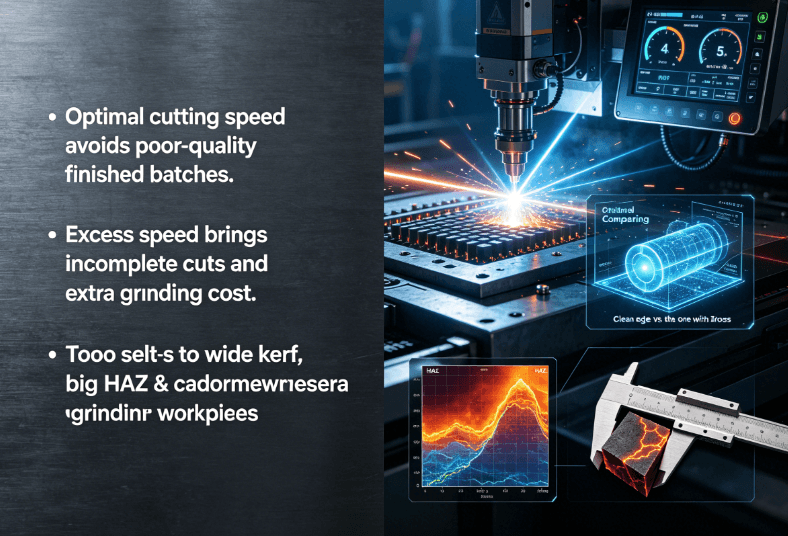
In a commercial B2B environment, speed is often equated with lower costs. However, there is a "Goldilocks Zone" for cutting speed that procurement officers must understand to avoid receiving low-quality batches.
Managing Feed Speed for Clean Edges
- Too Fast: If the feed rate is too high, the laser cannot melt through the material completely. This results in incomplete cuts or "heavy dross" (solidified slag) at the bottom of the part, which requires expensive manual grinding.
- Too Slow: Excessive heat input causes the kerf to widen and creates a larger Heat Affected Zone (HAZ). This can warp thin parts and alter the metallurgy of the edges, making them brittle or difficult to weld in later stages.
Assist Gas Selection: The Invisible Quality Factor
One of the most overlooked factors in sourcing laser cutting services is the choice of assist gas. This decision directly impacts the unit price and the finish of the part.
| Assist Gas | Cost | Edge Quality | Best For |
|---|---|---|---|
| Oxygen (O2) | Low | Oxidized (Black/Scaled) | Carbon steel where painting/coating follows. |
| Nitrogen (N2) | High | Clean, Bright (No Oxide) | Stainless steel, Aluminum, and high-spec parts. |
| Compressed Air | Lowest | Moderate Carbonization | Cost-sensitive internal components. |
If your parts require high-quality powder coating or welding, insist on Nitrogen cutting. Oxygen leaves an oxide layer that causes paint to peel and weakens weld joints.
Material Composition and Surface Condition
The consistency of your raw material is perhaps the most significant variable outside the machine’s control. Sourcing teams should be aware that "Standard Grade" steel from different mills can react differently to a laser.
Surface and Internal Factors
- Reflectivity: Materials like copper, brass, and aluminum reflect laser light back into the optics. Suppliers must use "Fiber" lasers rather than older CO2 technology for these materials to prevent machine damage and jagged edges.
- Surface Contaminants: Rust, oil, and scale interfere with the laser's path. High-quality suppliers will either use "pickled and oiled" (P&O) steel or perform a pre-cleaning step to ensure a smooth finish.
- Internal Stress: In lower-grade metals, internal stresses can cause the material to "pop" or bow during cutting, leading to head collisions and dimensional inaccuracies.
Mechanical Precision and Table Stability
Even the best laser source cannot compensate for a flimsy machine frame. In high-volume procurement, the "Motion System" of the factory's machinery is a key audit point.
Motion Control and Vibrations
- Acceleration and Deceleration: Precision at corners is determined by the machine's ability to decelerate and accelerate rapidly. Poor motion control leads to "overshoot" at sharp angles, rounding off corners that should be sharp.
- Vibration Dampening: In 2026, leading factories use marble or heavy-duty cast iron beds. Lightweight frames vibrate at high speeds, creating "striations" (visible lines) on the cut edge.
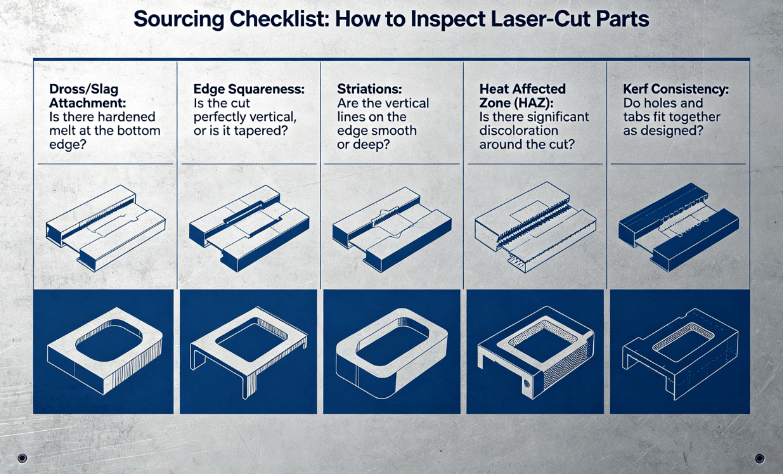
Sourcing Checklist: How to Inspect Laser-Cut Parts
When receiving samples or first-article inspections (FAI), use this checklist to evaluate the supplier’s control over the variables mentioned above:
- Dross/Slag Attachment: Is there hardened melt at the bottom edge? (Indicates poor speed/gas pressure).
- Edge Squareness: Is the cut perfectly vertical, or is it tapered? (Indicates incorrect focal position).
- Striations: Are the vertical lines on the edge smooth or deep? (Deep lines indicate vibration or gas turbulence).
- Heat Affected Zone (HAZ): Is there significant discoloration around the cut? (Indicates the material was "cooked" too slowly).
- Kerf Consistency: Do holes and tabs fit together as designed? (Indicates beam stability and calibration).
Summary
In the B2B marketplace, you often get what you pay for in laser cutting. A supplier offering a 30% lower price may be using Oxygen instead of Nitrogen or increasing feed rates beyond the "quality zone" to maximize throughput. For Bulk Buyers and Brand Owners, the goal should be "Total Cost of Ownership." A part that is cheaper to cut but requires manual deburring is not a bargain in the long run.
Reference Sources
The Fabricator: Laser Cutting Trends and Technology
American Welding Society: Edge Preparation Guidelines
Laser Institute of America: Laser Beam Parameters