The landscape of automated manufacturing in 2026 demands high precision and rapid production cycles. Selecting the correct CNC router axis configuration is the most critical decision for any modern fabrication workshop. This choice determines the complexity of the geometries you can produce and your overall operational flexibility.
Modern CNC machines utilize a Cartesian coordinate system to guide cutting tools across materials like wood, plastic, and metal. The number of axes dictates the freedom of movement the spindle or the workpiece possesses during the machining process. As the number of axes increases, the machine gains the ability to reach more angles and create more intricate 3D shapes.
Understanding these technical distinctions is essential for optimizing your long-term return on investment. Whether you are a custom furniture maker or an industrial components manufacturer, the axis count directly impacts your software needs. This comprehensive guide explores the specific capabilities and practical applications of each major machine configuration.
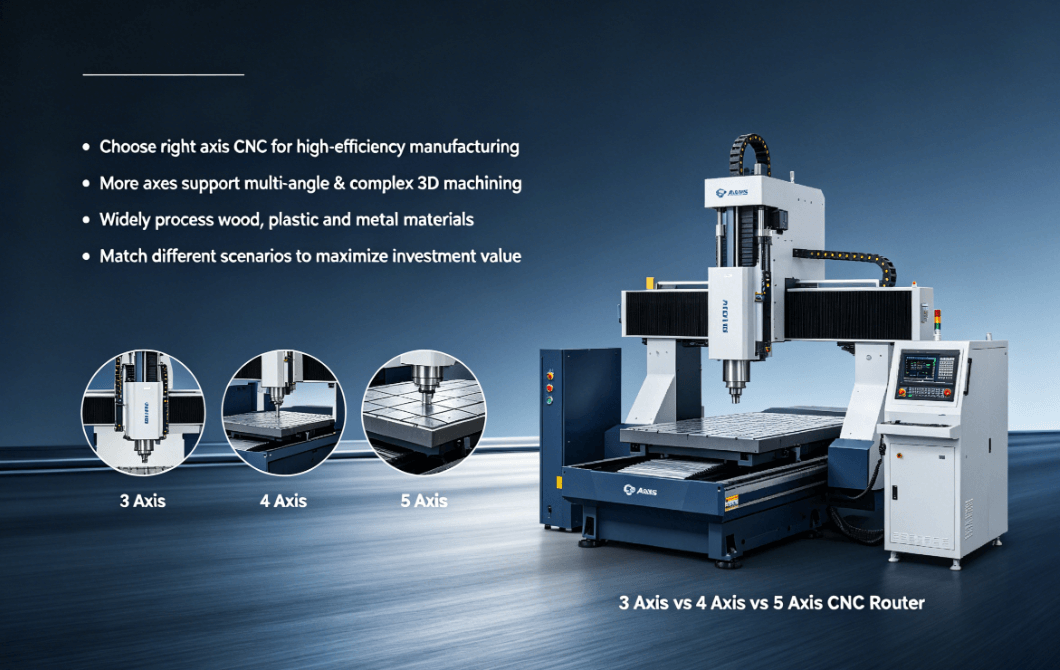
What are the differences between 3 axis, 4 axis, and 5 axis CNC routers?
A 3-axis CNC router is the most common entry point for basic fabrication shops. It moves along the X, Y, and Z planes simultaneously to process the workpiece. This setup is ideal for flat parts that require cutting, drilling, or shallow relief carving.
The CNC router axis count increases to four when a rotary movement is added to the system. In most configurations, this involves an A-axis that rotates the workpiece around the X-axis. This allows for machining on all sides of a cylindrical object without manual repositioning.
A 5-axis CNC router represents the pinnacle of machining flexibility and high-end precision. It adds two rotational axes, typically the A and B axes, to the standard linear planes. This configuration allows the cutting tool to approach the workpiece from virtually any direction.
Understanding the 3-Axis Linear Movement
The 3-axis system remains the industry standard for flat panel processing and basic 2D designs. It moves left-to-right (X), front-to-back (Y), and up-and-down (Z). This simplicity makes it the most affordable and easiest to program machine available.
Most 3-axis routers in 2026 offer high-speed spindles and automated tool changers. These features allow for efficient nested-based manufacturing for cabinets and signage. However, they struggle with complex 3D shapes that require side-access cutting or deep undercuts.
Exploring 4-Axis Rotary Capabilities
A 4-axis machine introduces the fourth dimension of movement by adding a rotary indexer. This indexer allows the material to rotate while the spindle moves along the three linear axes. It is a cost-effective solution for creating symmetrical 3D objects like table legs or pillars.
By rotating the part, the machine can access four different sides of a square block. This eliminates the need to stop the machine and manually flip the material. Consequently, it reduces human error and ensures much higher consistency across large production batches.
The Power of 5-Axis Simultaneous Motion
The 5-axis CNC router offers unparalleled control by moving in five different directions at once. This includes the three linear axes and two additional rotational axes for the spindle or table. It allows the machine to follow complex contours with extreme accuracy and smooth surface finishes.
Advanced 5-axis systems are essential for parts with deep cavities or complex curved surfaces. They keep the tool in an optimal orientation relative to the material at all times. This capability significantly reduces the number of operations required to finish a single component.
| Feature | 3-Axis CNC | 4-Axis CNC | 5-Axis CNC |
|---|---|---|---|
| Movement Planes | X, Y, Z | X, Y, Z + A (Rotary) | X, Y, Z + A + B/C |
| Geometry | Flat/2.5D | Cylindrical/4-Sided | Complex 3D/Undercuts |
| Setup Complexity | Low | Medium | High |
| Typical Accuracy | ±0.05 mm | ±0.03 mm | ±0.01 mm |
| Average Cost | $5,000 - $30,000 | $15,000 - $60,000 | $80,000 - $250,000+ |
Key Features and Industrial Applications of Different CNC Router Axis Configurations?
The application of a specific CNC router axis configuration depends on the complexity of your final product. In 2026, industrial sectors are increasingly specialized, requiring tools that match their unique manufacturing goals. Choosing the right machine ensures that you are not over-investing in unnecessary technology.
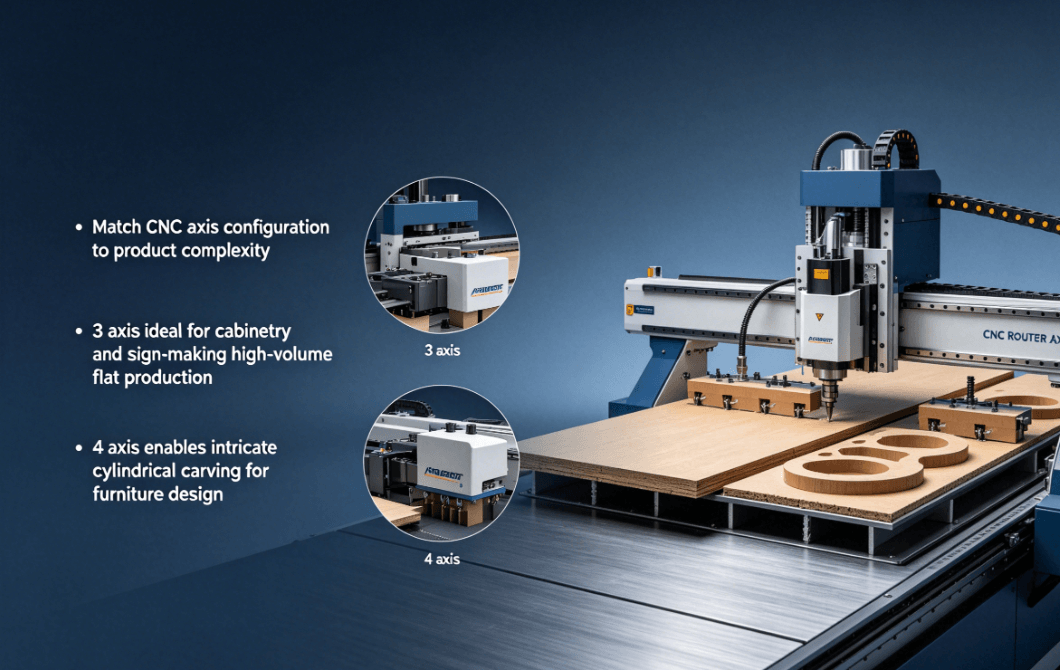
Cabinetry and sign-making businesses almost exclusively rely on 3-axis machines for their daily operations. These machines process large sheets of plywood or acrylic with high speed and reliability. The low operational cost makes them perfect for high-volume, flat-component production runs.
Furniture designers often prefer 4-axis routers to create decorative and structural components. The ability to carve intricate patterns on cylindrical surfaces adds significant value to their products. It provides a bridge between manual craftsmanship and fully automated 3D sculptural work.
Applications in Aerospace and Medical Fields
The aerospace industry utilizes 5-axis machines to produce lightweight and aerodynamic components. These parts often feature complex curves that are impossible to machine with fewer axes. The 5-axis configuration ensures maximum material removal while maintaining strict structural integrity.
Medical device manufacturers use 5-axis technology to create custom implants and surgical tools. These items must meet incredibly tight tolerances to ensure patient safety and comfort. A 5-axis router can machine titanium and advanced plastics into organic, bone-like shapes.
Woodworking and Architectural Millwork
In high-end woodworking, the 4-axis CNC router axis setup is a popular choice for custom stairs. It handles the rotation of balusters and the carving of complex handrail fittings. This automation allows small shops to compete with larger factories in 2026.
Architectural millwork often requires 5-axis machines for large-scale decorative installations. These machines can carve large blocks of foam or wood into artistic wall panels. The simultaneous motion creates a fluid surface that requires minimal hand-sanding or finishing.
Automotive Prototyping and Mold Making
Automotive engineers use 5-axis routers to create full-scale clay or foam prototypes of new cars. The machine can reach into deep wheel wells and follow the sleek lines of a car body. This speed is crucial for meeting the fast-paced design cycles of the modern era.
Mold making for plastic injection also heavily relies on 5-axis machining. The ability to machine deep cavities with shorter tools reduces vibration and chatter. This results in a superior mold surface that produces higher-quality plastic parts.
Technical Comparison: Precision, Cost, and Efficiency?
When evaluating a CNC router axis setup, you must consider the total cost of ownership. This includes the initial purchase price, software licenses, and the skill level of your operators. In 2026, the gap between low-end and high-end machines continues to widen.
Precision is a major differentiator between these three machine configurations during long runs. A 5-axis machine can often hold tolerances within 0.01 mm because it moves less frequently. Each time a part is manually repositioned on a 3-axis machine, accuracy can drop by 15%.
Efficiency is not just about spindle speed; it is about the total time from start to finish. While a 3-axis machine might be faster at cutting a single rectangle, it loses to 5-axis on complex parts. Finishing a part in one setup saves hours of labor and reduces scrap material.
Cost-Benefit Analysis for 2026
Investing in a 3-axis machine is the most financially conservative move for new businesses. These machines have lower maintenance costs and utilize simpler, often cheaper, CAD/CAM software. They typically provide a faster return on investment for standard panel-processing tasks.
A 4-axis machine represents a moderate investment that significantly expands your creative potential. The added cost of the rotary axis is usually between $2,000 and $10,000. For many shops, this small price increase opens up new markets for specialized products.
A 5-axis machine is a major capital expenditure that requires a robust business plan. The controllers for these machines are highly advanced and require expensive annual software subscriptions. However, for shops producing complex aerospace or medical parts, the machine can pay for itself within two years.
Production Speed and Efficiency Gains
In 2026, production speed is often limited by the number of times a part must be handled. 5-axis machines eliminate the need for custom jigs and fixtures for different angles. This reduction in "non-cutting time" can increase overall shop throughput by up to 40%.
Tool life is another factor where 5-axis machines hold a significant technical advantage. By tilting the spindle, the machine uses the side of the tool rather than just the tip. This distributes wear more evenly and allows for higher feed rates without breaking bits.
Shorter tools can be used on 5-axis machines because the spindle can get closer to the part. Short tools are more rigid and less prone to deflection during heavy cutting. This rigidity directly translates to faster cycle times and a much higher quality of finished surfaces.
How to Determine the Best CNC Router Axis Configuration for Your Business?
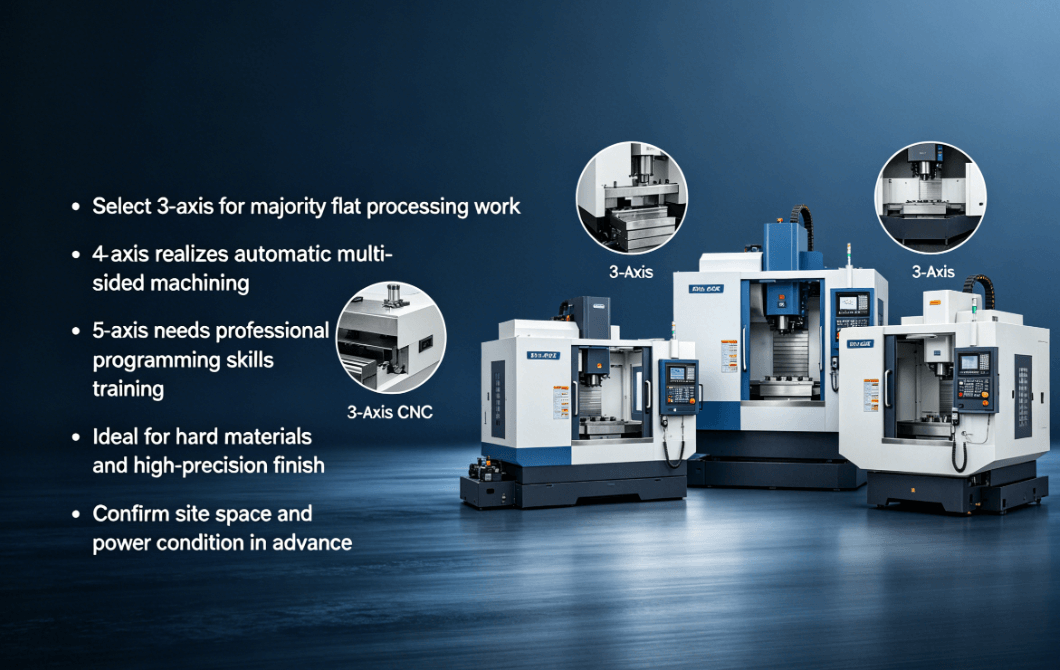
Choosing the right machine requires an honest assessment of your current and future production needs. You must first look at the complexity of the shapes your customers are currently ordering. If 90% of your work is flat, a 3-axis machine remains your most profitable option.
If you find your team spending hours manually flipping parts to machine different sides, it is time to upgrade. A 4-axis CNC router axis configuration is the perfect solution for multi-sided machining tasks. It automates the rotation process and ensures that all sides remain perfectly aligned.
Consider the technical capability of your existing staff and their willingness to learn new software. Moving to 5-axis machining requires a significant leap in programming skills and spatial awareness. You must be prepared to invest in intensive training or hire specialized CNC programmers.
Evaluate the materials you plan to cut and the level of finish required by your clients. Harder materials often benefit from the rigidity and tool-path optimization of 5-axis systems. If your market demands "mirror-like" finishes on complex curves, the 5-axis investment is unavoidable.
Finally, look at your available floor space and electrical infrastructure before making a purchase. 5-axis machines are often larger and require more sophisticated power stabilizers to protect their electronics. Ensure your shop environment is ready for the precision requirements of a high-end multi-axis system.
Summary
Choosing a CNC router axis configuration in 2026 depends on balancing your geometry needs with your budget. 3-axis machines are best for flat work, while 4-axis systems handle cylindrical parts efficiently. The 5-axis machine provides the ultimate precision for complex industrial parts but requires the highest investment in both money and training.
PRO TIP
If you are unsure about your future needs, purchase a 3-axis machine that is "4th-axis ready." This means the controller and wiring are already in place to accept a rotary unit later. It allows you to expand your capabilities modularly without the high upfront cost of a full multi-axis system.
FAQ
1. Is a 4-axis CNC router better than a 3-axis machine?
It is better only if your specific projects require rotation or machining on multiple sides of a part. For standard cabinet parts or flat signage, a 3-axis machine is actually more efficient due to its simpler setup. The extra CNC router axis on a 4-axis machine adds mechanical complexity that is unnecessary for 2D work.
2. What are the main benefits of a 5-axis CNC router?
The main benefits are reduced setup time, the ability to machine complex shapes, and superior surface finishes. A 5-axis machine can reach undercuts and deep pockets that other machines simply cannot access. It also allows for shorter cutting tools, which increases the accuracy and speed of the machining process in 2026.
3. Can I upgrade a 3-axis CNC to a 5-axis CNC later?
Generally, upgrading a standard 3-axis frame to a full 5-axis system is not cost-effective or physically possible. 5-axis machines require much higher structural rigidity and specialized high-speed controllers that 3-axis frames lack. It is usually better to sell the 3-axis machine and purchase a dedicated 5-axis system when your business grows.
4. Is 5-axis programming difficult to learn?
Yes, 5-axis programming is significantly more complex and requires advanced CAM software to prevent tool-spindle collisions. In 2026, AI-assisted programming is making this easier, but it still requires a deep understanding of 3D space. Most shops find that it takes several months for an experienced operator to become proficient in 5-axis motion.
5. Which axis configuration is best for custom furniture?
A 4-axis CNC router axis setup is typically the "sweet spot" for high-end custom furniture makers. It allows for the automated production of table legs, chair backs, and decorative carvings with minimal manual labor. While a 5-axis machine can do more, its high cost is rarely justified for most standard furniture designs.
Reference Sources
NIST (National Institute of Standards and Technology) - Trends in CNC Machining and Precision 2026
SME (Society of Manufacturing Engineers) - Advancements in 5-Axis Milling Technology
MIT Center for Bits and Atoms - Research on Digital Fabrication and Axis Control