

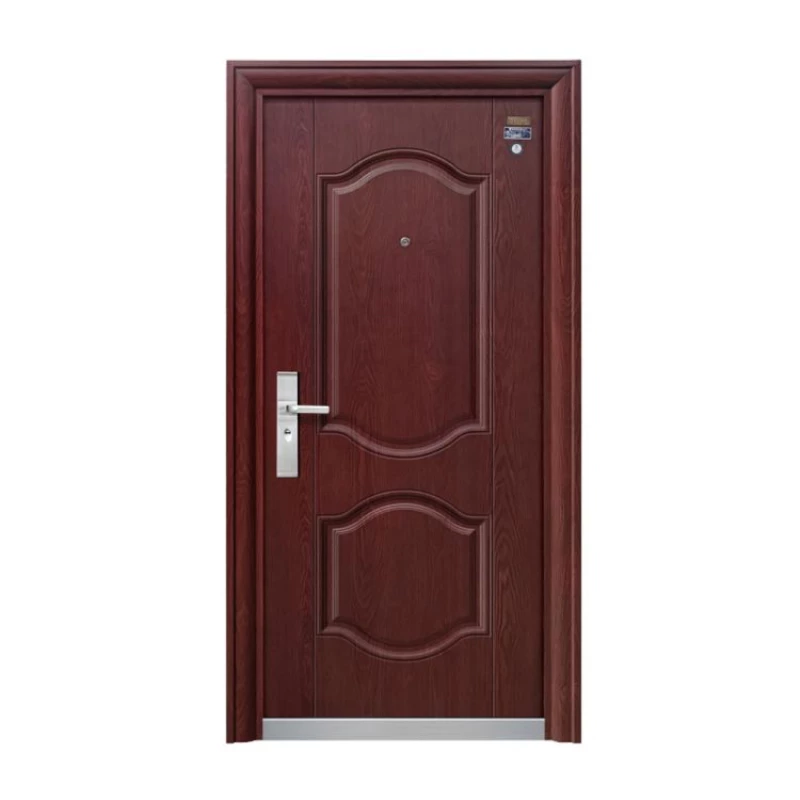
Rust-Resistant Stainless Steel Door with High-Security Locks
- Supply Type
- Original Manufacturer, Odm
- Sample
- Yes
- Transport Mode
- Sea, Land, Air, Express, Others
- HS Code
- 7308300000

Product Description
Product Details
| Standard Size | 2050*960 (Accept Customization) |
| Door Leaf Thickness | 68mm (can be customized) |
| Door Leaf | Standard 0.8/1.0mm (Accept Customization) |
| Inner Filling | Fire door core panel/honeycomb paper(Accept Customization) |
| Lock Set | High Quality Main Lock+Side Lock+Up-Down Lock |
| Surface Treatment | Heat Transfer(Accept Customization) |
| Open Direction | Inward/Outward/Left/Right |
| Accessories | Handle;Lock;Hinge;Peephole;Door Bell;Bolts |
| Fuction | Fireproof; Burglarproof |
What Makes a Security Door Safest?
1. Check the Performance and Structure of the Lock
- Choose a drill-resistant lock cylinder.
- The lock should have a three-point locking mechanism.
- For single doors, there should be three hinges; for double doors, six hinges.
- Consider adding additional deadbolts between the door leaf and the frame.
2. Consider the Number of Locks and Bolts
- Opt for a door with two locks, each controlling two bolts.
3. Assess the Thickness and Area of Reinforcement Plates
- The protective plate for the lock should be made of cold-rolled steel with a thickness exceeding 2 millimeters.
- The height of the protective plate should not be less than 500 millimeters.
- For enclosed security doors, other parts should have cold-rolled steel with a thickness of at least 1.5 millimeters.
4. Evaluate the Quality of Craftsmanship
- Material selection is essential, but the quality of craftsmanship is crucial.
- Pay particular attention to checking for any welding defects.
5. Consider the Material and Security Grade of the Security Door
- Most security doors on the market are made of steel, but there are also options in stainless steel, copper, steel-wood structures, and aluminum alloy.
- Security doors are graded as A, B, C, or D. For residential use, C and D grades are commonly preferred as they offer higher security performance.
- According to national standards, security doors should have a permanent fixed marking on the inner side at the top corner of the hinge, at a height of 1600mm ± 100mm from the ground.
6. Select Based on Exterior Design
- Security doors are available in luxury, mid-range, and standard categories. Choose according to personal preferences and requirements.
7. Examine the Lock Cylinder
- The lock cylinder is a crucial consideration for security doors.
- Security door lock cylinders have three levels, with B-level lock cylinders being commonly used for household security. However, for maximum security, consider using lock cylinders beyond the B-level, which even professional locksmiths find difficult to open, ensuring enhanced safety for your home environment.


