In the global drinkware market, China remains the undisputed leader, accounting for over 80% of the world’s stainless steel vacuum flask production. For procurement professionals in 2026, the challenge has shifted from simply finding a supplier to identifying a partner capable of navigating new sustainability regulations (like recycled steel targets) and advanced finishing techniques like 3D sublimation and durable powder coating.
Most high-tier stainless steel bottle manufacturers in China are concentrated in the Yongkang and Wuyi clusters in Zhejiang province. Known as the "Hardware Capital," this region offers a vertically integrated supply chain, from raw steel processing to specialized lid injection molding. This guide profiles the top manufacturers to help you align your sourcing strategy with your brand’s specific needs.
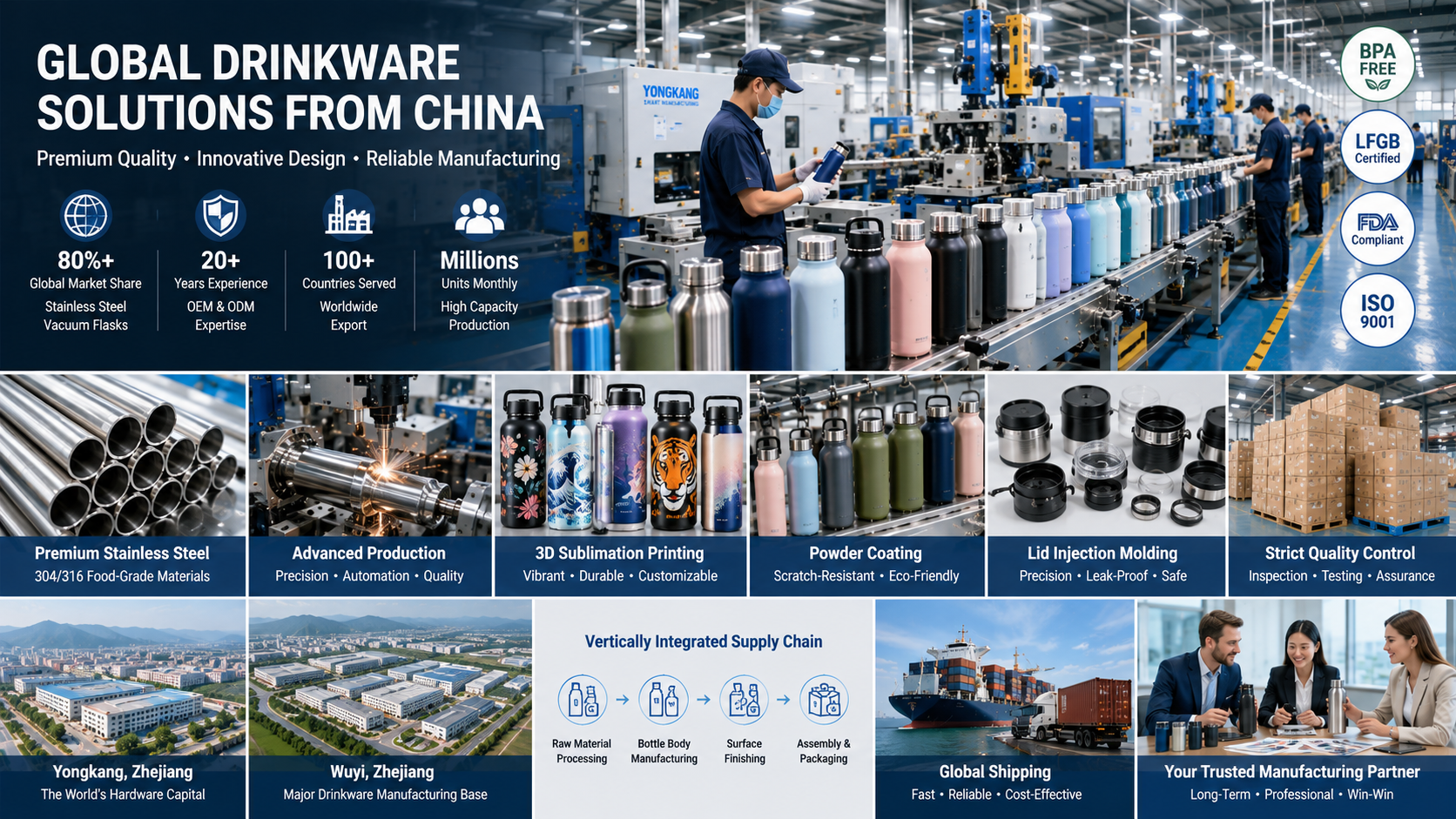
The 2026 Stainless Steel Bottle Manufacturing Landscape
Before evaluating suppliers, it is critical to understand the technical baseline. In 2026, "Food Grade" is no longer a luxury; it is the minimum requirement. High-performance sourcing now focuses on:
- SUS 304 vs. SUS 316: While 304 is the standard, 316 (medical grade) is becoming preferred for high-end coffee and tea flasks due to its superior corrosion resistance.
- Vacuum Integrity: Ensuring a <1% failure rate in thermal insulation over 12–24 hours.
- Compliance: Moving beyond FDA/LFGB to include ESG (Environmental, Social, and Governance) audits like BSCI and Sedex.
7 Best Stainless Steel Water Bottle Manufacturers in China
1. Zhejiang Haers Vacuum Containers Co., Ltd.
Specialization: Large-scale OEM/ODM for global outdoor and lifestyle brands.
Best For: Bulk buyers and high-tier brand owners requiring massive production capacity.
Haers is the largest publicly listed manufacturer in this sector. They operate multiple smart factories with high levels of automation. If you are sourcing for a major retail chain or a global outdoor brand, Haers offers the stability and R&D depth required for patented designs.
- Sourcing Suitability: High reliability, world-class QC, and strong IP protection.
- Limitations: High MOQs (typically 3,000+ units) and less flexibility for small, trend-driven startups.
2. Anhui Solidware Appliance Co., Ltd.
Specialization: Precision vacuum technology and high-end industrial design.
Best For: Premium brands focusing on long-duration thermal performance.
Solidware is known for its technical rigor. They excel in "double-wall vacuum insulation" that consistently beats industry averages for temperature retention. Their products often feature minimalist, ergonomic designs favored by European markets.
- Sourcing Suitability: Ideal for brands positioning themselves as "High Performance" or "Professional Grade."
- Limitations: Pricing is at the higher end of the Chinese manufacturing spectrum.
3. Everich (Zhejiang Everich Houseware Co., Ltd.)
Specialization: Trendy designs and rapid ODM development for e-commerce.
Best For: Ecommerce sellers (Amazon/Shopify) and fashion-forward brands.
Everich is the go-to for many "Amazon Best Sellers." They have a massive design team that releases hundreds of new molds every year, keeping up with trends like the "Stanley-style" tumblers or oversized sports jugs.
- Sourcing Suitability: Excellent one-stop service, including custom packaging and logistics coordination.
- Limitations: As they manage a massive volume of clients, communication can feel "transactional" unless you have a dedicated account manager.
4. Zhejiang Kingline Housewares Co., Ltd.
Specialization: Customized surface finishes (3D Printing, Laser, Powder Coating).
Best For: Mid-sized brands requiring unique aesthetics and differentiation.
Kingline has invested heavily in the "finishing" stage of production. While many factories use basic spray paint, Kingline specializes in durable powder coatings and intricate digital printing that doesn't peel or fade.
- Sourcing Suitability: Best for "Gift and Premium" markets or brands where the "hand-feel" is a key selling point.
- Limitations: Production lead times can be slightly longer due to the complexity of the finishing processes.
5. Nanlong Group Co., Ltd.
Specialization: Massive volume production and raw material integration.
Best For: Wholesalers and large-scale importers focused on price-to-volume ratio.
Nanlong is a giant in the Yongkang cluster. They are highly vertically integrated, meaning they control more of their supply chain than smaller competitors. This allows them to offer extremely competitive pricing on high-volume runs of "standard" bottle shapes.
- Sourcing Suitability: Best for "Value" brands or large-scale promotional orders.
- Limitations: Customization options for new, unique shapes are more limited compared to specialized ODM shops.
6. Tinto (Zhejiang Tinto Intelligent Technology)
Specialization: "Smart" bottles and innovative lid mechanisms.
Best For: Tech-focused brands and innovative startups.
Tinto focuses on the "Smart Drinkware" niche, integrating LED temperature displays and UV-C sterilization caps. As the market moves toward tech-integrated lifestyle products, Tinto provides the specialized electronics assembly that traditional bottle factories lack.
- Sourcing Suitability: Niche leader in electronics-integrated drinkware.
- Limitations: Electronic components introduce higher complexity in customs and battery regulations.
7. Wuyi Feifei Household Products Co., Ltd.
Specialization: Flexible manufacturing and lower MOQs.
Best For: Small buyers and boutique brand owners.
Feifei caters to the "growth" segment. They are more willing to work with smaller MOQs (500–1,000 units) compared to the giants like Haers. They maintain a wide range of "open molds" that can be private-labeled quickly.
- Sourcing Suitability: High flexibility and faster prototyping for new entrants.
- Limitations: Smaller scale means they may have less leverage during peak production seasons (e.g., pre-Christmas).
Comparative Procurement Matrix
| Manufacturer | Primary Target | Estimated MOQ | Tech Strength | Sourcing Tier |
|---|---|---|---|---|
| Haers | Global Brands | 3,000+ | Automated Scale | Tier 1 (Listed) |
| Solidware | Premium/Pro | 1,000+ | Vacuum Insulation | Tier 1 (Tech) |
| Everich | E-commerce | 500-1,000 | Trend/Design | Tier 2 (Service) |
| Kingline | Design-Heavy | 1,000+ | Surface Finish | Tier 2 (Custom) |
| Nanlong | Wholesale | 5,000+ | Cost Efficiency | Tier 1 (Volume) |
| Tinto | Tech-Savvy | 500+ | Smart Features | Niche Specialist |
| Feifei | Small Brands | 500 | Flexibility | Tier 3 (Growth) |
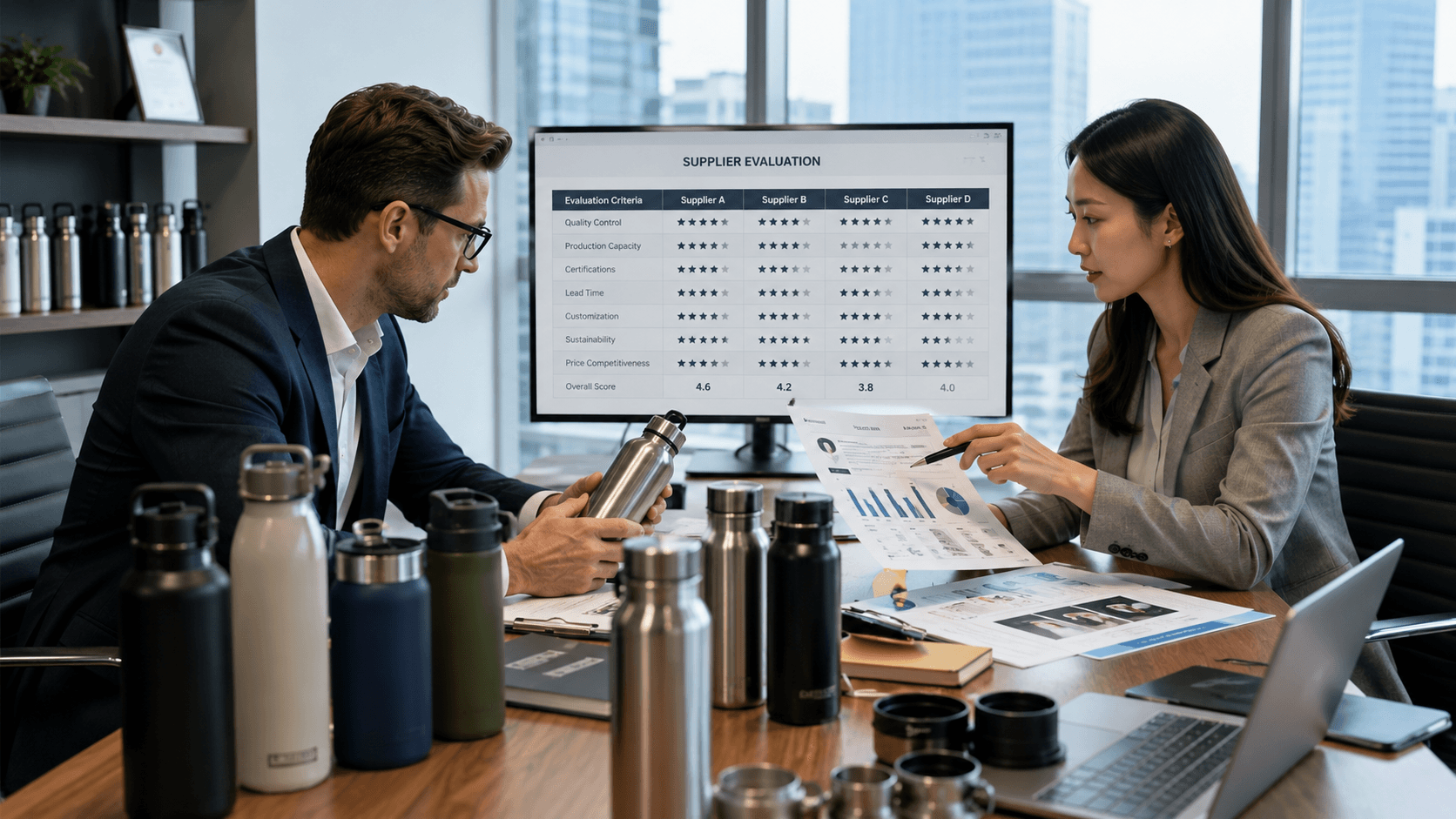
Buyer Logic: How to Evaluate a Bottle Factory
Many importers find that a low unit price often leads to "leaking" vacuum seals or lead-contamination issues in the solder. When evaluating a stainless steel bottle manufacturer in China, use this procurement workflow:
1. Material Verification (The "Salt Test")
Don't just take the "304" stamp for granted. For large orders, hire a third-party lab to perform a Spectrometer test. A common shortcut for dishonest suppliers is using 201-grade steel on the inner layer, which will rust when used with acidic drinks like coffee.
2. Vacuum Integrity Testing
A quality factory should have a "Vacuum Testing Room" where every bottle is placed on a thermal sensor belt. Ask for the Vacuum Failure Rate (VFR) data from their previous production run. Anything above 1% should be a red flag.
3. Coating Durability
If your brand is sold at a premium, the paint cannot chip. Ask for an Adhesion Test (Cross-Cut Test) report. Powder coating is generally 3x more durable than liquid spray painting for outdoor use.
4. Regulatory Compliance for 2026
Ensure the factory is ready for:
- Recycled Steel Certification: GRS (Global Recycled Standard) if you claim "Eco-friendly."
- BPA-Free Lids: Ensure the polypropylene (PP) and silicone seals have independent lab reports.
Reference Sources:
- Yongkang Household Products Association 2025 Industry Map.
- BSCI/Sedex Supplier Verification Databases.
- Global Sources Consumer Electronics & Houseware Reports.
- SGS/Intertek Food Contact Material (FCM) Guidelines.