

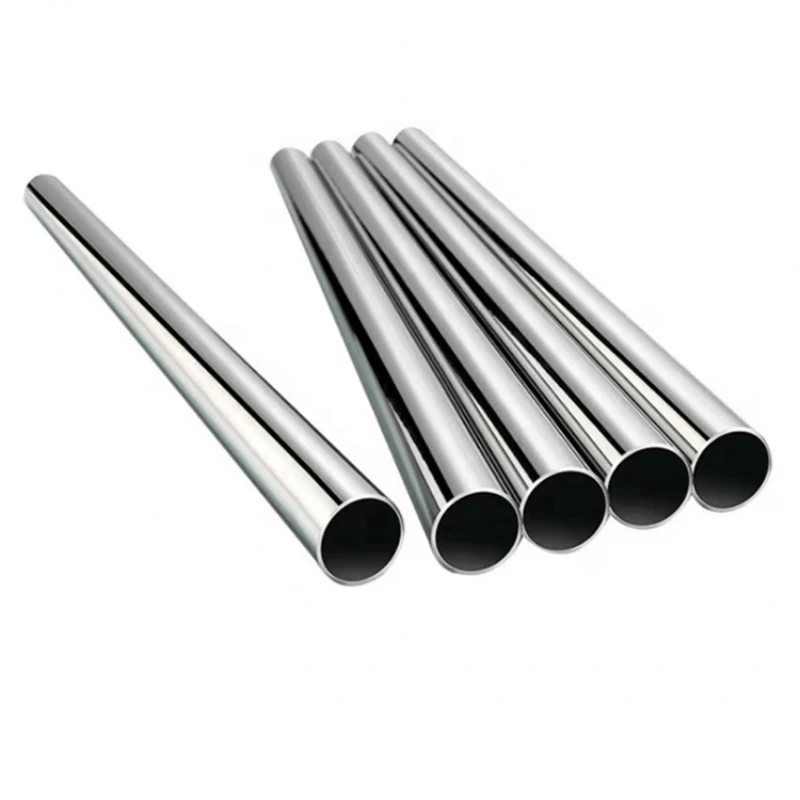
Niobium-zirconium Alloy refers to an alloy composed of metallic Niobium and metallic Zirconium. The most important Niobium-Zirconium Alloy is Nb-1Zr Alloy. Adding zirconium to niobium can improve the strength of the alloy without affecting the plasticity and processing properties of the alloy. Zirconium can also improve the alloy's resistance to oxidation and alkali metal corrosion. Nb-1Zr Alloy is the most widely used niobium alloy. It is a low-strength niobium alloy with good processing and welding properties. Mainly used in aerospace, atomic energy reactors, new electric light source sodium lamp and other application fields.
Why do we use Niobium And Zirconium Tubes? This is mainly because during nuclear reactions, fuel rods need to withstand extremely high temperatures and pressures. If traditional materials are used, they may melt or crack due to high temperature and pressure, causing nuclear fuel to leak and causing serious environmental pollution. The niobium-zirconium tube can remain stable in such an environment and ensure the safety of nuclear reactions.
In addition, the Niobium-Zirconium Tube(NbZr1) also has an important function, which is to control the speed of nuclear reactions. In a nuclear reactor, by adjusting the position and number of niobium-zirconium tubes, the distance between the nuclear fuel and the control rods can be changed, thereby changing the number of neutrons and controlling the speed of the nuclear reaction. This is key to ensuring the safe operation of nuclear reactors.
However, despite the many advantages of NbZr1, their manufacturing process is quite complicated. First, niobium and zirconium need to be melted through a vacuum electric arc furnace, and then made into a tube shape through a special process. Next, it is necessary to improve its mechanical properties and corrosion resistance through steps such as high-temperature heat treatment and cold working. Finally, strict quality testing is required to ensure its safety during use.
| Chemical Composition (Impurities % ≤) | ||||||||
| Elements | O | C | N | H | Fe | Ni | Si | Hf |
| Spec. | 0.025 | 0.01 | 0.01 | 0.0015 | 0.01 | 0.005 | 0.005 | 0.02 |
| Test | 0.007 | 0.002 | 0.002 | 0.0004 | 0.0012 | <0.001 | <0.001 | <0.001 |
| Elements | W | Mo | Ta | Zr | Al | Ti | Nb | --- |
| Spec. | 0.05 | 0.02 | 0.3 | 0.02 | 0.005 | 0.03 | Bal | --- |
| Test | <0.001 | <0.001 | 0.015 | <0.001 | <0.001 | <0.001 | Bal | --- |
| Grade | Ultimate Tensile Strength,min(Mpa) | Yield Strength(0.2%) min(Mpa) | Elongation in 1-in(25-mm)gage length,min,% |
| Type 1-Welded | 18000(125) | 10500(73) | 25 |
| Type 2-Seamless | 18000(125) | 8500(59) | 25 |
| Type 1-Welded | 18000(125) | 10500(73) | 25 |
| Type 2-Seamless | 18000(125) | 25 | |
| Type 3 | 28000(195) | 18000(125) | 20 |
| Type4 | 28000(195) | 18000(125) | 20 |
Core Properties and Applications: The core value of NbZr1 pipe lies in its excellent high-temperature strength and corrosion resistance.
Specifically: High-temperature Performance: The addition of zirconium (Zr) significantly improves the high-temperature creep resistance and strength of the niobium matrix through solid solution strengthening.
For example, at 800°C, the yield strength of Nb-1Zr alloy can be approximately 30%-50% higher than that of pure niobium. This enables it to maintain structural stability in high-temperature environments.
Corrosion Resistance: The alloy exhibits excellent resistance to liquid metals such as molten lithium and sodium, and forms a dense oxide film at high temperatures, resulting in superior oxidation and corrosion resistance compared to many other alloys.
Processability: Nb-1Zr alloy exhibits excellent cold workability (e.g., thin-walled pipes) and weldability (suitable for argon arc welding, electron beam welding, etc.). These properties make NbZr1 pipes commonly used in high-end industrial applications.
Nuclear Power Industry: Used as a jacketing material for nuclear reactor cooling system piping or internal components, due to its resistance to liquid metal coolant and radiation environments.
Aerospace: Used in the manufacture of high-temperature components such as rocket engine nozzles. Chemical Equipment: Used for piping and components operating in highly corrosive environments.
Superconducting Technology: Used as structural components in certain superconducting applications or experimental devices.
We have more categories for you. lf you can't find the products you want above,just fill in the form and tell us whatproducts you want to import from China.


